For infectious disease, what tests and at what time in disease course

Charna Albert

September 2023—For the tickborne and mosquito-borne arboviruses, which are frequently more transient in blood and tissue than other pathogens, both molecular and serologic testing have a place in the diagnostic toolkit. But what test to order, and at what point during disease presentation, is often misunderstood, and it can lead to result misinterpretation, says Elitza Theel, PhD, D(ABMM), director of the infectious disease serology laboratory and co-director of the vector-borne diseases service line at Mayo Clinic.

“The common thread is you’ll have a positive serology and the PCR will be negative, if it’s even ordered. And then clinicians will ask, ‘Is this serology positive due to past infection? Wouldn’t we expect the PCR to also be positive if this is an acute infection?’ The teaching point is that for most of the arboviral diseases, whether it’s Powassan, West Nile virus, or even Zika, if you’re testing in blood in particular, that viremic period is fairly short and transient.” And the level of viremia is low to begin with, further hampering the sensitivity of PCR testing. After the viremic period, PCR testing likely will be negative despite the recent infection, she says.

“We wouldn’t necessarily expect to see serology and PCR positivity at the same time. That’s why we have two different markers,” she says, “because they should be used at different times in the disease course.”

In a session at this year’s Association for Diagnostics and Laboratory Medicine meeting (formerly AACC) and in a recent interview, Dr. Theel, who is also professor of laboratory medicine and pathology, Mayo Clinic College of Medicine and Science, brought clarity to the confusion around infectious disease serology in common clinical situations.

She shared the case of a 56-year-old woman from Minnesota who presented to the emergency department in July with a 10-day history of fever, increasing confusion, gait instability, and aphasia. “And she had a maculopapular rash on her torso,” she says. A lumbar puncture showed elevated protein (75 mg/dL) and a lymphocytic pleocytosis, suggesting a viral infection. “She had a gamut—and I do mean a gamut—of infectious disease testing on serum and spinal fluid, all of which came back negative, including cell-free metagenomic NGS testing on her plasma and spinal fluid.” An arboviral serology panel was ordered three days post-admission; the patient had equivocal IgM results for West Nile virus in CSF and serum. The lab was asked: Could this be consistent with a West Nile virus infection, and if it is West Nile, why is the PCR negative in both specimens?

At the time the patient presented, there were reports in the news about Powassan virus, an emerging tickborne virus found in the upper Midwest. “That caught our attention because Powassan is in the same family as West Nile virus, so we wondered if this could be causing cross-reactivity,” she says. At that time they were developing their own Powassan PCR as well as working with a company to develop a Powassan IgM EIA, and decided to test the patient’s samples by both. The Powassan virus IgM EIA came back positive in CSF and serum. The PCR was again negative. “We ended up sending the sample to the CDC for plaque reduction neutralization testing to confirm our results,” and the titers were elevated at 1:128 in CSF and 1:1024 in serum. “So we had a case of Powassan virus.”

Powassan virus is an Ixodes tick-transmitted flavivirus maintained in small rodents. It can be transmitted to humans within 15 minutes of tick attachment, Dr. Theel says, “which is super rapid compared to transmission of other tickborne diseases like Lyme, Anaplasma, and Babesia,” which take 24 to 48 hours.

About five percent of Ixodes ticks in the upper Midwest and Northeast have been found to carry Powassan, and the number of cases reported to the CDC has increased over the past decade. “But a lot of them are underdiagnosed due to limited clinician awareness and a general lack of diagnostics,” she says. “So we’ll be seeing more of this virus in the coming years.”

About a third of Powassan patients develop systemic symptoms, and a third of those go on to develop central nervous system involvement. “It’s a bad virus—there’s about a 10 percent fatality rate,” she says. Though no targeted treatment is available, a diagnosis makes it possible to discontinue unnecessary empiric antibiotics and to provide diagnostic and prognostic information to physicians and patients. “And it helps us continue to understand the epidemiology of this emerging virus.”

Test selection for the neuroinvasive arboviruses should be guided by when patients present after symptom onset. The incubation period ranges from two to 10 days. “We then see a short viremic period—it peaks anywhere from two to four days after symptom onset, and then that viremia drops off precipitously by the end of the first week. So your molecular testing, if you have it, is most useful in those first four to five days after symptom onset.” IgM develops at the end of the first week of symptoms, and IgG develops two to three days later. “In patients with more than that week or five to seven days of symptoms, serologic testing is going to be your best approach.”

Few patients with symptoms pre­sent immediately, she notes. “Nobody presents on day one of a fever—they typically wait it out, they don’t feel better, and then they present,” at which point they may no longer be viremic. Even in the viremic period, the level of viremia is low. “It’s not like other viruses, like HIV, where you get into the millions of copies, potentially,” she says. “With these arboviral infections, they don’t get that high because humans are not the natural, amplifying host.” If a naïve mosquito feeds on a human host infected with West Nile virus, for example, the mosquito will not be infected due to the low viral load. “We’re considered ‘dead-end’ hosts because the virus dies with the human. So they just don’t replicate as well.” In addition, limited molecular tests are available, “which is why we continue to rely on serology, but it has to be used at the right time.”

Six cases of Powassan had been documented in Minnesota by late July, Dr. Theel says. “I don’t actually like the word ‘emerging,’ because the virus is and has been out there. We are only now more aware of and able to detect it. We need to be aware of these viruses that aren’t in our daily differential diagnoses.”

Dr. Theel shared the case of a 52-year-old man who presented to his primary care physician with a two-week history of persistent severe fatigue and headaches, as well as on-and-off fever and shortness of breath.

He was otherwise healthy and had been camping in upper New York State four weeks prior to symptom onset. His routine labs showed anemia and thrombocytopenia; his neurology, cardiology, and rheumatology labs were normal. His physician ordered a panel of tickborne disease serology and molecular testing. “He was positive for all of the serologies, but negative entirely by PCR,” she says. The question for the laboratory was how to interpret it.

The patient’s serology workup was as follows: Babesia microti Ab: 1:64; Ehrlichia chaffeensis Ab: 1:64; Anaplasma phagocytophilum Ab: 1:1024; and Lyme disease: EIA(+), IgM blot (+, two bands), IgG blot (+, seven bands).

“When it comes to tickborne disease serology, anything with a titer of 1:64 or greater is considered positive,” Dr. Theel says, “but anything with a titer of 1:512 or higher is typically considered to indicate more recent and acute infection. With that background, for the Babesia and Ehr­lichia we would say this is likely indicative of a past or more remote infection.” The patient’s elevated titer for Ehrlichia could be due to cross-reactivity to antibodies of Anaplasma, “because those are closely related organisms, so that might be bumping up the Ehrlichia a bit. But we were more concerned with a potential coinfection with Anaplasma and Lyme disease.” A negative PCR result for these doesn’t exclude infection.

With the tickborne diseases—other than Lyme disease, for which serologic testing is the preferred approach—timing is everything “when it comes to what test you’re going to use at what point after symptom onset in these patients,” she says. After a tick bite and infection, the incubation period is two to approximately seven days. Bacteremia (or in the case of Babesia, parasitemia) increases and peaks about four to seven days post-infection, and in otherwise healthy individuals, DNA levels decrease rapidly and may be negative two weeks after infection. “So molecular testing for tickborne diseases is most sensitive in that first seven to 10 days after symptom onset, with sensitivities ranging from 70 to 90 percent. They’re higher the sooner after onset you perform testing.”

IgM and IgG develop concurrently following the first week of symptoms. “We don’t recommend IgM testing for a number of reasons: one, cross-reactivity, but two, IgM is considered a marker of acute disease, and it’s not acute if it’s a week later,” she says. “And we have PCR testing,” which fills that role.

Dr. Theel

Mayo Clinic’s diagnostic algorithm for the tickborne diseases begins with establishing the appropriate clinical suspicions, Dr. Theel says. “What time of year is it? What are the symptoms? What are the exposure and pathogen risks?” If the patient’s risk factor is for Ixodes-transmitted pathogens, “we recommend considering testing for coinfections, because Ixodes can transmit multiple pathogens at the same time. And we also strongly encourage empiric treatment of patients while you’re waiting to get those Anaplasma or Ehrlichia results back.” For patients presenting with fewer than seven to 10 days of symptoms, the recommended approach is molecular testing for Anaplasma, Ehrlichia, and Babesia, and Lyme disease serology. “In patients with more than 10 days of symptoms we recommend starting with serology,” and adding on molecular testing in immunosuppressed patients. “We would expect the bacteremia or parasitemia to remain longer in those particular patients,” she explains. “In other patients, it wouldn’t be beyond the realm of possibility for the PCR to be negative that far out of symptom onset.”

The patient in this case was diagnosed with Lyme and Anaplasma coinfection and successfully treated, she says. “These coinfections are not uncommon—roughly 10 to 15 percent of patients with Lyme disease also have an Anaplasma infection. So for laboratories offering tickborne disease testing, it’s important to make sure you have panels put together for both your serology and your molecular tests, if you offer them, so we’re not missing these coinfections.”

In another of Dr. Theel’s cases, one related to herpes simplex virus 1/2 serologic testing, a 32-year-old woman presented to an STI clinic for screening.

There were no findings on the physical exam and the patient had no concerns. “Her clinician did the gamut of STI testing, all of which came back negative,” she says, “except he also ordered HSV serologies.” The IgG was negative and the IgM positive.

In this case, Dr. Theel says, “in the absence of any suspicious lesions which would be tested by PCR, the approach I suggested was a repeat serology, because if this were an acute HSV infection, that was asymptomatic, we would expect the IgG to seroconvert.” So the physician ordered a second HSV 1/2 antibody panel from an alternative laboratory, which came back negative. “Based on that, we would interpret that the IgM most likely was a false-positive,” she says. “The clinician attempted to tell the patient this was nothing to be concerned about—a false-positive on the lab side—but unfortunately she was convinced she had a newly acquired HSV infection, which she blamed a new boyfriend for and ended the relationship. So these results can have real-life consequences.”

In the U.S., 48 percent of those between 14 and 50 are seropositive for HSV-1, and 12 percent are positive for HSV-2, according to the 2015–2016 National Health and Nutrition Examination survey

(McQuillan G, et al. NCHS Data Brief. 2018;304:1–8). “Clinically we’re seeing an increasing number of HSV-1 anogenital infections, whereas many of those who have an HSV-2 infection are unaware, due to mild disease or unrecognized infection. But it’s important to identify these people to halt the transmission cycle,” Dr. Theel says.

HSV antibodies develop seven to 10 days post-infection, with IgM and IgG seroconverting to positive roughly concurrently. IgM decreases to undetectable in four to five months, while IgG in many patients persists indefinitely. HSV 1/2 IgM serologic assays are not type-specific, and cross-reactivity with parvovirus B19, varicella-zoster virus, rheumatoid factor, and SARS-CoV-2 can cause a false-positive (Vandervore L, et al. Diagn Microbiol Infect Dis. 2022;103[1]:115653). HSV-2 IgG assays are type-specific, based on HSV glycoprotein G (gG1 and gG2).

HSV-2 IgG testing is useful for a subset of patients, according to the Centers for Disease Control and Prevention 2021 STI treatment guidelines. They are patients with recurrent genital or atypical symptoms and a negative RT-PCR, women of childbearing age with lesions suspicious for HSV and a negative RT-PCR, those with a clinical diagnosis of genital herpes without laboratory confirmation, and those with a recently diagnosed partner, as well as patients who present for STI testing and have multiple partners or are living with HIV or at high risk. HSV-1 IgG testing, on the other hand, is less informative, Dr. Theel says. “There’s no distinction between site of infection,” and the seroprevalence rate is high.

The U.S. Preventive Services Task Force this year released its guidance reaffirming its 2016 recommendation against routine HSV-2 serologic screening in asymptomatic individuals (U.S. Preventive Services Task Force. JAMA. 2023;329[6]:502–507). “And the reason for that is you’re not going to treat these individuals,” she says. “There’s no clinical action you’re going to take on those test results.”

Moreover, IgM-based serologic assays often are used inappropriately to diagnose acute infection, with HSV IgM testing one of the most misused (Theel ES. Clin Chem. 2022; 68[1]:36–39). “HSV IgM testing is just flat-out not useful,” she says, noting that the American Academy of Pediatrics, the Infectious Diseases Society of America and American Society for Microbiology, and CDC all have released guidance stating that the testing should no longer be performed. “So we decided to look back on our utilization of HSV IgM testing in the laboratory, based on the case I presented and all of these guidance documents.”

Dr. Theel and her colleagues performed a retrospective review of all HSV tests ordered at Mayo Clinic Laboratories between May and July 2018, determining utilization and positivity rates for the following assays: HSV 1/2 PCR, HSV IgM only, HSV IgM and HSV 1/2 IgG serologic panel, and concurrent (within seven days) HSV IgM and HSV 1/2 PCR orders (Jung S, et al. J Appl Lab Med. 2020;5[1]:241–243). “At the time we were offering all sorts of HSV serology combinations, as well as HSV PCR,” she says. “During that three-month period, we performed almost 23,000 HSV tests, of which, to my shock and concern, 20 percent were for HSV IgM alone.”

During that period, the lab performed 9,999 HSV 1/2 RT-PCR tests, with a positivity rate of 15.7 percent and 14.2 percent for HSV-1 and HSV-2, respectively. Among the 4,584 HSV IgM-only orders, positivity was 2.3 percent. “If we’re thinking IgM is a marker of acute disease, that doesn’t jibe well with the 15 percent PCR positivity,” she says. Of the 8,100 IgM and IgG serologic panels performed, 0.6 percent were positive by IgM alone. And of 170 patients tested for HSV IgM and by HSV 1/2 RT-PCR within seven days, 49.7 percent were positive by RT-PCR only, 4.7 percent were positive by both RT-PCR and IgM, and only 1.2 percent were positive by IgM alone.

“Taking all this into consideration, we concluded that HSV IgM testing is significantly overutilized in our laboratory with questionable value added to patient care. Based on this and all the guidance out there, we decided there was only one solution to our HSV IgM problem and that was to discontinue the test, which we did in 2019, with a lot of education around our reasoning and alternative approaches for testing.”

Dr. Theel recommends that physicians and laboratories assess if HSV IgM testing is being sent out and why. “We have got to stop doing HSV IgM. There is no purpose for that test.”

“It was one of the most overutilized tests in my laboratory,” she says.

Charna Albert is CAP TODAY associate contributing editor.Add Custom Script

Lab’s steps to fewer contaminated urine cultures

Amy Carpenter Aquino

September 2023—A casual comment made in a routine exchange in an Avera McKennan Hospital laboratory sparked a five-year campaign to bring down the urine culture contamination rate.

“I feel like all I do is report contaminated cultures,” a microbiology technologist said in 2016. “That started the ball rolling,” says Kacy Peterson, MBA, MLS(ASCP)CM, DLM(ASCP), laboratory service line administrator at Avera McKennan Hospital and University Health Center, Sioux Falls, SD. It wasn’t a monitored quality indicator at the time, so Peterson and her colleagues dug into the data. “We were shocked to find that our microbiology technologist was right. Forty-five percent of the time those cultures she was reporting were contaminated.”

At the Association for Diagnostics and Laboratory Medicine (formerly AACC) meeting in July and in an interview shortly after, Peterson shared her laboratory team’s journey to a lower contamination rate and fewer unnecessary urine cultures.

Their first step was to look at the literature to find the urine culture contamination rate benchmark. “We knew 45 percent wasn’t good, but we were shocked to learn through a CAP Q-Probes study that based on this study, at that rate we were in the less than 10th percentile of labs” (Bekeris LG, et al. Arch Pathol Lab Med. 2008;132[6]:913–917).

“We’re a laboratory that prides itself on quality, so this lit a fire in us because this is not where we want to be,” Peterson says. “And to get to even the median, we needed to get our culture contamination rate down to 15 percent.”

In June 2016, a mini refrigerator was installed in the microbiology laboratory setup area. “Low-hanging fruit. Easy to implement,” Peterson says. “Regardless of how long we expect setup to take of that specimen, it goes in the refrigerator.”

In December 2016, nursing and physician leaders were brought into the conversation, and one month later laboratory staff had begun what Peterson calls a “tour of units.” In inpatient unit meetings, they discovered poor practices and a lack of understanding of the importance of the collection process, Peterson says, noting it was patient care technicians, not nurses, who in many cases were collecting the samples. “They didn’t understand there was a specific reason they needed to collect it in a sterile manner.”

In February 2017, she and colleagues introduced kits for clean-catch and foley-catheter collections. In each kit is an index card containing instructions and “a reminder of why this process is important to do appropriately,” she says. Also in the kit is a tube with preservative for culture testing, “so whether a urine culture is ordered or not, there is urine placed in the preservative tube. And once it hits the lab, it’s refrigerated immediately.”

For almost a year she and colleagues compiled data manually, and in January 2018, the overall urine culture contamination rate was 37.1 percent (106/286).

That month, she says, “we had a huge win.” A clinical intelligence dashboard was created for the project that would automatically pull monthly urine culture contamination rates for each inpatient unit and the emergency department. “We were able to then slice and dice that data in different ways to help us drive the project forward,” Peterson says.

By February, that meant monthly report cards sent to all units—with hospital administrator support—showing the prior month’s rate. “Every month a report card hit their inbox and it showed their unit’s contamination rate compared to all the other units in the hospital,” Peterson says. She and her laboratory colleagues were well aware of the variables and volume differences of the various units and how they affect a unit’s rate. Contamination rates of zero to 10 percent are reported in green, rates of 11 to 20 percent in yellow, and rates greater than 20 percent in red. The report cards were met with mixed reviews, she says. “But we all know what isn’t measured isn’t managed, and these leaders needed to see how their units were performing consistently.”

For some there was surprise about their rates, she says, and a few requests for a more limited distribution. “That report went out to everyone,” Peterson says, including hospital administration. “But once they discovered this isn’t punitive, and administration is not going to send them messages, they were on board and understood we needed to measure it.”

Though emergency department patients are not traditionally considered an inpatient population, the ED, with 24 beds at two locations—one ED attached to the hospital (plus seven overflow beds) and one freestanding ED—was included in the project because it accounted for many inpatient admissions and a large volume of urine testing orders. “Our ED partners were great to work with and extremely engaged,” Peterson says. ED leaders in May 2018 helped the laboratory team update and simplify patient collection instructions and standardize materials across all units. “We also simplified them to an eighth-grade reading level.”

Two years in, Peterson says, “We were starting to get discouraged.” The education and interventions failed to significantly decrease the urine culture contamination rate, which ranged from 37.1 to 39.9 percent between January and August 2018.

“At that point we asked ourselves, ‘What else can we do?’”

In August 2018, they took a closer look at the contaminated cultures to pinpoint the patient population source. A group of medical directors focused on the urinalysis reflex-to-culture orders. The criteria for reflex were a WBC greater than five/HPF, a positive leukocyte esterase, or a positive nitrate. They asked: “If we were to change these criteria to reflex only on a WBC greater than 10, what would happen to our data?” A retrospective study of any urine culture that would have reflexed using the old criteria but not with the new criteria revealed that more than 95 percent of the eliminated testing was unnecessary, Peterson says. “Within that subset there were contaminated cultures, no growth, or a nonpathogenic bacteria isolated.”

After standardizing the new reflex criteria, “we finally got that immediate dip in rates”: a urine culture contamination rate of 28.4 percent (58/204) in September 2018. Providers were still able to order a urine culture if clinically indicated (it wouldn’t reflex), but Avera McKennan’s urine culture contamination rate fell 10 percent “almost immediately,” she says.

By October, unit leaders proposed and implemented a new inpatient urine collection policy for using quick- or straight-catheter collections for patients who meet the standardized criteria, which led to an increase in those collections. By the end of 2018, the overall urine culture contamination rate, which began climbing above 31 percent after September 2018, had decreased to 28.6 percent (54/189).

“After our change in reflex criteria, we started talking more about unnecessary testing,” Peterson says. Jared Friedman, MD, clinical VP of emergency medicine for Avera Health, led a review of all emergency department order sets and in many cases eliminated urinalysis reflex-to-culture or urine culture orders embedded in the admission order sets. Physicians retained the ability to order a urine culture. “It just wasn’t embedded in their order set,” Peterson says.

By June 2020, the urine culture contamination rate was “finally headed in the right direction,” she says, reaching a low of 19.3 percent (22/114). “This was the culmination” of the steps taken to date.

In July 2020, Avera McKennan’s hospitalist team asked the laboratory to add Infectious Diseases Society of America guidelines-based queries to its urine culture orders to further address unnecessary urine culture testing.

“It’s just a pause,” Peterson says. If the person ordering can answer yes to any one of four queries, a urine culture is indicated.

They are as follows: Does the patient have dysuria, frequency, or urgency? Suprapubic pain/tenderness or costovertebral-angle tenderness? Unexplained fever of >100.4°F? Unexplained altered mental status changes in an elderly patient? If the answer to all of the queries is no, urine culture is not indicated. Providers still had the option to bypass the queries and order a culture.

“We were doing an average of 280 to 290 cultures a month” for the inpatient population at the outset of the project, and the number has dropped by more than 100 cultures a month, she says. “This decrease in testing was the result of the change in reflex criteria, the review of order sets, and the addition of the IDSA query.”

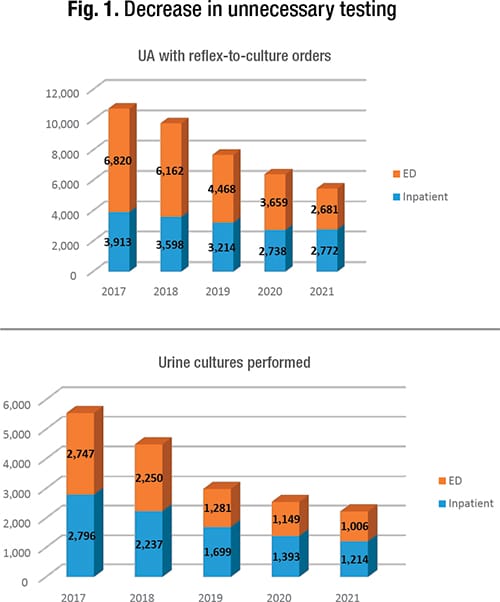
Over the course of the project, for the inpatient population and ED, urinalysis with reflex-to-culture orders decreased by more than 3,000 a year, Peterson says, and urine cultures performed decreased by more than 2,000 a year (Fig. 1).


The hospital’s lowest combined inpatient and ED urine culture contamination rate of 16.9 percent was achieved in December 2020. Although the contamination rate never reached the 10 percent goal, the decline was significant, Peterson says, and had a positive impact on the patient population, physicians and nurses, and the laboratory. Nurses especially appreciated the decrease in unnecessary testing “because they don’t have to worry about collecting urine for a patient that’s not clinically indicated.” The new best practices were shared with other Avera Health hospitals, some of which have undertaken their own process improvement projects, Peterson says.

The laboratory team did work in the outpatient settings also, particularly in the obstetrics clinics. They standardized the collection materials and provided education for patients and staff, but no report cards are issued at this time. Improvements were seen, she says, and have been correlated with continual education for staff.

In 2021, during the pandemic, they took a step back and are still in a sustainment phase. The dashboard automatically captures inpatient data monthly and it’s monitored for unit numbers that stand out.

The estimated cost avoidance over three years was $3 million, Peterson says, and continues to be about $1 million annually compared with the starting point of the project. When estimating cost avoidance, they considered supplies, labor, and the impact of delays in results. “Urine cultures take 24 to 48 hours. You’re 24 to 48 hours behind the ball for that patient, which may result in an increased length of stay.”

There’s also an antibiotic stewardship component to consider if patients are treated unnecessarily with broad-spectrum antibiotics in the absence of a culture result to lead clinical treatment decisions.

“On the flip side, if you choose not to treat,” she says, “there could be a missed or delayed diagnosis for your patients, and the potential associated complications will likely be costly for the patient and the health care system.”

Another plus: a microbiology team that was pleased to be part of a project that required them to engage with other partners in the hospital, and greater visibility for the laboratory. “People learned who I was,” Peterson says, and the laboratory developed other partnerships “that we were able to carry into many other process improvement projects.”

Amy Carpenter Aquino is CAP TODAY senior editor. Peterson notes the contributions of Raed Sulaiman, MD, Cory Gunderson, Courtney Rosendahl, and the hospital and laboratory administrations.Add Custom Script


New viscoelastic testing requirement in checklist

All common, molecular, hematology and coagulation changes

Valerie Neff Newitt

September 2023—A proficiency testing accreditation requirement in the new checklist edition was revised to add clarification, and a new requirement on viscoelastic testing will close an existing gap.

They are among the changes laboratories can expect to see in the 2023 checklist edition released last month, most of which were made in response to often-asked questions or commonly cited inspection deficiencies.

Among them is COM.01600, which requires the laboratory to integrate all proficiency testing and alternative performance assessment specimen testing within the routine laboratory workload and be analyzed by personnel who routinely test patient specimens. “It’s very important that you handle proficiency testing material exactly the same way you handle patient specimens,” says Amer Mahmoud, MD, vice chair of the CAP Checklists Committee and clinical associate professor of pathology, University of New Mexico.

The CAP is often asked if a person can be assisted by another person when looking at a proficiency testing sample, and who can assist. COM.01600 now clarifies that an individual may seek assistance from other onsite personnel for morphologic examinations—identification of cell types and microorganisms—or data review (for electrophoretic patterns, for example) for PT specimens, provided patient specimens are handled in the same manner, as defined by the laboratory’s policies and procedures.

What’s critical is that the person be operating under the laboratory’s CLIA/CAP certificate, Dr. Mahmoud says. “You cannot share it with somebody out of your lab, even if you are sending patient specimens within your laboratory system to another site. The rules do not allow it.” So if a technologist seeks assistance from another technologist, the technologist who is assisting must be onsite. The only exception would be for testing specified in the Centers for Medicare and Medicaid Services memorandum QSO-23-15-CLIA, released May 11, which defines specific conditions for the remote review of PT digital images or data by pathologists or other lab personnel under the laboratory’s CLIA/CAP certificate.

Dr. Mahmoud provides an example from his own work at Presbyterian Hospital in Albuquerque and TriCore Reference Laboratories. “We do a morphologic review for blood parasite,” he says of a patient specimen. “The technologist would look at the specimen, have a preliminary result, then send it to the hematopathologist for confirmation. My office is in the hospital across the street, with a different CLIA/CAP certificate. They ship the slides to me, and I write down my notes for confirmation, send it to them, and then they release it into the record.” A proficiency testing sample, by contrast, cannot be sent to him across the street. “I go there physically to be onsite and look at it onsite. That’s because of the PT rules.”

HEM.38700 Viscoelastic Testing—Error Communication is a new requirement that says if viscoelastic testing for hemostasis analysis is performed in the laboratory and the results are viewable remotely by clinical personnel in real time, the laboratory promptly communicates analytic errors to the responsible clinical personnel.

Viscoelastic testing allows for real-time visualization of clot formation and dissolution during low shear rate blood flow. “It’s a unique type of testing because the physician who will be acting on the results has the capability to review the data in real time,” Dr. Mahmoud says, noting the instrument can be in a separate physical location from the clinician. “If there is something wrong with the instrument that will require repeating the test, doctors must be alerted promptly in real time so they don’t take action based on potentially inaccurate data.”

Under the new requirement, if the results can be reviewed remotely in real time, the laboratory has to promptly communicate the analytic errors to the responsible personnel. The laboratory must ensure staff is trained for prompt notification, and communication must be recorded. Before this requirement was added, Dr. Mahmoud says, “this was a gap in that prompt reporting wasn’t explicitly required.”

HEM.37165 Coagulation Testing and Therapeutic Anticoagulant Recommendations, which requires that recommendations be made available to clinicians for several types of tests, now also includes viscoelastic testing. The requirement, as revised, says recommendations on the utility of viscoelastic testing in clinically meaningful situations must be available, including the following as applicable: proper test selection, instrument comparability, and/or for viscoelastic testing-based monitoring of antiplatelet or anticoagulant medications.

“You need to have recommendations about the utility and limitations of viscoelastic testing in therapeutic clinical situations,” Dr. Mahmoud says. For example: “How does it compare to other methods in the laboratory that might test similar parameters?”

In the molecular pathology checklist, MOL.36155 on the classification and reporting of variants in inherited disease, oncologic, and pharmacogenomic testing requires the lab to follow defined criteria for variant classification that take into consideration professional organization recommendations and guidelines, when available.

If the laboratory elects to deviate from the guidelines, it has to explain its rationale for doing so.

What’s new in this requirement is the focus on classification, not interpretation, Dr. Mahmoud says. “We received feedback about the original wording of the requirement, which referred to variant interpretation. Variant interpretation goes to the practice of pathology—looking up the literature, making judgment calls, using your experience and methodologies,” he says. “So we changed the language to variant classification rather than interpretation.”

The language of the revised requirement is also now more flexible about the laboratory’s use of professional organization guidelines. “There is still some debate about how definitive these guidelines are. So we wanted to remain flexible and strike a reasonable balance that will encourage the labs to look into the guidelines, but not make complete adherence a must.” This is the reason for what he describes as “softened” language. “Labs have the option to deviate,” Dr. Mahmoud says, “but they should have a clear rationale for that deviation.”

In the all common checklist, there are two additional changes. One change is in the note to COM.04300, which requires the laboratory to define acceptability criteria for the comparability of nonwaived instruments and methods used to test the same analyte, and to take corrective action when criteria are not met.

The note provides examples of data that can be useful in establishing the criteria, such as method validation or verification data, clinical significance of the variation between methods, biologic variation data, and data from external PT providers.

“For example, if you are testing a certain analyte by different instruments, you should get more or less the same result regardless of what instrument was used,” Dr. Mahmoud says of the requirement. “You need to compare instruments to make sure they give similar results. You need to establish your criteria to decide which results are considered similar and which are not.

“As you establish these criteria, you can look at your method validation or verification data,” he continues. “Each method has certain specifications in terms of accuracy and precision, and you will factor this in when determining how much variation you will allow between two instruments. As a medical director, you need to consider the clinical significance of the variation. You also can look at the biologic variation data because different analytes will vary biologically. You can look at data from external PT providers.”

New to the all common checklist but not a new requirement of laboratories is COM.30695 Biological Safety Cabinet. Previously this requirement was in the discipline-specific checklists—molecular and microbiology, to name two. Now it’s in the all common checklist and requires a certified biological safety cabinet to be available and used when appropriate.

A biological safety cabinet is used as a work practice control to protect personnel, specimens, the testing environment, or all three. The need for a BSC is determined by doing a risk assessment for the types of testing or procedures performed in the laboratory, such as handling specimens potentially containing highly transmissible infectious pathogens, the potential for aerosolization, the prevention of DNA/ RNA contamination, or maintaining sterility of cell cultures.

Moving the requirement serves two purposes, Dr. Mahmoud explains. “It standardizes the requirement across all the checklists. And if there are biologic safety cabinets in various other sections of the lab, the requirement ensures they are not missed by the inspector and are properly evaluated.”

New and revised requirements in the anatomic pathology, laboratory general, and other checklists were reported in the August issue (https:// bit.ly/CT-082023).

An Oct. 18 Focus on Compliance webinar (noon to 1 PM CST, registration open at www.cap.org) will highlight key checklist changes. CAP-accredited labs can access other compliance-related resources on www.cap.org (in e-Lab Solutions Suite, log-in required, under Accreditation Resources), including past Focus on Compliance webinars and lab inspection preparation videos. Also online are answers to the most common checklist-related questions, a self- and post-inspection toolbox, and customizable templates and forms for, among other things, competency assessment and quality management.

Valerie Neff Newitt is a writer in Audubon, Pa.
Add Custom Script


People, partners, and platforms at the point of care

September 2023—Point-of-care testing—the requests and the committees that oversee them, the connectivity, what AI might bring. CAP TODAY publisher Bob McGonnagle on July 21 met online with a laboratory operations director and a medical director from large health systems and with company representatives for a look at where things stand today. Their conversation follows.

It’s important that we define what the term point of care is and what it isn’t. We know it’s testing that’s done close to the patient and for which the test result is provided when the patient is still onsite so an intervention, such as adjusting a dosage, can happen. We talk about the tradeoff—convenience versus cost. We know that point-of-care testing and central or core lab testing have to coexist. This is overlaid now with a serious shortage of skilled labor, and, increasingly, patients being directed to patient service centers for their draws. Sarah Province, what more do we need to add to this general concept?

Sarah Province, director, laboratory operations, AdventHealth: I see two aspects to point-of-care testing. One is at the bedside or near the patient and performed with handheld devices for rapid testing and early intervention for usually critical situations. The other is near-patient testing at our freestanding emergency department locations—we refer to them as offsite EDs. We use low-volume laboratory instruments there, similar to in our main laboratory, but the ED lab location is close to the patient for rapid testing.

Kim Skala, can you comment on the definition?

Kim Skala, MLS(ASCP), associate project manager, customer education programs, Werfen: Having worked in the lab managing point of care for many years and more recently on the manufacturer side, I think it has to be a conversation about what we need to do at the point of care versus what we’re going to do in the main lab. In terms of definition, we’ve seen it become a bit blurred. Point of care might be at an ED tent doing COVID testing or at a freestanding ED, without the support of a traditional main lab setup. Environments are becoming more varied.

Amy Karger, what is the outline of point-of-care testing within the University of Minnesota system?

Amy Karger, MD, PhD, medical director, West Bank Laboratory at M Health Fairview University of Minnesota Medical Center, system director of point-of-care testing for M Health Fairview, and clinical pathologist and associate professor, University of Minnesota Physicians: We have a lot of at-bedside or near-the-patient bedside platforms. In our clinics we have pregnancy tests and glucose meters, et cetera. In our ICUs we have more near-bedside platforms, like blood gas instruments that we can wheel into the unit but are kept in our central lab. We try to be judicious about bringing in new point-of-care tests because there’s a lot to consider when doing that. We have a committee that reviews requests and the pros and cons.

The pandemic expanded our capability to set up pop-up testing sites, as well as clinical and public awareness of at-home testing. We don’t regulate or oversee at-home testing, but as laboratorians we’ll want to keep an eye on it to make sure those tests are high quality.

How many testing personnel do you need to qualify and certify in the course of 12 months at the University of Minnesota?

Dr. Karger (University of Minnesota): I oversee point-of-care testing for our entire health system, which is multiple hospitals and numerous clinics. Hundreds of people are being trained at those sites. When we’re looking at whether to bring in a point-of-care test, one of the considerations is whether it is reasonable to oversee the number of staff who would do that testing and make sure they’re trained properly and compliant with competencies.

Gwenn Brode, none of this can work without IT solutions connecting instruments to the EHR and to the laboratory. Can you comment on your customers’ needs for ever-better connectivity solutions?

Gwenn Brode, product manager, point-of-care testing connectivity solution, Orchard Software: For any kind of point-of-care testing they want to be able to dock the meters and get results to the EHR and to physicians quickly and with minimal user intervention. The same with near-patient testing—they want to get samples to the near-patient instruments and ensure results are efficiently captured and delivered to the patient’s chart in the EHR.

Corinne Fantz, Roche has a breadth of testing solutions that are scalable across the sites of a large health system. Can you talk about the need for families of instruments with compatible operating systems? That is, there’s one process within the box no matter the size of the box.

Corinne Fantz, PhD, chief medical partner, core lab and point of care, and VP, medical and scientific affairs, Roche Diagnostics: It gets to the economies of scale and the patient population you’re serving. If you’re at a large integrated health care network, you would want the patients who are going through that system—who start in the clinic, go to the local community hospital, then to the “mothership” hospital—to have comparable results across that continuum. Having smaller solutions helps standardize that. It’s more difficult to do if you have a variety of systems.

Point-of-care testing in that scenario is a balance between the central lab and the point-of-care and smaller chemistry solutions. What makes sense? It’s the medical problem you’re trying to solve in your patient population. Do all the devices meet the intended use for that population, and do you have the right personnel to perform the testing to accomplish the goal for that population? Sometimes you have that with a smaller device, and sometimes it makes sense, for economies of scale and if you don’t have a turnaround time expectation, to send it to a larger lab.

Sarah, health systems seem to be getting larger, and it would seem that the compatibility of the instruments chosen for their many sites would be a prime consideration. You don’t want multiple manufacturers of a chemistry machine, for example. Is that correct?

Sarah Province (AdventHealth): Yes. We’re highly standardized within our integrated delivery network. We’ve chosen one chemistry platform to be in every laboratory setting. But that might not translate to point of care. There’s not a perfect system that fits both scenarios. For example, we have the Siemens Epoc for our POC basic metabolic panel, which also has hemoglobin. That’s at the bedside. It has its own validated reference ranges that are good and we’ve done strict correlations. When a sample does come to the laboratory for testing, the reference ranges are different but comparable. So they serve their purpose in whatever setting they’re in and work well together. Our physicians do well moving from point-of-care results to the laboratory results.

Amy, there’s point-of-care testing in infectious disease and hematology, and then there are basic chemistries, immunoassays, and others. Does the application or the entity you’re testing for influence how you deploy point of care versus core lab automation?

Dr. Karger (University of Minnesota): The area of the type of test, whether it’s hematology, chemistry, or infectious disease, does not matter as much as whether there’s clinical benefit to putting it in place. Are we going to get a good result? Once we do implement, we follow up—do we see the benefit? We want to make sure that what we were anticipating is coming to fruition. So we not only vet before we implement but also monitor to make sure the testing is accurate and providing benefit.

Gwenn, do you think a new lab director of a large system should be paying attention to their IT connectivity solution as one of the first things they begin to evaluate and consider for their large network?

Gwenn Brode (Orchard): Yes, because you want the connectivity to do things that will help when you have labor shortages. You want automation and you want results to come across seamlessly and have rules set up so you don’t have a person sitting at a computer approving results. Connectivity for that purpose is perfect because it removes manual processes that are prone to error and time-consuming for personnel.

Corinne, we know of the various testing committees in which people make decisions about whether to keep a test in a core lab or send it to the point of care. Are those committees peas in a pod or do they differ in their thinking and decision-making?

Dr. Fantz (Roche): There are groups that primarily focus on operational needs. They are interested in workflow and process. Other groups focus on clinical accuracy and innovation and want to offer tests that are on the cutting edge—pioneer-type groups. And there are cost-conscious groups that want the cheapest test available and the fastest result. They look at the financial implications of that testing for their system. There are also blends of these groups. Depending on who’s on the committee and who has the loudest voice, each of these groups could make a different decision. They fall into these categories depending on who’s making the request and what the purpose of the request is. How they address it and how it gets built depends on the hat they have on—an operational hat; an academic, clinical-interest hat; or a cost-conscious hat. And where you see these different solutions pop up—that is, what gets accepted—depends on who makes up that committee, the type of system making the decision, and the problem being presented.

Sarah, competing interests might be represented in a point-of-care testing committee. Where are the asks coming from?

Sarah Province (AdventHealth): We have a set instrument profile for different types of testing; for example, the Siemens Epoc, the Nova Stat Strip for glucose, or the Radiometer ABL90 Flex Plus for co-oximetry. I’m seeing more requests to add these devices as our system grows—“We’re building a new tower, now I need five more devices,” or “We’re adding more beds, so we need more units for this service line.” It’s expanding the fleet of devices into areas that are already using it. The unit medical director has to fill out a justification form and then our point-of-care medical director reviews it, and we estimate the expenses. It typically gets approved if it’s already in place in another location and the justification is sound. We have more than 1,900 POC devices in our system and more than 13,000 users. We’re proponents of point-of-care testing and we see value in it, so it’s more about whether we can support it from a laboratory perspective.

For our manufacturer friends, one takeout would be that incumbency is a great virtue in point-of-care testing, if only because it’s easier to add a unit than change the whole system. Would you agree, Sarah?

Sarah Province (AdventHealth): Yes. The training element for so many users is burdensome; it’s challenging any time we have to change out a device.

Amy, do things work fairly well in these committees at your system?

Dr. Karger (University of Minnesota): Yes. We have a standardization committee of coordinators from each of the main hospitals and clinics that meets monthly, and I’m the medical director of that group. The committee is involved in day-to-day oversight and operations and in discussing issues that pop up. We have a smaller group that reviews and approves new requests, so it’s not up to the coordinators at each site to decide. It gets escalated to me and a few of the other lab leaders to review.

We also get a lot of requests when there are new units or new clinics that do what we’re already doing, and those are pretty easy. As an academic center, there are a lot of providers who go to research or professional meetings and hear about something new, then come back and want us to implement it. When we look into it, there’s no literature; there’s only the manufacturer data. Those are the most challenging—when we don’t have independent research or literature on a platform to help in making a decision. In those situations, if we look into it and it seems like a reasonable clinical ask, sometimes we’ll partner with the manufacturer to do our own independent studies. Or we will try to make an arrangement where we can stop using something if it turns out not to work.

Artificial intelligence is everywhere, and the clinical laboratory and point-of-care testing are no exception. Even at last year’s AACC meeting vendors were talking about their AI applications for their test devices. Corinne, what is your view of that?

Dr. Fantz (Roche): We’re in the beginning stages of what will be possible using AI. There’s a bit of an overcall on what AI is in terms of the solutions available today. A lot of it is rule-checking and having more digital solutions versus learning from data sets and pulling information and representing it in a different way. In the future there will be more decision support for clinicians and solutions to help guide decisions in real time and make predictions on what will happen with a patient.

Gwenn, are you seeing that same interest? There’s plenty of hype, but there’s also an underlying reality that’s making itself felt in this area, correct?

Gwenn Brode (Orchard): Yes. Artificial intelligence for point of care will be great. You’ll be able to put algorithms in that will help physicians create a plan for their patients quicker and with good information.

Kim, what have you been seeing with AI?

Kim Skala (Werfen): I agree with what has been said and would broaden the conversation to data in general. The CAP checklists emphasize risk management—what issues do you have to address at your site? You can use something as simple as a sample-handling report from a Gem Premier 5000 or GemWeb Plus 500 and see that a particular nursing unit is having problems with microclots. The point-of-care coordinator can then focus on that and retrain where it’s needed. It’s using actionable data. Manufacturers are making reports easier to use and call. It’s difficult to call reports for point of care from the LIS; that’s where our middleware is helpful. It helps direct you to problems you need to address at your site, and that may differ from hospital to hospital within a wide system.

We see a growing need for more data for patient blood management. Clinicians want more viscoelastic testing and are using ROTEM Sigma at the point of care to make goal-directed therapy decisions more quickly. There’s so much that can be done, and we’re seeing just the tip of the iceberg.

Dr. Fantz (Roche): There are two sides to that. There’s what Kim is saying, using AI for the laboratory to learn about and improve processes and be patient-specific for what is happening on the floor. And there’s another side with the diagnosis and making sure providers have what they need to be able to use all the data that is generated. There are two types of solutions being built from the manufacturer’s standpoint—those that help laboratories be more efficient and those that help clinicians be more efficient and accurate in their assessments.

Gwenn, as a purveyor of IT solutions, and also for those who are bringing the instruments and tests to bear, does a lot of the job of helping users of point-of-care test results understand what the data mean fall to you? You have customers saying, “Solve my problem: I don’t have enough operators or operators who understand. Can you build in rules, build in more autoverification?”

Gwenn Brode (Orchard): Yes. We want to make sure clients have the tools to be able to automate results, perform operator certification, distribute the quizzes to get operators certified, and implement rules to prevent approval of results if the operator is not certified. Having all this within the connectivity solution makes it easier.

Kim Skala (Werfen): I agree with Gwenn. Hospitals need that support from the connectivity standpoint. It’s important for manufacturers to provide IT specialists who can help implement new instruments. We also provide project management support for implementations via our clinical application managers.

At the analyzer level, it’s important to make sure your analyzer can detect a microclot or interference and notify the operator when it’s present. We’ll all need hemolysis detection in the future. Many staff members don’t necessarily have the laboratory background or the critical-thinking skills to understand what a preanalytical error is, like a trained medical laboratory scientist would, and how it might affect a patient’s result. So it’s building risk mitigation hardware and software solutions into the analyzers as well.

Sarah Province (AdventHealth): We find that hardwiring our point-of-care download bases is the most reliable way to transmit data. They send information wirelessly, but because our wireless network has been unreliable, especially around the imaging department, in the basement, or in underground areas like our emergency department, it became a challenge. Then we found when instruments moved throughout the hospital, they entered different IP zones, and when they changed IP addresses, sometimes they stopped working. We didn’t know about these challenges until more sophisticated connection methods were implemented.

Corinne, I want to return to what Kim said. I have a thesis that the efficiency and automation that IVD manufacturers were building into their systems were to some degree making up for what was already a developing shortage of skilled laboratory personnel. So the challenge is becoming ever greater for the manufacturers to continue to cover for that staffing shortage. Would you agree?

Dr. Fantz (Roche): Yes, although it’s challenging to ever replace a medical technologist because so much knowledge is needed to work with this equipment. We aim to make their jobs easier so they can do more and do more with less error. If they can rely on these systems to do specific checks, then they can manage the outliers or those tougher samples and spend their time dedicated to where we can use their brainpower. We’re trying to make them more efficient and consistently reliable for some of the decisions they’re making in real time and under pressure.

There’s no question in my mind that that’s essential, but filling those gaps is everyone’s concern, for all parties.

Dr. Fantz (Roche): Yes, and that’s why having AI to tell us what’s happening in the system and do remote patient monitoring of some of the samples in the labs is helpful. If we can see the stream of information, without the HIPAA data, to tell us if something’s wrong with the instrument or if it needs maintenance sooner because of the volume, then we can do preemptive service visits, and that helps the laboratory stay up and running.

Sarah, would you like to make a final comment?

Sarah Province (AdventHealth): We are going to institute the Cobas Liat for rapid strep testing in our pediatric emergency department. We were doing the strep screen there and sending the swabs to the laboratory for confirmation. There was a wait for a PCR test result and the physician was asking for rapid results, so we decided—why not get the PCR test in the emergency department? It’s one and done. It was a nice solution and the doctors are thrilled. And it will expand to more than strep.

How to store reagents is another point. Some reagents have very short outdates, or once you take them out of the refrigerator they have shorter room-temperature expirations so you have to redate them as an open date. It gets to be challenging with nursing. Having room-temperature reagents is essential for point-of-care testing.

Kim Skala (Werfen): I agree. It has to be room-temperature storage for reagents, and the onus is on manufacturers to provide that. It has to be low maintenance or no maintenance for instruments.

Going back to our data discussion, it’s about patient-specific data. It’s important to know if there is a residual drug effect for a patient who is on a direct oral anticoagulant and needs a procedure. We need instruments like VerifyNow to provide that information.

With cost a consideration, everyone is looking at plug-and-play management and wanting to make sure they have the right product for the right patient at the right time. We, as manufacturers, have to support our customers as best we can, in all of these ways.

Corinne, do you have final comment?

Dr. Fantz (Roche): People assume point of care is less accurate. That’s not always the case. We saw a lot of success during the pandemic with molecular methods at the point of care. We’re going to start seeing high-sensitivity troponin methods at the point of care. You have to understand the medical need, the problem you’re trying to solve, and then find the right solution with the right connectivity so you can be as efficient as possible. And within your system, look at the whole patient care journey, not just that one point in time, to make these decisions.Add Custom Script


Disruptive technologies—what impact on lab workflow?

September 2023—New from CAP Publications is Disruptive Technologies in Clinical Medicine, by Frederick Kiechle, MD, PhD. In his new book Dr. Kiechle says “disruptive technologies offer new paradigms in diagnostic medicine.” Technology-driven disruptions are stimulated by the need to improve patient care, he writes, and they have been “a feature of the practice of clinical pathology since the inception of the first clinical laboratory in 1895 at the University of Pennsylvania, the William Pepper Laboratory.”

It was at the University of Pennsylvania that Dr. Kiechle began his clinical pathology career in 1980. He moved to William Beaumont Hospital in Michigan in 1983 and then to Pathology Consultants of South Broward in Florida in 2006. Since 2018 he has been chief medical officer of Boca Biolistics Reference Laboratory in Florida.

CAP TODAY asked Dr. Kiechle about his new book; his answers follow. Part of his chapter on phlebotomy begins below.

You write in the book about biosensors, microfluidics, artificial intelligence, CRISPR, and many other technologies. Tell us about your topics and how you selected them.

The book reviews disruptive technologies and events that have been selected based on their past, present, or future impact on workflow in clinical medicine or clinical pathology practice, or both. These topics include three event-driven disruptive technologies: infectious disease, personal behavior, and cultural norms—cis/trans. Also reviewed are 12 technical disruptive technologies: biosensors for physiological monitoring and biochemical sensors, smartphones, MALDI-TOF MS, microbiome, phlebotomy practice, point-of-care testing, microfluidics, molecular diagnosis (oncology, single molecule sequencing, isothermal amplification, CRISPR/retrons, pharmacogenomics), organoids, organ-on-a-chip, and artificial intelligence.

There’s a table in the book that lists the disruptive technologies you experienced in your own career. It includes molecular diagnostics in 1993 when you initiated, with Dan Farkas, PhD, one of the first molecular diagnostic labs in the U.S.; introducing MALDI-TOF in microbiology in 2010 with Rodney Arcenas, PhD; and establishing SARS-CoV-2 molecular and immunoassay testing in 2020 with Gloria Shore, MT(ASCP), of Boca Biolistics and Boca’s CEO Val Aida and COO Michael Morris, to name just a few technologies on the list. Is there one disruptive technology that stands out in your career as most disruptive, most difficult, most interesting, or having provided the greatest number of lessons learned?

The introduction of point-of-care testing at alternative sites, which redistributed laboratory testing like glucose much closer to the patient’s bedside, was probably the most disruptive, difficult technology. Blood glucose analysis has for many years been performed in the centralized clinical chemistry laboratory. Patients and endocrinologists required a more rapid turnaround time, especially when the central lab glucose turnaround time was 60 minutes and the patient’s insulin drip needed to be adjusted every 30 minutes. Clinical biosensors were developed to measure plasma glucose from a fingerstick and later small needles that penetrate the skin into the interstitial space to measure the interstitial fluid glucose.

Clinical laboratorians initially had numerous concerns about the decentralization of glucose testing, but many of the issues were resolved after the development of various guidelines for establishing a decentralized hospital or non-hospital–based location. This approach to decentralized testing is now being used for a variety of analytes like intraoperative PTH, drug screening, and viral and malarial detection. Lateral flow methods have been used for these commercial products as well.

You’re well known for your expertise in phlebotomy and the CAP manual So You’re Going to Collect a Blood Specimen. There’s a chapter on phlebotomy in your new book. What do you foresee phlebotomy practice to be like 10 years from now?

It is always difficult to anticipate what new disruptive technology will be introduced to improve phlebotomy practice. There are methods available now for visualizing veins close to the skin and ultrasound-guided peripheral intravenous cannulation, which I write about in chapter five. In the next 10 years, I would anticipate the introduction of several needleless phlebotomy devices. Non-penetrable biosensors using osmotic techniques like current sweat chloride collection may be used. In the future, biosensors placed directly on the skin will be used to measure all the chemistry tests in a comprehensive metabolic panel and others.

In your chapter on AI, there’s a table on examples of AI models in clinical pathology, two of which are personalized antibiograms and plasma amino acid interpretation. Can you elaborate on one or both of those examples or any other example on the list?

Chapter 10 is devoted to artificial intelligence applications in clinical medicine, anatomic pathology, and clinical pathology. This chapter was completed before chatbot was introduced. Chatbot is a computer program designed to simulate conversation usually over the internet. There are now at least six types of chatbots: menu/button based, linguistic based (rule based), keyword recognition based, machine learning, hybrid model, or voice bots.

One example of AI models in clinical pathology is its use in the complex interpretation of plasma among acids used to diagnose and monitor inherited disorders of amino acid synthesis, catabolism, and transport, as well as organic acidemias and urea cycle defects (Wilkes EH, et al. Clin Chem. 2020;66[9]:1210–1218). Interpretation of these amino acid profiles can’t rely on differences in the actual concentration of the amino acid detected by liquid chromatography–tandem mass spectrometry. An assessment of the profile as a whole is required to distinguish the 50 different disorders diagnosed from a plasma amino acid profile.

Table 45 in chapter 10—examples of AI models in clinical pathology—lists the supervision type and algorithms used in the Clinical Chemistry study. Supervision type defines the amount of labeled and/or unlabeled data that’s used. In supervised learning a supervisor is used to teach or train the machine using well-labeled data. Semi-supervised refers to a mix of labeled and unlabeled data. An unsupervised machine learning algorithm uses methods to analyze and cluster unlabeled data sets. The plasma acid interpretation study used supervised learning followed by the comparison of interpretation accuracy using three machine learning algorithms: random forest nonlinear, weighted-subspace random forests, and extreme gradient boosted trees (XG Boost).

Briefly, random forest nonlinear uses multiple decision trees for predicting the output compared with only one tree used in decision tree regression. Weighted-subspace random forest was introduced in 2012 to classify high-dimensional data with random forests built using small subspaces. XG Boost is a scalable boosted decision tree machine learning library. It provides parallel tree boosting for regression, classification, and ranking problems. Common biases like race, ethnicity, and gender may be hidden in the labeled or unlabeled data sets. These biases will then be transferred to the machine learning algorithm. These issues need to be understood and detected early to avoid interpretation bias. In the plasma amino acid interpretation of three machine learning algorithms, all three provided excellent predictive performances. Application of AI to clinical medicine and/or clinical laboratory application is in its infancy of development.

Why did you decide to write the book and what are you hoping the reader will take away from it?

I was stimulated to write this overview of disruptive technologies and events to assess the issues faced as a clinical pathologist laboratory director for more than 30 years. It also provided an opportunity to evaluate the historical growth development and impact of past, present, and future disruptive technologies and events. The major takeaway from reading this overview is to develop a sense of how these pervasive disruptive developments will influence your own clinical pathology laboratory workflow, which may require change in personnel skills and workstation development.

[divider]

Below, from Disruptive Technologies in Clinical Medicine by Frederick Kiechle, MD, PhD, is part of chapter five on phlebotomy, with only some of what Dr. Kiechle wrote on the topic of lateral flow methods (and without the chapter references). To order (PUB318), call 800-323-4040 option 1 or go to www.cap.org (Shop tab) ($36 for members, $45 for others; ebook: $32). If you are interested in writing a book, contact Katy Meyer at [email protected].

Disruptive Technologies in Clinical Medicine book cover

Phlebotomy

Phlebotomy is the practice of drawing blood for laboratory patients. The location of the vein in the patient by manual palpation may be difficult. Alternative methods, transillumination, or ultrasound guidance may aid in this process.

A. Aids for Visualizing Veins Under the Skin
Good visualization of veins in the arm or back of the hand using a fiberoptic light source will increase the success rate of venipuncture in pediatric patients to 100% from 83% without the aid of transmitted light. The height or weight of a patient does not predict the rate of successful phlebotomy. Current strategies to improve the visualization of veins include glasses with special lenses that include filters that enhance the exact color of deoxygenated blood under the skin and enhance the location of veins and near-infrared (740-760 nm) light source illumination and orange/red LED side transillumination. These systems visualize veins situated 3-5 mm under the skin. A comparison of three near-infrared skin illumination devices (VeinViewer, ICEN IN-G090-2, AccuVein AV400) demonstrates that these devices have different image visibility under different viewing angles, lighting, humidity interference and presence of body lotions. Veinsite and Penlite LP212 had shorter times to successful venipuncture compared to controls (tourniquet). The effect of tourniquet time vs infrared illumination without a tourniquet revealed that there are measurement errors after 60 seconds of tourniquet time.

Near-Infrared Light Illumination

B. Ultrasound-Guided Peripheral Intravenous Cannulation
Patients who are obese, diabetic, have chronic kidney disease, abuse drugs, or have had numerous intravenous catheters may present with peripheral difficult intravenous access (DIVA). Ultrasound guidance has higher success rates for veins with a diameter >0.4 cm compared to <0.4 cm and with veins at a depth of 0.3 to 1.5 cm compared to <0.3 or >1.5 cm. In contrast, near-infrared visualized veins are only 3 to 5 mm under the skin (Chapter 5A). A prototype image-guided autonomous venipuncture robot has been reported that used both near-infrared and ultrasound guidance systems to visualize and puncture a vein. Some hospitals have formed vascular access teams that specialize in performing ultrasound-guided venipuncture in DIVA patients.

During ultrasound guidance, a gel is required to ensure acoustic coupling between the skin and the transducer. This gel will be penetrated by the needle and may lead to complications, like infection. A barrier drape, which consists of a transparent piece of sterile plastic, has been described that separates the gel and transducer from a dry skin area used for the venipuncture. Ultrasound images show dark vascular fluid-filled veins or arteries and light surrounding tissues.

The transverse view is the easier technique, illustrating cross-sections of vessels. Veins are compressible with light transducer pressure and can be differentiated from arteries by the absence of visible pulsation. The longitudinal technique is more difficult and illustrates a vein or artery as a tubular structure. Ultrasound-guided venipuncture is the preferred method for central venous catheter placement.

C. Needleless Venipuncture, Sample Types and Lateral Flow Methods
There has been a major effort to reduce needlestick injuries, which represent 13 to 62% of injuries reported to the Hospital Occupational Health Service. Ballout, et al reported moderate quality evidence that phlebotomy safety devices reduce the risk of needlestick injuries in healthcare workers, but have no effect on bloodborne pathogen infections. Butterfly needles are more commonly used for venipuncture than a needle and syringe or indwelling IV catheter. In an emergency department, butterfly phlebotomy reduced the incidence of hemolysis by more than half compared to IV catheter phlebotomy. Arm venipuncture is usually performed in the antecubital fossa using the preferred median cubital vein rather than the cephalic vein which tends to roll. Never use the basilic vein since it is close to the brachial nerve.

Disposable, automated, retractable lancet devices have been introduced. For fingerstick collection, the proper size lancet device is required. For adults, the puncture depth should be between 2.2 to 2.5 mm. For children greater than 20 lbs, 1.7 to 2.0 mm puncture depth is recommended. Table 1 reviews the appropriate depth for lancet penetration for infants <1 kg (2.2 lbs) to 3 kg (6.6 lbs) or greater. In general, blood volume collected increases with the lancet diameter and penetration depth. Lancet devices with triggered-linked lancet movement were significantly less painful than capillary fingersticks. Capillary fingersticks should puncture the side of the finger pad cutting across the lines of the finger and not along the lines of the finger. For neonatal heelsticks, the back sides of the heel should be used. First, prewarm the infant’s heel (no higher than 42º C) for 3 to 5 minutes. Use Table 1 to select the appropriate retractable lancet size. The order of drawing specimens differs for capillary blood draws compared to venipuncture (Table 2).

The ultimate goal is to develop a needle-free venipuncture technique. The Defense Threat Reduction Agency (DTRA) Chemical and Biological Technologies Department is supporting the modification of an existing commercially available push button device to increase the volume collected from 200 μL to 750 μL. The current commercial device attaches to the patient’s skin by an adhesive ring. It draws blood after a button is pushed by activating lancets or needles to gently puncture the skin and capture blood in a self-sealing vacuum tube. The device is easy to use and less painful than a finger prick. It is designed for use on the battlefield.

Another approach, called PIVO (Velano Vascular, San Francisco, CA), used a polymer catheter that is threaded through the existing short peripheral catheter past the hub and end of the short peripheral catheter tip into the vein. PIVO received FDA clearance in 2015. Studies comparing PIVO blood specimens with blood drawn directly from peripheral venous catheters showed significant difference in hemolysis on lab test results. After completion of blood collection, the PIVO polymer catheter is retracted and removed from the IV and discarded. PIVO requires that the patients have a short peripheral catheter in place prior to its use. This would increase the use of peripheral catheter, but would markedly reduce the 10 to 20 needlesticks each of the 400 million inpatients receive per hospital stay. The goal of needleless venipuncture is to reduce the pain of repeated venipuncture, needlestick injuries and potential associated bloodborne infection like HBV, HCV, HIV, etc.

Blood specimen types include whole blood, plasma and serum. Blood contains liquid components and cellular components. When anticoagulant is added to prevent clotting, the liquid component of blood is called plasma. When blood is allowed to clot in a tube, the resulting liquid is called serum. Serum does not contain all the proteins present in plasma because some proteins, clotting factors, are consumed when blood clots. There are four anticoagulants that can be added to the collection tube to prevent clotting: EDTA, sodium citrate, heparin and fluoride-oxalate.

Another approach to reduce the frequency and amount of blood collected is to reduce the volume of plasma/serum needed for analysis using microfluidics and/or lateral flow analysis. The Velvet system (Weavr Health, Cambridge, MA) uses lithium heparin whole blood (180-240 μL) added to a collection device and separates the cellular components from the plasma after drying the device over 12 hours. The dried spots (cellular and plasma) are removed from the paper lateral flow device using a punch. These punches are rehydrated in diluent and analyzed using routine laboratory equipment. A pilot project successfully provided accurate measurements for hemoglobin A1C in the cellular component from the paper lateral flow system and cholesterol, HDL, LDL, triglycerides and chloride from the plasma. Chloride was used to normalize variability secondary to extraction and undefined plasma volume. A blood collection device using blood-based lateral flow to filter out red blood cells without hemolysis (DCNovations, DCN Dx, Carlsbad, CA) provides plasma to be used for analyte testing.Add Custom Script


AMP case report: Lung micropapillary adenocarcinomas revisited

A tale of antithesis with yearslong accumulative genetic alterations

September 2023—CAP TODAY and the Association for Molecular Pathology have teamed up to bring molecular case reports to CAP TODAY readers. AMP members write the reports using clinical cases from their own practices that show molecular testing’s important role in diagnosis, prognosis, and treatment. The following report comes from Henry Ford Hospital. If you would like to submit a case report, please send an email to the AMP at [email protected]. For more information about the AMP and all previously published case reports, visit www.amp.org.

Ejas Palathingal Bava, MD
Zhiqiang B. Wang, MD, PhD

Micropapillary pattern of adenocarcinomas (MPC) are considered aggressive variants of lung adenocarcinomas. They have been associated with unfavorable outcome in terms of five-year survival in stage-matched patients with other morphological variants.1 The presence of a micropapillary component of greater than five percent was reported as an independent risk factor for recurrence in patients treated with wedge resection or segmentectomy for lung adenocarcinomas 2 cm or smaller in size.2 Other investigators stated that the prognosis is poor, regardless of the percentage of micropapillary component.3 We herein report one case with a primary pT4 MPC that recurred 13 years after surgical resection. At the same time, we set out to delineate the molecular events and explore the pathophysiology behind the primary and recurrent tumors.

Case. The patient was a 78-year-old male with no history of smoking. He had a history of a left lower lobe lobectomy for a micropapillary predominant (>50 percent) lung adenocarcinoma 13 years earlier. The tumor measured 7.2 cm and was staged as pT4N0 (clinical stage IIIA). Other risk elements were negative, e.g. margin (1.5 cm to closest parenchymal margin), pleural invasion, and lymphovascular invasion (Fig. 1A-B). He received adjuvant chemotherapy with cisplatin/Navelbine after the primary tumor resection.

This time he presented with a biopsy-proven lung adenocarcinoma of the left upper lobe. PET imaging revealed negative mediastinal lymph nodes and distant metastasis. He underwent left upper lobe wedge resection that revealed 3.5-cm lung adenocarcinoma with morphologic similarity to the previously resected left lower lobe tumor (Fig. 1C-D). The tumor invaded visceral pleura and was 0.5 cm from the parenchymal margin. The sampled hilar lymph node was negative for metastasis. The tumor was staged as pT2aN0.

Next-generation sequencing using the Illumina MiSeq instrument and data analysis by the Sophia DDM platform with a panel of 53 genes were performed to determine and characterize the genetic alterations associated with the primary and recurrent tumors. Three NGS assays were performed on DNA extracted from formalin-fixed, paraffin-embedded tissue blocks: 1) microdissected MPC of the primary tumor, 2) microdissected papillary component (PC) of the primary tumor, and 3) recurrent tumor. RNA sequencing was not performed.

The NGS assays were monitored with the following benchmarks: 1) percent of targets with coverage greater than 500× (>95 percent), 2) coverage 10th quantile (>500), 3) coverage heterogeneity (<5 percent), 4) percent on target (enrichment) (>70 percent), and 5) duplication fraction (<90 percent). All of the NGS assays were successful, indicating high DNA quality after 13 years of preservation.

As summarized in Table 1, the primary lung adenocarcinoma demonstrated the following genetic alterations: two TP53 tier one/two variants on the PC; two same TP53 variants and a MET exon 14 skipping mutation on the MPC. Additionally, one tier three variant was also seen on the MPC portion. On the recurrent tumor, a total of 14 tier one/two variants were identified, including one same truncating TP53 variant (TP53 p.Arg213*) that was detected previously and one actionable EGFR variant, with an additional 88 tier three variants of unknown significance.

Discussion. In contrast to the notion that MPC is aggressive, our patient with stage III MPC lived 13 tumor-free years until recurrence. Behind the indolence were the morphologic features indicating that the peripherally abundant MPC appeared to have grown out of the centrally located papillary “nidus” as a secondary structure and the relative paucity of genetic alterations. Separate NGS assays performed on microdissected papillary component and MPC of the tumor detected two same TP53 variants (c.853G>A, p.Gly285Lys; c.637C>T, p.Arg213*) in both portions. Such results were hence supportive of their clonal essence. TP53 gene is the most common mutated gene in lung cancers.4 In addition, the reduced allelic fractions of both TP53 variants from 20 percent of PC to 10 percent of MPC implicated the subclonal rather than primary or de novo nature of MPC of this tumor. Subclonal evolution of the MPC was also supported by the detection of actionable MET c. 3313+1G>A variant, which affects the evolutionally conserved splice junction leading to exon 14 skipping of the MET gene. Although it is debatable if the subclonal features of MPC obligated the tumor’s clinical behavior similar to papillary adenocarcinoma, these unique findings should open research opportunities to improve our understanding.

While the discussion of clonal and subclonal tumor evolution highlighted the established notion of intratumoral genetic heterogeneity,5 the recurrent tumor offered a rare chance to gain further insights. We noted that the same TP53 variant (p.Arg213*) was detected in both NGS runs on the primary and recurrent tumors. According to our in-house data, the variant p.Arg213* of TP53 was seen in one percent of all tumors tested. In addition to the same morphology, such a rare molecular event provided evidence supporting the clonal nature of the recurrent tumor.

Intriguingly, on top of this finding was the detection of numerous molecular events in the recurrent tumor. Such results were in sharp contrast to the primary tumor and highlighted the cumulative genetic damage over a 13-year period. It is noteworthy, however, that the patient’s adjuvant chemotherapy after resection of the primary tumor may have had an impact on the genetic profiling of the recurrent tumor. It is known that chemotherapies are mutagenic and can contribute to tumor mutation burdens including inducing new mutations that render resistance to treatment, eliminating treatment-sensitive mutations, or driving tumor evolutionary patterns.5 Hence, the genetic profile of the recurrent tumor should be interpreted as a combined result of biological acquisition during the long-term evolution and therapeutic induction.

Finally, it is worth mentioning that among genetic alterations in the recurrent tumor was the EGFR variant c.2155G>T, p.Gly719Cys. Along with the major EGFR gene exon 19 in frame deletions and exon 21 codon L858/L861 mutations, EGFR p.Gly719Cys has been identified as broadly sensitive to kinase inhibitors. The patient has been receiving osimertinib treatment and is doing well five years post-surgery.

Conclusion. We report a rare case of MPC lung adenocarcinoma that recurred in a different lung lobe after 13 years. We characterized the molecular events in different portions (PC and MPC) of the primary tumor and the recurrent tumor, with results demonstrating a relative paucity of genetic alterations in the primary tumor but strikingly numerous genetic alterations in the recurrent tumor. By telling this rare tale of antithesis to the established notion that MPC is aggressive, we explored the possible mechanisms behind the indolence and behind the differences in genetic alterations between the primary and recurrent tumors. 

  1. Monroig-Bosque PDC, Morales-Rosado JA, Roden AC, et al. Micropapillary adenocarcinoma of lung: morphological criteria and diagnostic reproducibility among pulmonary pathologists. Ann Diagn Pathol. 2019;41:43–50.
  2. Nitadori J, Bograd AJ, Kadota K, et al. Impact of micropapillary histologic subtype in selecting limited resection vs lobectomy for lung adenocarcinoma of 2cm or smaller. J Natl Cancer Inst. 2013;105(16):1212–1220.
  3. Cao Y, Zhu LZ, Jiang MJ, Yuan Y. Clinical impacts of a micropapillary pattern in lung adenocarcinoma: a review. Onco Targets Ther. 2016;9:149–158.
  4. Coleman WB, Tsongalis GJ, eds. Essential Concepts in Molecular Pathology. 2nd ed. Elsevier; 2019.
  5. Venkatesan S, Swanton C, Taylor BS, Costello JF. Treatment-induced mutagenesis and selective pressures sculpt cancer evolution. Cold Spring Harb Perspect Med. 2017;7(8):a026617.

Dr. Palathingal Bava is a third-year pathology resident and Dr. Wang is senior staff pathologist, Department of Pathology and Laboratory Medicine, Henry Ford Hospital, Detroit.

[divider]

Test yourself

Here are three questions taken from the case report. Answers are online now at www.amp.org/casereports and will be published next month in CAP TODAY.

  1. Which of the following is the most common mutated gene in lung cancers?
    a. KRAS
    b. TP53
    c.BRAF
    d.EGFR
  2. Which of the following statements about lung adenocarcinomas is false?
    a. Micropapillary pattern of adenocarcinomas (MPC) are not considered aggressive variants of lung adenocarcinomas.
    b. The presence of a micropapillary component of greater than five percent is an independent risk factor for recurrence.
    c. The adverse prognosis of MPC is directly proportional to the percentage of micropapillary component.
    d. Patients with MPC have lower five-year survival in stage-matched patients compared with other morphological variants.
  3. Which of the following statements about lung carcinomas is false?
    a. MPC is not the result of expanded growth of the papillary component.
    b. TTF-1 immunohistochemistry positivity is seen in lung adenocarcinomas.
    c. The most frequent EGFR gene mutations are targetable for therapy.
    d. Newer mutations are acquired during tumor evolution.‘Test yourself’ answers

[divider]

‘Test yourself’ answers

In the August 2023 issue was a case report “Small intragenic structural variants in SATB2-associated syndrome,” written by members of the Association for Molecular Pathology. Here are answers (in bold) to the three “test yourself ” questions that followed that case report.

  1. What is the first-line diagnostic test for patients with intellectual disability and/or developmental delay?
    a. Chromosomal microarray
    b. Exon sequencing
    c. M-Chat
    ➙ Chromosomal microarray analysis is often considered the first-line diagnostic test for individuals with unexplained intellectual disability and/or developmental delay. “Consensus statement: chromosomal microarray is a first-tier clinical diagnostic test for individuals with developmental disabilities or congenital anomalies” was published in 2010 (Miller DT, et al. Am J Hum Genet. 2010;86[5]:​749–764). This test can detect chromosomal abnormalities and copy number variations that may contribute to these conditions. Exon sequencing and M-Chat are not typically used as first-line diagnostic tests for intellectual disability and/or developmental delay. Exon sequencing may be used in certain cases to identify specific genetic mutations, while M-Chat is a screening tool for autism spectrum disorder.
  2. Chromosomal microarray is designed to detect which type of variants?
    a. Unbalanced chromosomal gains or losses
    b. Low-level mosaicism
    c. Single nucleotide variants
    ➙ Chromosomal microarray is designed to detect unbalanced chromosomal gains or losses, also known as copy number variations. These types of variants involve larger segments of DNA and can be associated with conditions such as intellectual disability, developmental delay, and autism spectrum disorder. Chromosomal microarray is not typically designed to detect low-level mosaicism or single nucleotide variants, though some types of chromosomal microarray can detect certain types of mosaic copy number variations or smaller variants such as submicroscopic deletions or duplications. For the detection of single nucleotide variants, other types of genetic testing, such as targeted gene sequencing or whole exome sequencing, may be used.
  3. What is the most frequent variant described in SATB2-associated syndrome?
    a. Missense variants
    b. Large deletions
    c. Internal tandem duplication
    ➙ The most frequent type of variant described in SATB2-associated syndrome is missense variants. Missense variants are a type of genetic mutation that change a single nucleotide in the DNA sequence, resulting in an amino acid substitution in the protein. SATB2-associated syndrome is a rare genetic condition caused by alterations in the SATB2 gene, and missense variants in this gene are the most commonly reported variant type associated with this syndrome. Large deletions involving SATB2 have also been reported in some cases of the syndrome, but they are less frequent than missense variants. Internal tandem duplications have not been reported as a common variant type associated with SATB2-associated syndrome.

Add Custom Script


Genetic counseling within the laboratory: For oncology cases, lab’s consult service plugs gap

Julia Keefe, MB(ASCP)CM
Abigail Finer, MS, LCGC
Andrea Pannone
Jochen K. Lennerz, MD, PhD

September 2023—What happens when an oncologist cannot confidently determine what type of genetic test to order for their patient? Where can a provider turn if they do not know whether a genetic variant is clinically actionable? As genetic testing becomes a more integral part of personalized medicine and health care in general, there is a growing need to bridge the gap between those skilled in molecular diagnostics and those on the patient-facing side of care. In response to this need, the Center for Integrated Diagnostics (CID), a high-complexity molecular diagnostics laboratory at Massachusetts General Hospital, created its Consultation Service.

The CID Consultation Service was launched in late 2021 with the goal of streamlining a series of recurrent practice-related questions about high-complexity molecular diagnostic cases.

Since its launch, the service has received more than 500 requests, which can be attributed to its accessible platform. Providers can submit a consultation request by using the service’s electronic health record form, which links each request to the patient’s medical chart. In addition to using the EHR form, providers and their patients can contact the Consultation Service via email or phone.

The Consultation Service is a multidisciplinary team consisting of board-certified molecular genetic pathologists, a medical technologist, and a certified genetic counselor. A surgical pathologist, radiologist, and/or oncologist may supplement the team depending on the question. Each member of the service team brings a unique perspective to every case. Attending pathologists specialize in a variety of domains, and each week one attending is on service and provides their unique expertise to the team. The high-complexity medical technologist has a deep understanding of the technical aspects of molecular testing and interacts with attending pathologists to help interpret test results. As the CID’s genetic counselor, one of the authors (A.F.) synthesizes the patient’s medical and family history along with insights from attending pathologists, medical technologists, clinical databases, and relevant literature to produce a comprehensive case report.

The genetic counselor’s role within the service differs from that of many of her peers who see patients in clinic. Classically, clinical genetic counselors often provide services within the scope of hereditary disease. The genetic counselor on the CID Consultation Service focuses on somatic genetic testing in the field of oncology. While also working closely with physicians to provide personalized patient care, the genetic counselor works directly within the laboratory as opposed to a clinic. Essentially, she serves as a liaison between the molecular genetics professionals within the laboratory and the physicians on the clinical side of care.

Although the genetic counselor works within the laboratory, her responsibilities differ from those of a traditional commercial laboratory genetic counselor. While genetic counselors in laboratories typically use highly specific skills such as variant interpretation, the Consultation Service counselor plays a variety of roles as she works through the most complex cases the laboratory receives. In addition to her variant interpretation services, she performs in-depth reviews of each patient’s medical history to provide comprehensive recommendations on clinical actionability and future testing. In this setting, a genetic counselor ensures that patients receive high-quality test result interpretations and relevant clinical recommendations.

Common inquiries and a consult case. From next-generation sequencing assays to PCR-based small molecular testing to FISH, the Center for Integrated Diagnostics, with its Consultation Service, is a one-stop shop for genetic testing related to personalized medicine and cancer care. However, the comprehensive test menu (49 in-house tests currently and numerous send-out tests) generates an extensive list of questions from a variety of providers.

To date, almost one-third of the questions submitted to the Consultation Service are about whether a variant with a high variant allele frequency (VAF) is germline or somatic in origin. When a variant has a high VAF, providers often wonder if further germline testing is warranted. The answer to this question depends on many factors such as the variant classification (variant of unknown significance, pathogenic variant, likely benign, etc.) and the patient’s health and family history.

Some providers are interested in the clinical management implications of genetic test results.

In fact, one in five inquiries is related to the clinical actionability of a genetic variant. For instance, if a molecular test reveals that a patient’s tumor harbors a specific variant, providers can contact the Consultation Service to learn about personalized treatment options or connect with trial staff or both.

The most frequent and captivating consultation cases are inquiries about the relatedness of tumors and the primary site that might be unknown; these discussions often happen in tumor boards. Solving these questions ad hoc can be particularly challenging. To illuminate this aspect of the Consultation Service, we share a complex tumor origin case.

In 2022, a female patient with a history of neuroendocrine carcinoma was diagnosed with endometrioid carcinoma of the ovary. Upon this diagnosis, the patient’s oncologist contacted the Consultation Service to determine the origin of the endometrioid carcinoma. The oncologist asked whether the two carcinomas had similar molecular features and came from the same neoplastic process or if they had evolved separately. Molecular testing identified an ESR1::AKAP12 fusion in the endometrioid ovarian carcinoma that was not present in the neuroendocrine carcinoma; however, both tumors shared six other genetic variants. Additional testing revealed that aside from the six variants the tumors shared, the endometrial cancer contained two unique variants while the neuroendocrine carcinoma contained one unique variant.

Since the molecular profiles of each tumor were not identical, the Consultation Service opted to perform additional genetic testing on normal tissue to gauge whether the shared variants were germline or somatic. The test on the normal tissue detected five of the six variants present in both tumors. The results from normal tissue testing suggested that the five shared variants were germline and thereby specific to the patient (rather than a shared phenomenon of the tumors). After comparing the variants across the tumors and the normal tissue, the team found that one pathogenic TP53 variant was present in both tumor types but not the normal tissue.

Ultimately, with this new data comparing both cancers to the normal tissue, the team concluded that the two tumors were distantly related and that a clonal divergence event occurred early in the cancer’s development.

The genetic counselor was responsible for the initial draft of a comprehensive report on the case that summarized each detail from the patient’s medical history and the test result interpretations for each variant found in each tissue. Since the overarching goal of the Consultation Service is to improve the quality of patient care through personalized medicine, the report included recommendations on clinical actionability. The service advised the patient’s oncologist to consider CDK4/6 inhibitors as they can effectively target ESR1 gene fusions, which were present in the endometrioid ovarian carcinoma.

Financial impact. In addition to guiding testing and treatment decisions, the Consultation Service works with hospital billing staff to mitigate medical costs for the laboratory and patients. To date the service has received and processed numerous billing-related questions and helped draft more than 20 appeal letters to payers.

Incorrect test orders waste the laboratory’s resources, and insurance denials cause stress for patients. Thus, the Consultation Service helped develop a triaging workflow that ensures that each patient receives the most appropriate tests, coupled with prior authorization, management of billing questions, or both. To further educate providers on the appropriate context for each test, the team also created a test order tip sheet, which provides suggested order sets for a variety of cancer types and syndromes.

Before the service was created, attending pathologists provided their expertise to other providers informally—via email, for example. The attending pathologists often spent a substantial amount of time helping them with complex cases, but their input was not necessarily documented in the medical record nor were they compensated for their work. According to the consultation reports, a pathologist’s time spent on consultation case reviews can range from five minutes to three hours depending on the complexity of the case. Pathologists in the Center for Integrated Diagnostics can now use the 2022 pathology clinical consultation CPT codes to track and bill for the time they spend on each case. The most common CPT code used for CID consult billing is code 80505, which represents 41 to 60 minutes of comprehensive medical record review and high-level medical decision-making.

Patient perspective. The Consultation Service saves time and money and reduces stress for patients, providers, and attending pathologists. It also brings a patient-centered perspective to laboratory work that high-complexity technologists may not otherwise experience. The team is now in the initial stages of developing a patient-facing clinic at MGH, which will focus on somatic cancer testing and molecular diagnostics within the scope of personalized care. This will provide an additional layer of patient service that entails direct patient interaction.

As genetic testing and genetic counseling become more common in all areas of health care, we expect to see growth of multidisciplinary teams that synthesize information from high-complexity tests. Other clinical molecular diagnostics laboratories could use a platform similar to the Consultation Service as a blueprint for developing their own service. The successful implementation and expansion of the Consultation Service demonstrates the benefits of increasing collaboration between genetics and nongenetics providers within the scope of high-complexity testing. The breadth and success of our service underscore the value of integrating genetic counseling into the laboratory space.

Julia Keefe is a medical laboratory technologist, Abigail Finer is a genetic counselor, Andrea Pannone is a medical laboratory technologist, and Dr. Lennerz is medical director—all in the Center for Integrated Diagnostics, Department of Pathology, Massachusetts General Hospital.Add Custom Script


From the President’s Desk

A fear-free workplace

Emily E. Volk, MD

September 2023—In the past two years, I’ve written a lot in this column about leadership and why pathologists make natural health care leaders. Effective leaders emerge from a process of continual self-correction in those who constantly seek out new ideas and hone their leadership skills.

Lately I’ve been listening to and reading some work by Cy Wakeman, an author and speaker who promotes what she calls reality-based leadership. She says that a leader’s main job is to remove fear. When I first heard that, I was dubious. Isn’t a little bit of fear a good thing? Doesn’t fear drive accountability?

But I’ve become convinced that fear in the workplace is a useless and destructive emotion. It does not drive people to succeed; instead, it prevents people from thriving in their roles. We all experience fear in our jobs from time to time, and I think if we’re honest with ourselves, we can agree that it is overall a hindrance rather than a motivator.

Thinking about fear at work reminds me of the importance of managing our internal environment. I have spent years honing the skill of pausing before reacting to a stressful situation. It’s not about masking anger or fear; it’s about having the personal clarity and self-control to be able to identify when I am experiencing stress during an interaction and then being able to pause and reframe in order to neutralize a spicy internal reaction.

That’s a skill I need just as much now as I did earlier in my career. For example, when a colleague blames my team for something, it’s only natural to feel anger start to build up. I have to remember that at its root anger is driven by an underlying fear.

By pausing before responding, I have a moment to try to understand my anxiety. When I ask myself what is frightening about a particular situation, or why I feel threatened, I can gain a tremendous amount of clarity. I’ve been most successful in getting to a solution when I can dissect and defuse the fear. Then I can focus on the mission of doing the best work possible for our patients.

In my own career, I have seen just how valuable it is to overcome fear and find more effective motivation. As leaders, if we can eliminate fear for the people who report to us, we can improve our chances of success across the board. When folks don’t have to be afraid at their jobs, they can honestly tell leaders what’s going on—they can report problems, flag potential issues, or admit mistakes without having to worry about reprimand or retribution. Without a fear-free environment, leaders will not get the full story of what’s going on in their organizations. Problems can take root and spread if we don’t have the insight we need to fix them.

As leaders, we have the opportunity to model how to deal with frustration, anger, anxiety, and other negative emotions in the workplace to help give our teammates the tools to deal with their own issues. We also have the responsibility to dig in when problems do arise—to be willing to turn over the rocks and see what’s underneath so we can fix it. It’s the only way to achieve lasting solutions and to create real trust among a team.

As I sign off from this column and from my term as president of the CAP, I want to tell you what an honor it has been to serve my fellow pathologists in this role. I am grateful to my fellow CAP members for electing me to this position, to my family for their support, and to my colleagues and mentors for their assistance.

It is a real pleasure to know that we will all be represented next by Donald Karcher, MD. I have had the pleasure of working with Dr. Karcher not only in his role as president-elect during the past two years but for several years before that as vice chair to his chair on the Council on Government Affairs. I know that he is absolutely dedicated to the CAP and the success of the profession. He will do an amazing job as our next president, and I wish him all the best.

Dr. Volk welcomes communication from CAP members. Write to her at [email protected].Add Custom Script


Clinical pathology selected abstracts

Editor: Deborah Sesok-Pizzini, MD, MBA, chief medical officer, Labcorp Diagnostics, Burlington, NC, and adjunct professor, Department of Clinical Pathology and Laboratory Medicine, Perelman School of Medicine, University of Pennsylvania, Philadelphia.

Recognizing and addressing workplace bullying in pathology and laboratory medicine

September 2023—Approximately 30 percent of U.S. employees report that they have been bullied in the workplace, and these numbers are even higher for remote workers. Bullying is defined as any act or situation in which someone is subjected to recurrent, systematic, serious negative or hostile behavior and long-lasting acts designed to oppress or abuse another person. This behavior may include belittling, humiliating, personally attacking, verbally criticizing, or intentionally excluding a coworker. Bullying can harm both the target of the attack and the organization that employs the bully and the targeted person. The potential negative effects on an organization can be high staff turnover, a decrease in employee performance and productivity, and an increase in errors and medical mistakes. The person being bullied can experience mental distress, anxiety, depression, chronic pain and headaches, musculoskeletal problems, and symptoms consistent with post-traumatic stress. Even people that witness workplace bullying can experience adverse reactions. The authors conducted a study to examine the prevalence of bullying in a laboratory workforce made up of pathologists, doctoral-level clinical scientists and other scientists, technologists, technicians, and support staff. The study also addressed types of bullying, the impact of bullying on an individual’s wellness and productivity, and organizational solutions to mitigate bullying. The authors distributed invitations containing a survey link to the clinical laboratory community using email addresses obtained from professional organizations and alumni networks and by posting invitations on professional organizations’ online forums and listservs. The authors also encouraged participants to forward the survey invitation to other laboratory professionals to maximize participation. The survey was available online for approximately three weeks. All participants completing the survey were offered the opportunity to participate in a future online education course on bullying and were eligible for a drawing for an Amazon gift card. The authors collected cross-sectional data through the Web-based survey to gather exploratory demographic information and assess the association between intensity of exposure to bullying and laboratory productivity. The survey also explored workplace resources for employees and their impact on productivity and job fulfillment. The results showed that 68.6 percent of laboratorians were victims of workplace bullying, and 55.3 percent of bullies were a peer of the victim. The types of negative workplace acts—having opinions ignored, being given an unmanageable workload, or being personally ignored or excluded—were consistent with the experiences of other health care professionals, but the frequency reported by laboratory professionals was significantly higher. The study also showed that the intensity of workplace incivility correlated with the number of sick days taken by laboratory professionals. Laboratorians employed by facilities with a more supportive work environment took fewer sick or mental health days. The authors recommend that organizations state in written hiring contracts that they have zero tolerance for bullying to demonstrate to employees and management their commitment to resolving this issue.

Chiou PZ, Mulder L, Jia Y. Workplace bullying in pathology and laboratory medicine. Am J Clin Pathol. 2023;159:358–366.

Correspondence: Dr. Paul Z. Chiou at [email protected]

Analysis of ABO nonidentical platelet transfusions in relation to patient outcomes

It is estimated that 40 percent of platelet transfusions in the United States are ABO mismatched to the recipient. In the United States, platelets are primarily collected by apheresis, which helps limit the amount of incompatible plasma transfused to the recipient when using ABO-mismatched platelets. Reasons for transfusing ABO minor and major incompatible platelets include supply-and-demand issues, limited platelet shelf life, and variability in institutional policies and practices. Major mismatch platelets are when the donor platelets carry A/B antigen that is not compatible with the recipient ABO type—for example, type A donor and type O recipient. Minor mismatch is when the platelet plasma is not compatible with the recipient ABO type—for example, type O platelet donor and type A recipient. Studies have examined outcomes for ABO-mismatched platelets, yet guidelines vary significantly. The authors conducted a study using the large four-year publicly available Recipient Epidemiology and Donor Evaluation Study-III database to identify associations between ABO nonidentical platelet transfusions and the clinical outcomes of mortality, sepsis, and thrombosis, with the intent of helping to shape future platelet transfusion guidelines. They investigated patient outcomes associated with ABO nonidentical platelets from January 2013 through December 2016. There were 26,902 encounters identified among the study cohort of 21,176 patients, who received 79,473 platelet transfusions. An encounter was defined as an inpatient receiving a platelet transfusion. Platelet transfusions were defined as ABO identical, major mismatched, minor mismatched, or bidirectional mismatched (donor platelets and plasma are not compatible with the recipient—for example, type A donor and type B recipient). After the statistical analysis was adjusted for possible confounding factors, the data showed no statistically significant association between ABO nonidentical platelet transfusion and increased risk of mortality. However, when diagnostic category and recipient ABO group were examined, mortality for major mismatched transfusions in two of the eight subpopulations increased. These subpopulations were hematology/oncology blood groups A and B (but not group O) recipients with a hazard ratio (HR) of 1.29 and intracerebral hemorrhage group O (but not groups A and B) recipients with a HR of 1.75. The authors also found that major mismatched transfusions were associated with increased odds of receiving additional platelet transfusions each day through day five, regardless of the recipient’s ABO group. They concluded that prospective studies are needed to determine which patient populations may benefit from receiving only ABO-identical platelets and that ABO-identical platelet products minimize patient exposure to additional platelet doses.

Bougie DW, Reese SE, Birch RJ, et al. Associations between ABO non-identical platelet transfusions and patient outcomes—a multicenter retrospective analysis. Transfusion. 2023;63:960–972.

Correspondence: Dr. Daniel W. Bougie at [email protected]Add Custom Script


Anatomic pathology selected abstracts

Editors: Rouzan Karabakhtsian, MD, PhD, professor of pathology and director of the Women’s Health Pathology Fellowship, Albert Einstein College of Medicine, Montefiore Medical Center, Bronx, NY; Shaomin Hu, MD, PhD, staff pathologist, Cleveland Clinic; S. Emily Bachert, MD, breast pathology fellow, Brigham and Women’s Hospital, Boston; and Amarpreet Bhalla, MD, assistant professor of pathology, Albert Einstein College of Medicine, Montefiore Medical Center.

Revised FIGO staging of endometrial cancer

September 2023—Understanding of the pathologic and molecular features of endometrial cancer has advanced measurably since the FIGO (International Federation of Gynecology and Obstetrics) staging system was updated in 2009. New treatments, results of clinical trials, and prognostic survival data that correlate with pathologic and surgical findings have been reported. Therefore, the FIGO Committee on Women’s Cancer determined that changes to the FIGO system were necessary. The goals of the revised staging system are to further clarify the diverse biologic nature of endometrial carcinomas with differing prognostic outcomes, better define the prognostic groups, and create substages that yield more appropriate surgical, radiation, and systemic therapies. The cancer committee developed a subcommittee on endometrial cancer staging in October 2021, of which the authors are members. Since then, committee members have met frequently and reviewed new and established evidence about the treatment, prognosis, and survival of endometrial cancer patients. They identified opportunities for improvement in the categorization and stratification of these factors in each of the four stages of endometrial carcinoma. Data and analyses from the molecular and histological classifications published in the recently developed ESGO/ESTRO/ESP (European Society of Gynaecological Oncology/European Society for Radiotherapy and Oncology/European Society of Pathology) guidelines were used as a template for adding the new subclassifications to the proposed 2023 molecular and histological staging system. The first substage is broken down into IA1, a nonaggressive histological type of endometrial carcinoma limited to a polyp or confined to the endometrium; IA2, nonaggressive histological types of tumors involving less than 50 percent of the myometrium with no lymphovascular space invasion (LVSI) or focal LVSI, as defined by WHO criteria; IA3, low-grade endometrioid carcinomas limited to the uterus with simultaneous low-grade endometrioid ovarian involvement; IB, nonaggressive histological types involving 50 percent or more of the myometrium with no LVSI or focal LVSI; and IC, aggressive histological types, including serous, high-grade endometrioid, clear cell, carcinosarcomas, undifferentiated, mixed, and other unusual types without myometrial invasion. The second substage composes IIA, nonaggressive histological types of endometrial carcinoma that infiltrate the cervical stroma; IIB, nonaggressive histological types that have substantial LVSI; and IIC, aggressive histological types with myometrial invasion. The third substage is made up of IIIA, differentiation between adnexal and uterine serosa infiltration; IIIB, infiltration of the vagina/parametria and pelvic peritoneal metastasis; and IIIC, refinements for lymph node metastasis to pelvic and para-aortic lymph nodes, including micrometastasis and macrometastasis. The fourth substage includes IVA, locally advanced disease infiltrating the bladder or rectal mucosa; IVB, extrapelvic peritoneal metastasis; and IVC, distant metastasis. Complete molecular classification (POLEmut, MMRd, NSMP, p53abn) is encouraged for all endometrial cancers. Known molecular subtypes are recorded in the FIGO stage with the addition of “m” for molecular classification and a subscript indicating the specific molecular subtype. Molecular classification that reveals p53abn or POLEmut status in substages I and II leads to upstaging or downstaging of the disease (IICmp53abn or IAmPOLEmutb). In summary, 2023 FIGO staging of endometrial cancer includes the various histological types and tumor patterns and molecular classification to better reflect improved understanding of the complex nature of the types of endometrial carcinoma and their underlying biologic behavior. The revised system should provide a more evidence-based context for making treatment recommendations and collecting outcome and survival data.

Berek JS, Matias-Guiu X, Creutzberg C, et al. FIGO staging of endometrial cancer: 2023. Int J Gynecol Obstet. 2023. doi:10.1002/ijgo.142923

Correspondence: Dr. Jonathan S. Berek at [email protected]

An integrated pathologic score to stratify select patients with pancreatic ductal adenocarcinoma

Neoadjuvant therapy is increasingly used to treat patients with pancreatic ductal adenocarcinoma. Pathologic parameters of treated PDAC, including tumor (ypT) and lymph node (ypN) stage and tumor-response grading (TRG), are important prognostic factors in this patient group. To the authors’ knowledge, a multifactorial prognostic score combining pathologic features, including ypT, ypN, and TRG, in treated PDAC patients has not been reported. Therefore, the authors performed a retrospective analysis on a cohort of 398 PDAC patients who received neoadjuvant therapy and underwent pancreaticoduodenectomy at their institution. All pancreaticoduodenectomy specimens were evaluated grossly and microscopically using a standard protocol. The integrated pathologic score (IPS) was calculated as the sum of the scores for ypT, ypN, and TRG according to the MD Anderson grading system (IPSMDA) or College of American Pathologists grading system (IPSCAP). The IPSMDA and IPSCAP were correlated with clinicopathologic parameters and patient survival. Using the IPSMDA or IPSCAP, PDAC patients were stratified into three distinct prognostic groups for disease-free (P<.001) and overall (P<.001) survival. The IPSMDA and IPSCAP correlated with tumor differentiation, margin status, American Joint Committee on Cancer (AJCC) stage, and tumor recurrence (P<.05). In multivariate analysis, IPSMDA, IPSCAP, margin status, and tumor differentiation were independent prognostic factors for disease-free (P<.05) and overall (P<.05) survival. However, patients with AJCC stage IB, IIA, or IIB disease had no significant difference in disease-free or overall survival (P>.05). The authors concluded that the IPS appears to provide better prognostic information than AJCC staging for patients with PDAC treated preoperatively.

Sohn AJ, Taherian M, Katz MHG, et al. Integrated pathologic score effectively stratifies patients with pancreatic ductal adenocarcinoma who received neoadjuvant therapy and pancreaticoduodenectomy. Am J Surg Pathol. 2023;47:421–430.

Correspondence: Dr. Huamin Wang at [email protected]

Interval appendicitis features: Potential mimickers of other conditions

Patients with perforated appendicitis are often managed with antibiotic therapy followed by a delayed appendectomy. Histologic features of appendectomy specimens have been incompletely described, especially in the recent literature. The authors of this study described the histomorphology of interval appendicitis, focusing on the features that could mimic important conditions, such as infections, Crohn disease, and mucinous neoplasms. They systematically evaluated histologic findings from 100 interval appendectomy specimens, documenting the nature and distribution of residual inflammation, architectural alterations of the appendix, and epithelial changes in the mucosa. Fifty-four of the 100 patients had radiologic evidence of appendiceal perforation, and 97 were treated with intravenous or oral antibiotic therapy, or both, prior to appendectomy. Percutaneous drains were placed in 34 patients. Common histologic findings included mural eosinophilic infiltration (54 percent), periappendiceal fibrosis (54 percent), and xanthogranulomatous inflammation (31 percent). Periappendiceal fibrosis was frequent among patients with radiologic evidence of perforation. Nine cases featured pulse granulomata associated with fecal material. Epithelioid granulomata were detected in six cases and confined to mucosal lymphoid follicles in all of them. Only four of these cases were accompanied by mural lymphoid aggregates that raised the possibility of Crohn disease. Changes mimicking mucinous neoplasms were more common: 14 cases displayed goblet cell hyperplasia, 15 contained diverticula, and 16 showed mural or periappendiceal mucin pools. The authors concluded that although interval appendectomy specimens occasionally contain inflammatory infiltrates that mimic infections or Crohn disease, or both, changes that can be confused with mucinous neoplasms are more frequently encountered.

Mostyka M, Yantiss RK, Chen Z, et al. Interval appendectomy specimens: potential mimickers of important inflammatory and neoplastic conditions. Arch Pathol Lab Med. 2023;147(5):546–551.

Correspondence: Dr. Maria Mostyka at [email protected]Add Custom Script