

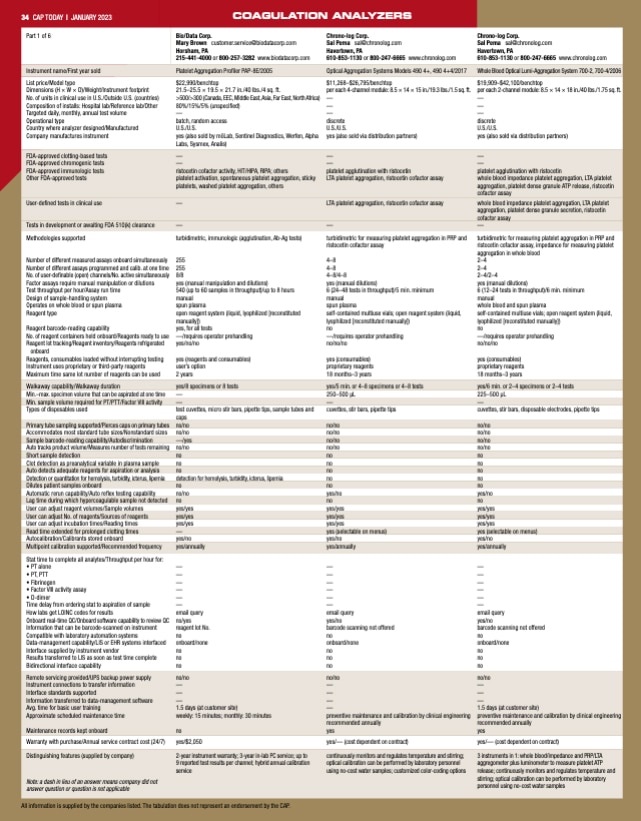
[wpdatatable id=30]
Download Excel version
[one_third]
[/one_third]
[two_third]
Coagulation tests and COVID: inside labs, industry
January 2021— COVID-19 and coagulation testing were up for discussion on Nov. 20 when six people joined CAP TODAY publisher Bob McGonnagle to talk about that and laboratory labor, relationships with industry and hospital administration, and the distribution of testing. “We’re working with all the manufacturers to support rapid point-of-care testing to manage hot spots that will pop up once there is a vaccine,” said Orchard Software’s Curt Johnson.
With Johnson and McGonnagle on the call were Oksana Volod, MD, of Cedars-Sinai Medical Center; Neil Harris, MBChB, MD, of the University of Florida; Annie Winkler, MD, MSc, of Instrumentation Laboratory; Nichole Howard, MBA, of Diagnostica Stago; and Jason Lam, MBA, MLS, of Siemens Healthineers. Drs. Volod and Harris are members of the CAP Hemostasis and Thrombosis Committee.
Dr. Volod, the coagulation findings that have come out of early investigations of COVID have been interesting. What is top of mind for you as you think about coagulation and coagulation systems? What’s most important?
Oksana Volod, MD, director, coagulation consultative service, and associate professor of pathology, Cedars-Sinai Medical Center and David Geffen School of Medicine at UCLA: The good quality of the reagents and the assays available and the quick turnaround time, and potentially new assays that I can bring in-house quickly during this COVID period, specifically assays for fibrinolysis. As you said, there are the specifics of COVID coagulopathy, and now they are pointing out that fibrinolysis shutdown is one of the elements of the COVID coagulopathy. However, only the reference laboratories would have this type of testing. So we are validating fibrinolysis assays on our instruments.
Dr. Harris, are you also seeing a rise in demand for this particular assay?
Neil Harris, MBChB, MD, clinical professor and core laboratory medical director, Department of Pathology, Immunology, and Laboratory Medicine, University of Florida: Yes, we’re seeing a rise in demand for D-dimers and also coagulation factors, especially factor VIII. We used to run factor VIIIs mostly during the day, except in emergencies, and now we are running them around the clock.
The other thing I’d like to point out, and it’s something we have discussed at meetings of the CAP Hemostasis and Thrombosis Committee, is that a number of clinicians have said to me they have certain criteria for D-dimers, but in fact there are different units for D-dimers. For COVID management, as with other situations, there hasn’t been a standardization of D-dimer units.
[two_third_last]