

Editors: Raymond D. Aller, MD & Dennis Winsten
NYU Langone Health rings in new year with new digital pathology program
January 2025—NYU Langone Health, a New York-based multisite system with six inpatient facilities, is implementing digital pathology—some would say lightning quick considering its size. Having started the project in mid-October with six subspecialties, pathology services expects to fully implement the digital distribution of images systemwide by this spring.
“What we’ve seen at other systems is a very slow transition that sometimes never gets accomplished to 100 percent,” says Joan Cangiarella, MD, vice chair of clinical operations, Department of Pathology, NYU Grossman School of Medicine. “Here we presented it as, ‘We are all going to go digital.’”
To prepare staff for a speedy conversion, Dr. Cangiarella consulted with other pathology department leaders, change-management personnel in NYU Langone’s administration, and the medical center’s information technology team, among others. Working together, they scheduled orientations, town hall meetings, focus groups, and training sessions to introduce the whys and hows of digital pathology. They emphasized that, after a training period, glass slides would be stored but no longer distributed. They also discussed how workflow would change, solicited ideas, and answered questions.
Most of the pathologists, medical laboratory scientists, and other staff welcomed digital pathology, says Syed T. Hoda, MD, director of digital pathology, clinical and bone and soft tissue pathology, at NYU Langone, noting that due to the nature of health care, “some inherent caution was to be expected.”
Gaining support from the pathology and IT leadership teams, generated through meetings early in the process, was critical to helping staff want to change. “If leaders don’t exhibit confidence about using the system,” Dr. Cangiarella says, “you will have people that will never use it. Then you get a hybrid workflow and you don’t have any efficiency in the lab from not having to distribute the slides.”
Drs. Cangiarella and Hoda feel fortunate that the chief executive officer of NYU Langone, Robert Grossman, MD, is a radiologist who foresaw the transition to digital pathology decades ago. “The big chatter at national pathology conferences has been, ‘How can we convince our leadership of doing this when the return on investment may be long term?’” Dr. Cangiarella says. With Dr. Grossman at the helm, they did not encounter this issue. “Of course our proposal initially went before a technology review board and some of the vice deans,” she continues. “But we did not have very much of a challenge.”
The decision-makers recognized the project’s potential to improve collaboration among NYU Langone’s 80 pathologists, who work at four hospitals, Dr. Cangiarella says. Another important rationale was to be ready to transition quickly to the “inevitable” use of artificial intelligence-based technology in the next five to 10 years, she adds.
To kick off the digital pathology initiative, Drs. Cangiarella and Hoda sent requests for proposal to several companies.
They chose Philips for multiple reasons, including the quality of its imaging and efficiency of its SG300 scanners and because NYU Langone already had a multispecialty collaboration with the company. The institution has installed nine SG300 scanners, Philips’ second-generation machines that hold 300 slides, at NYU Langone Tisch Hospital and four at NYU Langone Hospital — Long Island. The hospitals process histology for all NYU Langone sites. The pathology labs also installed Objective Imaging’s compact Glissando 20SL tabletop scanners near their multiheaded microscopes that are routinely used for intraoperative consultations.
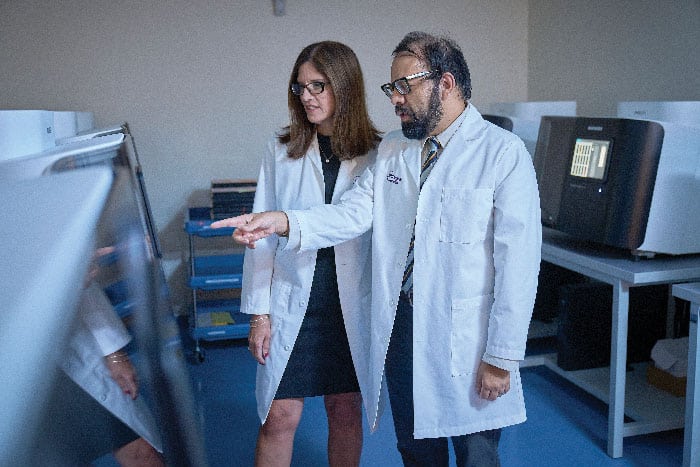
Beyond pricing hardware and associated software, Dr. Cangiarella says, health systems considering a move to digital pathology need to evaluate the high cost of storage. Because each scan creates a large digital file, and it’s important to determine how files will be stored and for how long, NYU Langone has initiated a two-tier system of storage: easy access storage of digital files for months-old cases and archiving of older cases at a more affordable rate. The plan is to keep the files indefinitely, despite the expense. However, Dr. Cangiarella notes, this decision may be revisited.
The scanning itself is done by a new category of employees that NYU Langone calls digital pathology coordinators. More than 15 coordinators had been onboarded by CAP TODAY press time, hired and supervised by the digital pathology operations manager.
Among other tasks, the digital pathology coordinators spend 60 to 90 seconds scanning each slide and then conduct quality control checks. Once all slides for a case have been scanned, the images are immediately available for viewing through Philips’ image-management system via a link in Epic Beaker. The glass slides are retained as well in case a pathologist wants to view the specimens using a standard microscope.
Digital pathology at NYU Langone was rolled out first for bone and soft tissue; head and neck cardiothoracic; the genitourinary and dermatopathology divisions; and cell blocks from cytopathology cases. The subspecialties outside of pathology were chosen because they had leaders who championed digital pathology. Staged implementation also allowed time to hire and train successive waves of digital pathology coordinators.
As NYU Langone settles into digital pathology, it expects to scan 1.5 million slides per year.
The large volume is helpful as the health system is partnering with Philips to develop AI models for pathology.
Drs. Hoda and Cangiarella are also working on plans to allow pathologists to sign out images from home. “I think the work–life balance aspect of this has encouraged others to learn it, if they were skeptical,” Dr. Cangiarella says. Another advantage of the sign-out-from-home plan will be the ability to recruit pathologists who want to work from distant locations rather than move to New York City. The digital pathology team wanted “to get everyone up and running at the hospital as well as comfortable with the system prior to rolling out any concrete remote work plans,” Dr. Hoda adds.
Even as NYU Langone tweaks its digital pathology initiative, the program is offering benefits. At tumor boards, for example, surgeons and oncologists often ask to add unscheduled cases. “Normally I would say no, I don’t have the means to go and get those slides right now. Now it’s more like radiology, where you just bring up the images,” Dr. Hoda enthuses. “It really changes the dynamic of how pathology interacts in these situations. We’re much more available in real time. Every single tumor board I’ve had, they’ve all commented on it.”
Support for the program has extended as far as the cafeteria, Dr. Hoda adds. A cafeteria employee approached him one day as he was paying for lunch and said, “I’m so excited about your digital pathology program!”
“Digital pathology is putting us in a place where people start to understand what we do and how we do it,” Dr. Hoda says. “That’s a cultural change in our specialty.”
—Faith Reidenbach
Mount Sinai opens facility to advance AI
New York City-based Mount Sinai Health System has opened the Hamilton and Amabel James Center for Artificial Intelligence and Human Health, an interdisciplinary center that focuses on merging artificial intelligence with data science and genomics.
“By integrating AI technology across genomics, imaging, pathology, electronic health records, and beyond, Mount Sinai is revolutionizing doctors’ capacity to diagnose and treat patients,” said Eric Nestler, MD, PhD, director of the Friedman Brain Institute at the Icahn School of Medicine at Mount Sinai and chief scientific officer, Mount Sinai Health System, in a press statement.
The center, located on the Mount Sinai Hospital campus, is dedicated to advancing a range of AI research and development initiatives, including integrating machine learning and AI-driven decision-making throughout Mount Sinai’s eight hospitals. It initially will house principal investigators, graduate students, postdoctoral fellows, computer scientists, and support staff.
PathAI enhances system with applications from other companies
PathAI recently integrated several artificial intelligence products from other digital pathology companies into its AISight image-management system.
PathAI has collaborated with Deep Bio, DoMore Diagnostics, Paige, and Visiopharm to incorporate those companies’ algorithms into AISight.
“Utilizing the AISight IMS, partner laboratories will be able to seamlessly access a diverse portfolio of digital pathology algorithms from leading global AI companies,” according to a press release from PathAI. “Through these deep integrations, pathologists will benefit from rich visual support, including AI-generated overlays, and embedded quantitative results driving differentiated workflows.”
AISight is available for research use only in the United States.
PathAI, 833-451-2147
CHOP announces AI model for cell segmentation and classification
Researchers at Children’s Hospital of Philadelphia have created CelloType, an artificial intelligence tool to identify and classify cells in high-content tissue images, and are offering it to researchers as open-source software for noncommercial use.
The offering leverages transformer-based deep learning, which automates the analysis of high-dimensional data, allowing CelloType to capture complex relationships and context. “It is highly efficient for handling large-scale tasks like natural language processing and image analysis, subsequently learning patterns and making predictions or classifications,” according to a press release from CHOP. “It is programmed to improve accuracy in cell detection, segmentation, and classification.”
A study of CelloType, published in Nature Methods (Pang M, et al. Published online Nov. 22, 2024. doi.org/10.1038/s41592-024-02513-1), showed that the tool outperformed other segmentation methods on various types of images, including natural, bright-light, and fluorescence images.
“Using a multiplexed tissue image, an advanced biomedical image that displays multiple biomarkers within a single tissue sample, the researchers also demonstrated how CelloType can be used for multi-scale segmentation and classification of both cellular and noncellular elements in a tissue,” CHOP reported.
CelloType is available at https://github.com/tanlabcode/CelloType.
Dr. Aller practices clinical informatics in Southern California. He can be reached at rayaller@gmail.com. Dennis Winsten is founder of Dennis Winsten & Associates, Healthcare Systems Consultants. He can be reached at dennis.winsten@gmail.com.