

April 2020—High rates of positivity but glimmers of hope. That’s what Gregory Sossaman, MD, was seeing in southeast Louisiana on April 14 when writer Meredith Salisbury spoke to him for CAP TODAY.
Dr. Sossaman is system chairman of the Department of Pathology and Laboratory Medicine, Ochsner Health, New Orleans. Ochsner is an integrated delivery network located primarily in southeast Louisiana, though it has formed partnerships in recent years with other systems and hospitals in the state.
Here is what Dr. Sossaman had to say.
What did you do to scale up for COVID testing?
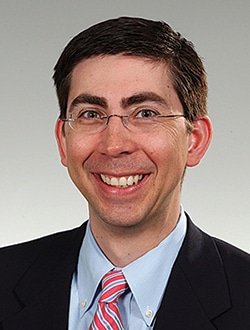
Dr. Sossaman: For the PCR-based testing, we were struggling with there being only one CDC available kit for a while. Should we try to purchase a Roche instrument and bring that up? Our original strategy was that we probably needed to engage one of our partner labs from a send-out perspective until we could get it in-sourced. We quickly pivoted to, let’s go ahead and get this in-sourced.
We’ve been partners with Abbott for many years in standardizing chemistry throughout the Ochsner system and had purchased a little while ago its m2000. We were close to validating some of Abbott’s molecular tests — HCV, HIV, and others — on two instruments. We repurposed those two instruments to do COVID testing. As soon as Abbott released its assay for the m2000, we verified it on those two instruments — at the same time purchasing two more instruments. One we placed here and another we placed at a facility at LSU Shreveport. We quickly ramped that up.
We also are partners with Cepheid and have that platform here, so we were able to bring that assay in-house.
It’s been about a week and a half now since Abbott released its ID NOW test. We also have a number of those devices in the system, so we also brought that up for testing, initially in the emergency department and labor and delivery and now we’ve expanded that testing for any patient who’s admitted. Our strategy moved to our wanting all patients in the hospital tested — anybody who’s coming into the hospital for any type of admission or procedure. That’s to help provide a measure of safety for employees too. We’re getting toward the end of that testing.
So we have those three platforms. We’re also looking at serology testing, as everybody probably is. Abbott is bringing up serology testing on its i2000s and we’re partnering with Abbott on bringing that in-house as soon as we can.
What do you see as the role of serology testing for COVID-19?
Dr. Sossaman: Since we still don’t know as much about the time course of antibody production as we would like, we think that’s probably going to give us information about exposure only. Until we know more from ongoing studies, we’re not going to know as much about immunity as we would like. But hopefully we will be able to contribute information to that as CDC and others look to link exposure and antibody production — what does that really mean as far as an immune status? We’re going to continue to test here to get an idea of the exposure. We’re not using it for diagnostic purposes. But importantly, we will be able to tell people you are negative for exposure, so continue to be careful.
Have you experienced trouble getting lab supplies?
Dr. Sossaman: No, Abbott has been a fantastic partner for us. We’re also a large system in a heavily affected area. The combination of those has helped us maintain a good supply. Nasopharyngeal swabs have been difficult to get, as have viral transport media. Our purchasing department has been proactive. We have done equivalency studies to see if we can use just swabs in saline. We may be moving to that to conserve viral transport media. We think we can probably use that within the system internally where we can get the specimens to us fairly quickly, but outside the system we may be using viral transport media.
How have COVID-19 testing protocols shifted over time?
Dr. Sossaman: Initially we had fairly strict criteria from the CDC guidelines. There were order sets built within Epic that included a flu test, and initially people were ordering a lot of viral respiratory panels. Now that the flu is uncommon, we’ve backed that out of order sets. So we’ve delinked respiratory viral panels and we’ve delinked flu testing. And we have loosened the criteria somewhat over time. Now it’s maybe a subjective fever or some of the more uncommon symptoms that have been noted — GI symptoms and loss of smell.
Has it been challenging to navigate all the new test options coming out?
Dr. Sossaman: We’re fielding a tremendous number of calls [about new tests] and innumerable emails. Particularly with serology testing, we looked initially at a couple of kits; it’s hard to see the quality in some of these kits. We were waiting for Abbott to come up with its serology test on its more automated platforms because it’s much more scalable. Kit testing would be hard to scale. We looked at some ELISA testing but we don’t have the ability to scale that like a larger commercial lab.
How much of a reduction have you seen in non-COVID testing?
Dr. Sossaman: It depends on the area. AP has changed dramatically. Clinical lab testing in different areas is also down dramatically. A lot of it is half of what it previously was, but in other areas it may be much more than that.
Do you have a view on how or when normalcy might return?
Dr. Sossaman: I don’t think we have an idea. We’ve been in this COVID bubble of trying to get the diagnostic testing up. Our organization is beginning to think now about the second half of the year. We’re talking about how we can ensure services are ramped up appropriately. It will probably take all of May and June to get to that point where clinics are open and hospitals are seeing different patients other than just COVID patients. We hope the second half of the year is more normal and that we see the volume we would need to have a good second half. I think we’ll struggle with accommodating the AP and CP volume as people come in who have put off routine testing.