

October 2025—Knowledge of laboratory tests that most effectively work up a patient presenting with bleeding or clotting manifestations is crucial to develop a sound and timely action plan for the benefit of the patient. It is important for medical professionals to know which tests best evaluate the causes of hemostasis disorders and what common clinical scenarios can significantly interfere with accurate test results, such as the impact of anticoagulant agents on routine and special coagulation assay results.
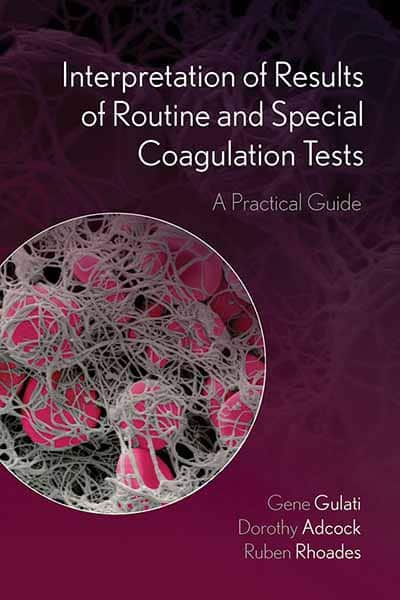 Interpretation of Results of Routine and Special Coagulation Tests: A Practical Guide, by Gene L. Gulati, PhD, Dorothy M. Adcock, MD, and Ruben Rhoades, MD, is a concise, comprehensive, and accessible reference text for any medical professional who must order, understand, or interpret tests of the hemostasis system. For each test, this book provides the causes of abnormal results, including what can lead to false-positive and false-negative results. When possible, information is provided in table form for quick reference, such as the impact of commonly used anticoagulants on the results of hemostasis tests. This practical guide also includes tests that evaluate global hemostasis and clot lysis by viscoelastometry, as well as a discussion of laboratory monitoring of anticoagulants, antiplatelet agents, antifibrinolytics, and thrombolytics.
The book is published by Oxford University Press and can be purchased at http://bit.ly/4gvW7ii.