


August 2025—The Dark Intelligence Group, led by its founder and CEO Robert Michel, announced in March it had sold its information services assets to LabX Media Group of Midland, Ontario, Canada, led by CEO Bob Kafato. Among these assets are The Dark Report, DarkDaily ebriefings, and events such as the annual Executive War College. Thus it is that Michel begins his exit from the laboratory field and his path to retirement. CAP TODAY publisher Bob McGonnagle and editor Sherrie Rice spoke with Michel in May about the sale and his decades at the helm of an intelligence service that many in clinical and anatomic pathology labs and in industry turned to for the news and the experiences of early adopters. Here’s what he told us.
We’ve had 30 years of the Executive War College and The Dark Report. Our readers will want to know exactly what the deal is for you and the new owners. So to start, explain your current status and your ongoing responsibilities.
The transaction closed early this year and LabX Media Group took over all the assets of The Dark Report. As part of this sale, they took 100 percent of our employees and our independent contractors. These employees and contractors continue with all the duties they have. My editorial responsibility has ceased. They see a role for me in continuing to guide the Executive War College and introducing the executive team at LabX Media Group to the major influencers in laboratory and pathology. And they have the resources with which we might be able to develop different products and services for the laboratory profession. I’ll be more of a senior advisor to LabX Media Group going forward.
How long do you expect to be involved or is that yet to be determined, and can you tell us a little about the new owner?
It is yet to be determined. LabX Media Group was established in 1995 as an analytical lab instrument buy-and-sell exchange called LabX.com, which has done well. The group has about 14 bioscience-type publications. It’s a stable, long-serving team, and there is no venture capital or private equity money in the company. Because they’ve never fully developed the conference business opportunities across all of their specialty publications, that is one potential opportunity we discussed with this transaction.
It seems that The Dark Report and the Executive War College took over about 90 percent of the core audience of the Clinical Laboratory Management Association in executive roles.
CLMA has an interesting history. It was organized in 1974 by independent pathologists who owned clinical labs and who needed a way to train their managers, such as their directors of couriers, their directors of lab billing, and their sales/marketing managers. That’s why it was called the Clinical Laboratory Management Association. In the ’80s, public lab companies began to buy up independent pathologist-owned labs—it was the first lab consolidation trend for our profession. Meanwhile, hospital-based lab managers filled the membership. The CLMA meeting was among the lab profession’s biggest, with about 3,000 to 3,500 people in attendance during the mid-1990s. Our first Executive War College was in 1996.
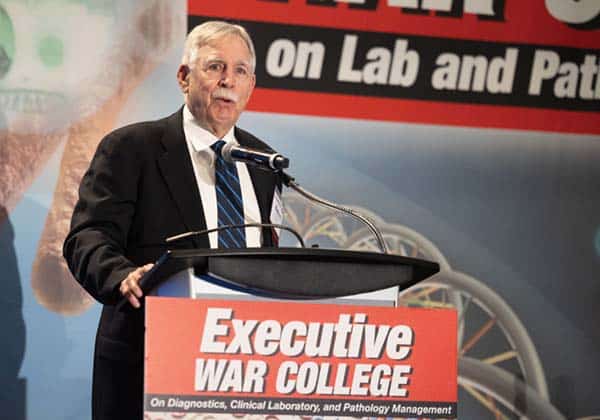
To differentiate our Executive War College from existing lab industry meetings, we tried to appeal to the C-suite leadership of clinical laboratories and anatomic pathology groups. If it’s an independent lab company, it’s the CEO, CFO, CIO, CMO. If it’s a hospital or health system lab, it would be their counterparts—the administrative director of labs, the medical director of laboratories. Our speakers talked about the strategy of how to position your lab—whether it’s a hospital lab or an independent commercial lab. The Executive War College was organized to help people who were at a senior level in labs understand what was changing in health care and the lab marketplace and with the various technologies. What innovations are ready for implementation? It was a time when core lab automation was beginning to hit the marketplace. We’ve always tried to find the early adopter lab leader who is using one of these technologies or a new management model like Lean, Six Sigma, or ISO 15189 and have them do what I like to call a case study in front of their peers. “Here’s what works for our lab, here’s what hasn’t worked. Here are the lessons our lab learned.” That has always been a winning formula for those lab managers who want to keep their lab at the front edge of lab testing excellence and financial stability.
You were the first lab organizer-commentator to understand the implications of managed care, the implications of per-member-per-month payments and the need to get clever when negotiating with insurers and health plans. Essentially, you were probably first to organize a laboratory conference during this time that was post-fee-for-service, post-DRG, post-TEFRA. Would you agree?
Absolutely. I started working at the Nichols Institute laboratory in Portland, Oregon, in 1991. Portland was one of the first markets where managed care became a dominant mode of contracting for hospitals, physicians, and laboratories. Managed care also made fast inroads in Minnesota, Texas, Florida, and California at that time. As I was learning my way around the lab profession, one of the disruptive factors were these managed care contracts from an HMO—it was a capitated rate often with full utilization risk. And what was clear to me early on is that labs, like hospitals and physicians, thought, If we can get an exclusive contract for this insurer’s population in this county, let’s give them a marginal cost price for the service. Hospitals did this, doctors did this, labs did this. If capitated business was five percent of your total revenue book, you were okay. But between the early ’90s and, say, ’95, ’96, managed care often got to be 40 to 60 percent or more of a provider’s revenue book, and it was priced at marginal cost. I was observing this at Nichols. And when we launched The Dark Report and the Executive War College in 1996, one of the big issues was how labs could negotiate better contract prices with HMOs.
Remember, in the ’80s, hospitals, doctors, and labs—as an “any willing provider”—could submit a claim to any insurance plan with a usual and customary fee and be paid. In the early 1990s, HMOs came in and said, “Providers, we’ve paid you full retail for all your services. We’d like another arrangement. We’ll give you exclusive or near-exclusive access to a population of patients in this community if you’ll give us a discounted price.” That was the business proposition the HMOs put on the table for the providers. Until then providers enjoyed getting their claims paid under the longstanding “any willing provider” and “usual and customary fees” arrangement. Consequently, providers never needed much business acumen in contract negotiations and financial management. HMOs radically changed the business model of being a provider and having to interact with a health insurance plan.
In the lab world in the ’80s, there wasn’t a well-established network of the people who were leading labs in different parts of the country, and this is another key part of what I think contributed to the success of The Dark Report and the Executive War College. It was a time when few lab leaders had a network of peers outside their communities. But I had that network when I was at Nichols Institute in Portland because Nichols owned regional labs in several states. If something was happening with HMO contracting in Portland—it might be hospitals buying doctors’ practices, for example, which meant your lab could lose that test business from that doctor’s office—I could call the lab director at the Nichols lab in Houston to ask if they were seeing the same. And they would say, “Oh, we went through this a year and a half, two years ago. And here’s what happens.” I could take that intelligence back to our Nichols team in Portland, and we had a proven response for that kind of market dynamic. So that’s another aspect of what we did through the second half of the ’90s with information in The Dark Report and presentations at the Executive War College. We began to connect these lab leaders in different parts of the country who had never met each other because that type of business networking was not happening at most lab industry meetings.
Through the structure of The Dark Report and of the Executive War College, you created a natural home or network for all the people who were concerned with these issues at the time. You created a new entity. In some ways you’re the father of groups like the Compass Group and the Project Santa Fe Foundation and its Clinical Lab 2.0, because what you demonstrated was if you need to have discussion with your peers and learn from each other and bring in experts to help in that learning, that’s what you do. It’s the people who were the regulars at the Executive War College and regular readers of The Dark Report who began to put these kinds of entities together, be it the Project Santa Fe Foundation or the Compass Group or others.
There is much truth to the fact that the core group of lab leaders reading The Dark Report and coming to the Executive War College during those years then created groups like you mention to drill down even further in the operational, financial, and clinical issues of clinical laboratories and anatomic pathology groups.

There is another dimension to this story: As HMOs in the first half of the ’90s began to convert a lot of fee-for-service business to capitated full-risk contracts, providers began to consolidate to have more clout at managed care negotiations. For example, in a community with four hospitals, two or three of them would get together and form an integrated delivery network so they would have negotiating clout with the managed care plans. The number of multihospital health systems increased from about 400 to 600 between the end of 1994 and the end of ’96. We watched this and reported on it. By the way, this is when the multihospital laboratory system was created that hadn’t existed in the first half of the ’90s. And if you were now the lab director or administrative director of labs for a three-to-five-hospital system, management was on you to cut costs and rationalize testing. Where were you going to go?
From 1996 forward, the Executive War College had case studies about what these multihospital system lab leaders were doing. Do you have centers of excellence among your participating hospital labs or do you have a core lab? Should it be an onsite core lab or offsite core lab? That was a big part of the Executive War College’s timing: As hospital lab leaders were finding themselves managing something they’d never managed before, the Executive War College was a meeting for what was working and what was not, and we were writing about the same things in The Dark Report.
That’s absolutely true.
The next thing that happens is the arrival of Lean and Six Sigma. It was in about 2003 that we did our first full-day optional workshop on Lean, and about 20 to 25 percent of the War College attendees stayed over for that. That was the first formal presentation of Lean in the lab profession. Ortho Clinical Diagnostics, then a division of Johnson & Johnson, had a business unit called ValuMetrix devoted to helping labs implement Lean and Six Sigma. ValuMetrix was integral to providing us with management experts from the automotive and other industries to talk about how Lean worked. That started laboratories and even hospitals on the path to Lean. It was a way to improve workflow while addressing all the problems of service failures and a way to develop economies of scale while liberating scarce lab labor that could be moved to higher and better value positions. It was all part of this curve.
That brings up the problem today—the labor shortage in laboratories. With it being such a widespread problem and so long-lasting, do you have any of your own thoughts on that?
In the early days of the internet, I found a chart online from a group that reported the number of medical technologist certifications by year starting in about 1960. As soon as Medicare is authorized in 1966, the number of certifications for medical technologists starts to climb, and the number remains high until 1983, which is the start of Medicare DRGs that reduced payments to all classes of providers. With less money in the health care system, the annual number of new medical technologist certifications falls, and it begins to trail down even more in the ’90s as medical technologist training programs closed. You could clearly see the influence of how Medicare money was driving job opportunities in laboratory medicine specifically and probably all of health care in general.
In the 1990s it was recognized that the demand for medical technologists exceeded the supply, but it wasn’t critical. In the decade of the 2000s it was recognized that the retirement of the baby boomers was going to exacerbate the shortage. Well, you get into the 2010s and—this is something we followed closely—the projected demographics, the gap, did not show up. Many medical technologists might be retiring, but they would continue to work part time. In some cases, though, the retiring medical technologist didn’t want to come back to the core lab where people were overworked because of how Lean was stripping things down to their essentials. Instead, they would pick up work in physician office labs.
It’s true.
I’ll give you an example of how Lean could substitute for labor. In 2003, Naples Community Hospital in Florida was one of the first hospital labs to do Lean in a rigorous way with the team from OCD’s ValuMetrix. They applied Lean methods and workflow in their core lab chemistry and hematology. They had nine medical technologists working in that section. Following the Lean implementation, it could be run with one medical technologist and they staffed with two. The instruments were organized like a racetrack. The chemistry and hematology instruments were arranged in an oval. The technologist would load instrument number one, then load instrument number two, then instrument number three, and by the time they made the circuit, instrument number one was ready to be unloaded and reloaded. No one had ever done that kind of thing before. This greatly boosted productivity of the medical technologists in the core lab. They were freed up and could be assigned to other areas of the lab.
The years 2003 and ’04 were the first when major hospital labs were willing to put their core lab under the chopping block of a rigorous Lean assessment and makeover. At that time, it was a great leap of faith to let somebody come into the laboratory and reconfigure everything in ways that had never before been done. Interviewing those first movers using Lean and having them speak at the Executive War College proved to be high interest for other lab leaders.
In the years around 2017 is when the incoming supply of medical technologists is clearly deficient and the baby boomers are fully retiring out. It is also the time when the use of things like Lean/Six Sigma to redo workflow and improve the productivity of a lab’s highest-value labor is beginning to max out. That left most labs with a demand for service and a labor supply that was inadequate. And it is chronic, especially today. Nothing will change this in the short term other than more professional society recruitment of candidates. Over the past 10 or 15 years at the Executive War College, we’ve consistently presented examples of health system labs that are effective at developing programs to recruit and retain clinical laboratory scientists and other skilled positions.
The ability of the industry to innovate to help automate workstations and even full tracks helped to some degree to cover the shortage for a while.
That’s right. Automation and Lean have consistently been the two primary tool sets.
Now we are at what seems to be the absolute limit. Sometimes clinic labs don’t open because they don’t have people who can staff them on a given day.
The culture around Lean has frayed around the edges as people come and go within a Lean lab and the new people aren’t trained in Lean and the management team doesn’t have the time to sustain the culture. Many labs got a one-time boost from doing Lean and combining Lean with automation and other workflow innovations. But every lab must sustain the Lean culture so it can continually handle more volume with less labor while maintaining a high level of quality.
Do you have any predictions about artificial intelligence based on what others have said at your meetings or in conversations with you?
I think it’s accurate to say that as we go forward, the vendor of every lab analyzer, every lab automation solution, every software solution, and every service offered to a clinical lab or a pathology laboratory will tell them there’s artificial intelligence parked inside. AI is actually made up of six or eight primary technologies for managing data, but the point is if you’re a lab manager or a pathologist, you will be told that AI is integral to what you’re buying to put into your lab for patient care and, because it’s so sophisticated, lab managers will be required to trust the black box that is AI.
You set up a dedicated session on anatomic and academic pathology that’s been a hit at the Executive War College over the years. You recognized early on that the pathologists who had been broadly based in AP and CP were now specializing at fast rates and you began to call that out frequently. That was to your credit and should be acknowledged.
There’s something, though, that has long distinguished your work for us, particularly in The Dark Report but also in the conference, and that is your fearlessness in talking about some of the bad actors in our field in terms of billing and business practices. We remember well your recounting of the high percentage of actionable violations of law within the laboratory business over a huge span of time. That deserves to be recognized. It shows also a great deal of reportorial courage and helps to situate the audience in a reality they knew about but wasn’t talked about.
In 2005 I did a story about the large percentage of CEOs of public lab companies who had been criminally indicted. It was 25 percent of national public lab companies, a phenomenal ratio. In many respects hospital lab people did not know the extent and nature of this fraud, not to mention the consequences of lab fraud and abuse with Congress, with CMS, and with each administration. That’s why we regularly gave attention in The Dark Report and at the Executive War College to the fraud and abuse in laboratory testing.
You were the first and most consistent reporter on Theranos.
We were the first to regularly question the effectiveness of the technology given what anyone trained in lab medicine knew were its limits, and to report that Theranos never shared data with any health system or clinical laboratory it claimed to have as a collaborator, such as Intermountain Health and Cleveland Clinic. We were first to report in spring 2015 that Theranos had stopped doing capillary blood collections in Phoenix and was only collecting blood specimens using traditional venipuncture procedures. It wasn’t until that fall that the Wall Street Journal story broke.
As you prepare to exit the field somewhat, do you have one or two pieces of advice for those management-minded laboratory professionals?
Not advice but a recommendation. If someone has trained in some aspect of laboratory science and is inclined to move upward in management, they need to educate themselves in management to a greater degree than typically happens. I can give you an example. I’ve worked at three Fortune 100 companies in my career. One was Procter & Gamble, where each year I participated in one to two weeks of formal management training and development designed to strengthen our skill sets. I don’t know of a hospital that has a program where they rotate all their managers through some kind of regular, annual management development training.
When I worked for Procter & Gamble, management’s span of control was five to eight people. A sales manager would have five people and was expected to spend at least a day a week with each of the five and prepare them to take over his or her job. Their boss was doing the same. I don’t know of any corporation or health care entity these days that has that ability to train managers on the job and carve out a week or two each year to put people through a formal management development program.
So my first recommendation is that if you are trained in lab medicine and you aspire to management and administration, on your own initiative you should hunt out, learn, and master these techniques and acquire the skills to be an effective manager. That includes market analysis, organizational strategy, and how organizational tactics support strategy and achieving goals. At a minimum, learn how to prepare a financial return on investment.
My second recommendation for any laboratory professional who would like to move up in management is to create a circle of peers who are capable of getting results. I call it mastering the Pareto Principle, the 80/20 rule. In this case, it is finding the 20 percent of lab professionals and managers who are getting 80 percent of the results. Those are the kinds of people you want when building your network.
Excellent advice.
It goes back to the book Think and Grow Rich from the 1930s. How that book got written is a great story. Andrew Carnegie called the writer, Napoleon Hill, into his office and said, “I spent the first half of my life building my wealth. I’m going to spend the second half of my life giving it away.” He tells Hill to interview every successful person in society at the time and to write a book about the things they were doing in common. So Hill interviewed Thomas Edison and Henry Ford and others and Think and Grow Rich was the product. And its wisdom is as timeless today as it was in the ’30s.
Final question for you: Which will consolidate faster: laboratories or vendors? I’m sure you’d agree we have a lot more consolidation coming in the next 10 years.
In the world of modern business, getting larger is always believed to generate financial benefits to management and investors. Maybe we can call it the “curse of consolidation.” If you look at the multiplicity of IVD companies in the late ’80s and ’90s, you can see that anytime an IVD company launches with a new diagnostic technology, as soon as it achieves annual revenue of $100 million or $200 million, the IVD behemoths are going to buy it. Ventana, for example, had revenue of $268 million in 2008 and Roche wanted to buy it; Ventana didn’t want to sell and Roche ended up paying $3.4 billion for Ventana in 2008. That’s consolidation on the lab vendor side and that will continue. We will see more mergers among the 10 to 15 largest IVD companies. Last month’s announcement that Waters Corp. will pay $17.5 billion to acquire a bioscience and a diagnostic unit from Becton, Dickinson demonstrates that consolidation within the IVD sector is ongoing.
On the health care side, laboratories are already consolidated. You have a duopoly of Labcorp and Quest Diagnostics, with Sonic Healthcare USA as a third player. On the hospital side, Ted Schwab of Schwab Tremblay Solutions predicted 10 years ago that the 600 health systems from the 1990s would be down to about 350. That has happened, and Schwab also predicted that ongoing consolidation will continue until we are to end up with 50 health systems around the United States, and we might end up with five. The evidence is compelling that consolidation will continue.