

Karen Titus
December 2025—People who are lucky enough to be swimmers know there are two basic ways to enter the water—taking the plunge and submersing yourself all at once, or gradually dipping in one body part at a time, from toes to temple.
Both approaches have their advocates. Both involve a certain amount of apprehension and grimacing. And whether it’s sooner or later, both will get you gliding through the water.
As it turns out, this is also true for bringing next-generation sequencing in-house.
Nevertheless, NGS rates appear to remain low (Ferreira-Gonzalez A, et al. J Mol Diagn. 2024;26[4]:292–303). And the barriers—ranging from reimbursement and lack of expert knowledge to logistical difficulties—might seem high, especially outside of large academic medical centers.
But they’re not insurmountable, say two molecular diagnostics experts who recently shared their experiences with CAP TODAY.
At both Sentara and Florida Cancer Specialists, the commitment to NGS was strong. And when each decided to bring the testing in-house, they approached the waters, so to speak, differently. Call it—with apologies to the late popular science writer Daniel Kahneman, PhD—NGSing, fast and slow.
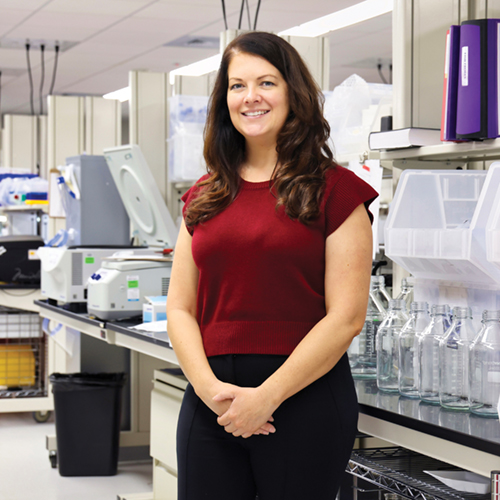
The polar plunge-type of entry comes courtesy of Jennifer Gass, PhD, who arrived at Florida Cancer Specialists & Research Institute (FCS), based in Fort Myers, in August 2020.
There were, of course, other testing mountains to climb that year. But Dr. Gass, associate director of the genetics laboratory, was focused on building an in-house molecular laboratory from the ground up.
It began, she says, “as just sort of a dream of our oncologists to add molecular to our pathology lab,” which already offered histology, flow cytometry, chemistry, and cytogenetics. (The lab’s clients are FCS oncologists—it is not a reference lab for outside hospitals—and the patient population is adults, mostly older.) Adding the missing element of molecular testing would, they felt, enable better and more convenient patient care.
Dr. Gass was hired to make that happen. She recalls: “I was given these two small rooms and told this was where the lab would go.” She pauses. “I don’t think people understand the amount of space you need for a molecular lab,” she says, citing the need for designated pre- and post-amplification areas, as well as space for large instruments that, because they generate considerable heat, can’t be placed near one another. Following that initial land grant, so to speak, Dr. Gass estimates the lab has since quadrupled in size, including converting a conference room.