

Valerie Neff Newitt
July—When COVID-19 set in, much of residency education in the U.S. moved online. At the University of Washington School of Medicine, anatomic pathology faculty took online learning a step further by creating a virtual two-week anatomic pathology rotation for medical students.
The faculty is aiming for a four-week virtual rotation inclusive of more laboratory medicine, to be used even after the pandemic has passed.
“All medical student rotations were canceled. But some students had expressed an interest in pathology, and we felt bad they couldn’t get their rotation in,” says assistant professor of pathology Lisa Koch, MD, PhD. She suggested to the medical school leaders that a virtual rotation might be possible. “They said, ‘Great. Can you take 40 students?’”
That number gave Dr. Koch pause—the typical monthly student load for a UW pathology rotation is six—but Elizabeth Parker, MD, the breast/gynecologic pathology fellow at UW, assured her, “We can do it.”
They and Oliver Chang, MD, acting assistant professor of pathology, created “Remote Pathology Medical Student Education.” “In the beginning, our goal was just to accommodate some of these stranded medical students,” Dr. Chang says. “But Dr. Parker and Dr. Koch felt ambitious and wanted to make a rotation from scratch that would be truly appropriate for medical students. After all, no one knew how long the COVID situation would go on. So we decided if we were going to do all of this work, we might as well create something long term out of it.”
While the content would focus on anatomic pathology as always, Dr. Parker says, “the structure had to change substantially since we couldn’t fold students into our normal workflow. We tried to simulate various elements—we took pictures of our actual gross lab, multi-headed microscopes, sign-outs, et cetera—as much as possible. And we designed and developed content specifically for the student cohort we would be teaching—clinical students, most of whom are not going into pathology.” They highlighted what they wanted their future non-pathologist colleagues to understand and take with them, she says.
“A goal for this rotation was for students to walk away having multiple pathology pearls at their fingertips, so that when they eventually see patients at the clinic or provide care in the OR, they will know how to navigate our system and how to interpret our reports in a way that is elevated. Of course, we’re also hoping we convert some of the med students into wanting to go into pathology.” It was an opportunity, she adds, for them to reach a much broader audience than previously.
“Our goal also was to help medical students grasp the challenges within our daily pathology practice,” says Dr. Koch, “and to understand the terminology around neoplasia and reactive processes so that when they see those words on a report they know what we’re talking about. We want them to understand the processing in pathology, why things take the time they take, what a frozen section is, how that all works. They don’t get that instruction in medical school.”
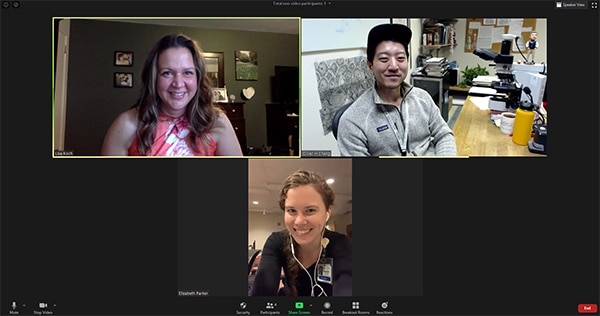
It took a month for the team to create a structured curriculum and content, decide on what technology to use, and fine-tune the expected student experience for the online elective. When the program launched in April, team members saw before them “a real evolution in education,” Dr. Chang says. “We have come up with a course that makes our service, both pathology and lab medicine, less of a black box of diagnostic medicine.”
The rotation, which occurs over 10 weekdays, requires students to attend one two-hour Zoom session every morning, and one two-hour, small-group Zoom session in the afternoon.
Dr. Koch, Dr. Parker, Dr. Chang, or a resident who’s interested in education and a particular organ system lead the morning didactic sessions. “We have two one-hour lectures that involve PowerPoints as well as virtual slides. The first two days are a big picture orientation. We talk about terminology, histology, processing, and then go through organ systems. We have a day of running through high-yield GI pathology, then high-yield GU pathology, et cetera.”
Morning sessions are highly interactive. “There are features on Zoom that allow students to annotate,” Dr. Parker says, “and actually draw on slides. In addition, we are using an online open-source platform called PathPresenter. It includes an open public library of virtual slides, from which we’ve created a virtual slide tray that students can go through, and zoom in and out of the slides.”
During afternoon sessions students are split into small groups instructed by teaching assistants who are former post-sophomore fellows in pathology. Participants go over virtual slides “in classic unknown slide sessions,” Dr. Parker says, “which are interactive, with lots of conversation.”
The presentation of particularly challenging cases consists of what they call “detective cases,” Dr. Chang says. “Loosely based on a board game called Sherlock Holmes, the students play resident doctors. They receive two cases, and the goal for each is the same: Solve the case, come up with a diagnosis, and find out other things to do with that disease process.”
The first detective case is a guided tour led by a teaching assistant, where students get an initial presentation from a patient. “They get very limited additional information,” Dr. Chang says. “The TA coaches them into asking the right questions, ordering the proper lab tests, getting results, ordering new tests, forming new impressions, differentials. The goal on the first case is to hold their hands right through the final diagnosis and discuss every step along the way.”
The second detective case is a “hands-off” case. “Everybody’s blinded,” Dr. Chang says. “We provide students with the initial presentation and then leave them alone.” Group members discuss among themselves what they should do. They’re allowed to consult volunteer “experts” in various fields, drawn from UW residents. They can email these experts (who also do not know what the diagnosis is), simulating how they might confer with a clinician in the real world.
“If the students ask for a biopsy,” he says, “they get a histologic image sent to them without any description, without a pathology report. They can take that image to an expert pathology resident and ask, ‘Can you help us out? What do you see? What do you suggest we do?’ They decide how to proceed from there. They order tests and get results.” At the end of the two weeks, they’re asked a series of questions to uncover how far they got. “The challenge is between two small groups so there’s an element of competition. The group that made fewer moves, ordered fewer tests, and still got the correct diagnosis wins.”
Journal articles posted by instructors, self-study resources, and student access to PathPresenter so they can examine slides are supplements to the e-learning.
“And at the end of the rotation,” Dr. Koch says, “we include a lecture about hospital autopsy, signing a death certificate, those kinds of things, which are important for med students to hear.”
For others who may wish to develop a similar online rotation, the faculty members say “it takes a team.”
“I don’t want to say we were at a point of desperation, but we were up against an enormous time crunch,” Dr. Chang says. “We needed to prepare this quickly and wanted good ideas to run with. We had overwhelming enthusiasm from our residents and from the post-sophomore fellows. All of them offered ideas and asked to help. And our administration team organized meetings virtually and taught us to get the most out of Zoom and Microsoft Teams, and more. These were all new skills we had to learn.”
Dr. Koch agrees: “We’ve all gained a lot of skills that we didn’t need to have before. But now that we have them, we will be able to use them even when we’re not in this pandemic situation.” Adds Dr. Parker, “It has been such a tremendous opportunity, in such trying times, to develop educational content and grow as an educator.”
Suzanne M. Dintzis, MD, PhD, UW associate professor of pathology and president of the Washington State Society of Pathologists, says she is impressed by her colleagues’ innovation and what it means to pathology.
“This chance to expand contact with medical students is huge, especially in the context of the COVID interest in laboratory medicine and pathology. The program has helped to fill the teaching gap caused by COVID. Normally, we have at most six medical students a month who engage in our AP curriculum. With the new e-learning pathology course that our faculty built, we now have three two-week courses scheduled, each of which have 23 medical students enrolled. So our number of students has increased 10-fold.”
Dr. Dintzis envisions the new online rotation, while focused now on medical education in pathology, “evolving to be of service to fields that use and study pathology: veterinarians, nurses, dentists, and others. You can imagine this kind of content being modified and applied in a lot of different ways. The reach, although right now focused on medical school, could be much broader.”
Dr. Koch says the virtual rotation could form a foundation for expanded e-learning at UW. “We are hoping that the things we’ve put together here will be a platform to do more virtually for both residencies and medical school rotations, particularly if we don’t come back in person in the fall.”
At UW, lab medicine is a distinct department from pathology. “Lab med is now putting together its own two-week course, a companion to this one, folding medical students into some of the activities they have going on. We have big plans for the future to get a more integrated four-week course,” says Dr. Koch, one that could outlive the pandemic.
The pathology team has eagerly awaited feedback from the first students in the program. “Honestly, they were like beta testers,” Dr. Chang says. “We were fortunate to have so many participants right off the bat. We know that’s because of the circumstances, and we intend to take full advantage.” They developed surveys to see how the students’ knowledge of pathology compares pre- and post-rotation. “We’re going to use that information to compare it with the in-person/in-house rotations. We want to fine-tune this process.”
Response so far suggests success. In a written evaluation, one student wrote: “I really enjoyed the structure of lectures in the morning followed by interactive afternoon sessions. Looking at, describing, and working through actual slides helped me to apply and ingrain the knowledge from the morning sessions. Having all of this followed by an interactive and engaging case study was terrific. It was awesome to have a few COVID-related lectures as well, since this is on the forefront of everyone’s minds at the moment.”
Dr. Dintzis believes the quickly yet skillfully produced online course reflects “the very nature of the pathology department” and what it can produce.
“There’s so much talk nationally about trying to make pathologists visible and making sure they’re members of the clinical care team. This program helps to do that by reaching medical students early, and in a climate where they are hungry for learning while hunkered down in their homes. The opportunity is huge, and our faculty stepped up to the plate in a way that is remarkable.”
Valerie Neff Newitt is a writer in Audubon, Pa.