

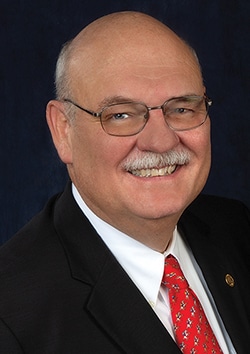
Patrick Godbey, MD
May 2020—The most pressing topic in pathology today is the COVID-19 pandemic. Because this column must be written a few weeks before it is printed and delivered to readers, anything I write in April will be out of date by the time you see it. Numbers will be wrong, and comments on testing methodology will be obsolete.
Instead, I’ll focus on the bigger picture. As we watch the world’s response to the pandemic, I am proud to be a physician and a pathologist. I am honored to work with phenomenal laboratory personnel, and this is by no means unique to me. Across the medical community, we have seen people come together for a shared mission in ways we have never experienced before. The demands on our laboratories are tremendous, and we are rising to the challenges of producing tests and directing therapies under conditions we have not seen before.
Throughout the pandemic, my team has been heroic. Like many CAP members, I know labs that are hurting and pathologists who are facing employment uncertainty. Demand for services we usually provide in clinical and anatomic pathology—our bread-and-butter offerings—has decreased tremendously. Laboratory staff are seeing significant reductions in the hours they work, and many have already experienced layoffs. Pathologists are worried for their own well-being and that of their families. Still, hospitals are understandably putting enormous pressure on pathologists to get new tests up and running or to find somewhere to have the testing performed. Yet too many health insurance companies wrongly refuse to pay our members for work that is fundamental to the diagnosis and treatment of COVID-19. Many of our members have had to remind clinicians and administrations that there is testing and then there is reliable, quality testing. Those with whom I work have listened.
It is a tough time and the organization that is really taking active measures to help our community is the CAP. Even as the pandemic was beginning in the U.S., the CAP was hard at work developing resources and pushing for policy changes to help our laboratories. I urge you to check the CAP website, which is being updated regularly with reliable, helpful information. Also, we removed the fees on more than 75 online CME/SAM courses during April, with programs for junior members and fellows. Many residents found their training programs affected by their institution’s COVID-19 response. We provided a daily virtual lecture program. Each morning, trainees from around the world stay connected and keep moving forward with their education during this crisis. More than 800 people attended our first #capvirtualpath lecture. The program has been so successful that it has been extended through May 29.
In addition, the CAP’s advocacy staff has been extremely active and is succeeding in its efforts to help labs. The CAP led the charge on remote sign-out, working with Rep. Buddy Carter (R-Ga.) and Rep. Bobby Rush (D-Ill.) to make it possible for pathologists to work from a location that is not a CLIA-licensed facility, such as our homes. The CAP also successfully pushed to delay CAP inspections and CLIA proficiency testing during the pandemic, allowing pathologists to conserve precious reagents and streamline operations while not allowing our CLIA and state certifications to be questioned. We are engaged in trying to improve the financial soundness of our members and the lab personnel we work with so they can continue to meet the demands placed on them. More than any other organization, the CAP has stepped into the breach to protect pathologists and the labs we direct during this difficult time. We have had huge wins and we aren’t done yet.
Those are the things I’m proud of. Now for the disappointments. Some politicians, some media outlets, and some organizations have taken advantage of this crisis to further their own political agendas. They are putting their own interests ahead of the needs of the country, including those of the patients we serve. That would be unfortunate even in less stressful times, but during this pandemic, it is truly shameful.
Despite that, I am choosing to find optimism wherever possible. I am hopeful this experience will provide a lasting education about the importance of pathologists to the general public, hospital administrations, and government leaders alike. The vast majority of medical decisions are made in our laboratories. These decisions include identifying patients in need of care, determining who can safely return to work, as well as the use of PPE and pharmaceuticals in short supply. I hope no one will forget the key role CAP members and the labs we direct played in getting us through this. And we will get through this.
To all of our members, the laboratory professionals with whom we are so fortunate to work, and your families, please stay safe and healthy. Our patients need us.
Dr. Godbey welcomes communication from CAP members. Write to him at president@cap.org.