

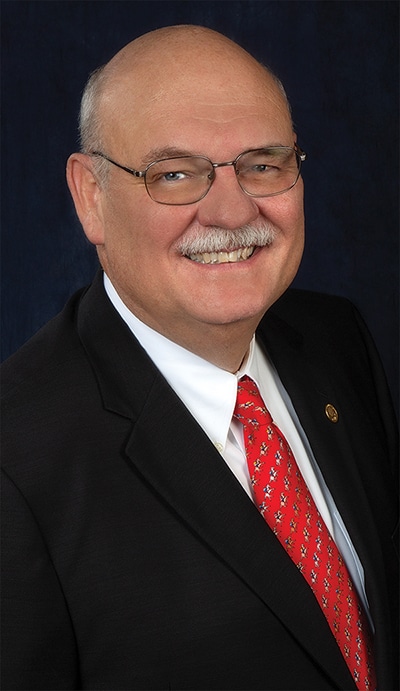
Patrick Godbey, MD
October 2019—I have two goals as a pathologist, and I suspect that my colleagues share them. First, I want to be the best physician—the best pathologist—so I can give the best possible care to my patients. Second, I want to get paid fairly for the service I provide.
Being the best pathologist comes with a number of requirements: staying up to date on the latest information and protocols, practicing in a quality lab, and working with great pathologists. On all fronts, being active in the CAP makes a difference. The CAP grants more continuing medical education hours than any other organization in pathology, ensuring that members have the opportunity to stay up to date. Our laboratory accreditation process supports members’ access to the best-quality laboratory procedures. There is no better laboratory text on quality than the CAP’s accreditation checklists, and they are updated regularly by CAP fellows. In other words, if you follow what’s in the CAP checklists, you will have a quality laboratory. The CAP plays an important role in helping to attract good medical students into our field and protecting our graduate medical education programs to ensure we have a steady supply of talented, qualified professionals to join our ranks.
As for the second goal, I don’t apologize at all for my interest in getting paid appropriately for the vital service I provide for patients—and I hope you don’t either. But it’s about more than just a paycheck; it’s about recognition of the important service we provide to our patients every day. We must be allowed to be involved in writing the regulations that dictate everything from our income to our compliance guidelines. I want to make sure that pathologists can help determine their own fate. Again, active members of the CAP are best positioned for success on this front. Our Council on Government and Professional Affairs, which I had the good fortune to chair, performs invaluable functions that matter to all members.
The CAP is the only organization that has a political action committee that looks out solely for the interests of patients and pathologists. We also have an office that facilitates ongoing conversations with the Food and Drug Administration, the Department of Health and Human Services, and the offices of senators and representatives in Washington, DC, as well as those in the state capitals. More than any other pathology organization, we have a chance to influence what goes on in federal and state organizations.
Like many of you, I’ve been a member of the CAP much longer than I’ve been an active member. One of my goals is to encourage others to take an active role in the CAP. After all, supporting this organization is not only good for our profession but also crucial for the care of the patients we’re trying to help.
Getting involved is easier than you might think. The simplest way is to vote. It’s a privilege that the CAP allows every fellow to vote directly for all of the organization’s leaders. The CAP’s unique structure makes it that much more important that every fellow take part.
You can also get involved through our House of Delegates, which is an important voice of CAP fellows and includes nearly 500 members. The speaker and vice speaker of this group attend the Board of Governors meetings and vote. In addition, membership in the House of Delegates can be a pathway to future leadership positions within the CAP. Similarly, our Residents Forum engages young leaders in our field and serves as a helpful network for pathology residents. The forum chair attends and votes at Board meetings, ensuring that residents have a say in what goes on in the CAP.
You can participate by becoming a member of the CAP’s extensive network of committees and councils, where much of the CAP’s work is carried out. With nearly 70 active committees and councils, there’s something to suit any member’s interest. These groups have more than 1,000 positions, giving our hard-working pathologists an opportunity to make a difference for their peers and our patients.
If you want to go beyond voting and committees, and I hope you do, then you should know something else that makes our organization different: Any fellow can run for a Board or an officer position. All you have to do is get a petition with 100 signatures from other fellows and you’re on the ballot. The first CAP position I ran for was that of governor, and I never thought I’d be elected. I’m from a small town in South Georgia and at that time almost no one knew who I was. But I did win that election, and two years ago I was honored to be elected by my peers to the position of president-elect. This is an organization in which the individual pathologist really can make a difference.
The CAP is an extremely important organization. If you care about your profession and our patients, the CAP is the best way I know of to make changes and move forward. As for me, my interest in the specialty is stronger than ever now that my daughter is a brand-new pathologist and a CAP fellow. By working closely with all of you, I hope to ensure that our field continues to flourish for a whole new generation, and many more to come.
The thought of my family, my wife and daughter, makes me wish to express my great and sincere appreciation for them, and for my colleagues who have allowed me to serve in this position. In particular, I’d like to recognize my CAP predecessor and friend Bruce Williams, MD, whose many years of CAP service culminated in his presidency. Thank you, Bruce, for your friendship and leadership.
Dr. Godbey welcomes communication from CAP members. Write to him at president@cap.org.