


Valerie Neff Newitt
July 2025—Two years into its program to introduce high school students to laboratory careers, Mayo Clinic in Rochester, Minn., is seeing the hoped-for interest and demand.
Discover Mayo Clinic Lab Explorers Program is the name, and the program is open to students in grades nine through 12. “Over the last two years, we’ve had roughly 100 students participate, and both times we opened registration it was full within three to five days,” says Liana Michelfelder, talent solutions specialist with the Mayo Clinic human resources workforce development team. In the program’s second year, which took place this year in April, she says, there was a 60-student waiting list. “So we are seeing strong results so far,” Michelfelder says.
Students are surveyed at the conclusion of the three-hour program held in the spring on a Saturday morning, as one way for Mayo to measure its impact. “Just over the past two years, we’ve seen positive results,” she says. “For example, 96 percent of students felt they were confident they could name at least five health careers. Ninety-three percent said they were interested in working in the health care industry and said the event motivated them to do well in their classes.” And 93 percent also said after the program experience that they could see themselves working at Mayo Clinic.
The program is open to any student on a first-come, first-served basis, and its promotion is targeted to local schools and local career and technical programs. The schools forward a flyer about the program to students they think might have an interest and be most successful in the program. “But all students are welcome if they’re curious about health careers or lab science careers,” Michelfelder says.
The suggestion for the program came out of a Department of Laboratory Medicine and Pathology staff group focused on recruitment opportunities. The group “elevated the idea and said, ‘We need to invest in early talent,’” she says. “Leadership asked, ‘What are you going to do, and what resources do you need?’ That level of buy-in was critical to making it happen.”
“We took some time. We considered who could execute this, who should be involved,” Michelfelder says. It was members of the workforce development team and an education team, as well as a variety of staff from the Department of Laboratory Medicine and Pathology. “They put their heads together,” she says, to determine what the program would look like and what careers to spotlight. About four months lead time was needed for the initial planning.
“We focused on roles that are critical to the patient experience and to Mayo Clinic and that we know will be in demand in three years, five years, 10 years. This program is helping to build a pipeline of potential staff for us down the road,” Michelfelder says.
From a resource standpoint, “we had to have all our different activities mapped out,” she says, as well as the needed supplies. “We were able to tap into the educational spaces of those local experts within the organization who come from the high-demand career areas and identify staff within those teams who are passionate about education and about raising awareness about these career areas,” she says, adding that staff who invest in the students are not expected to do so “over and above as volunteers.”
Michelfelder says they chose to kick off the Saturday program with a keynote speaker “for inspiration.”
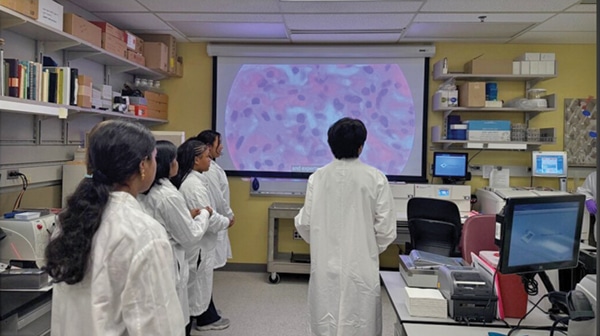
“We are trying to help students see how cool lab careers are.” The keynote speaker shares their own story and what led to their pursuing a laboratory career, in addition to “why they stay, what a typical day looks like, what their favorite part is, and even why it’s challenging.”
Students rotate through the different career areas and talk with experts from each. “They ask about their education and what strengths they have that drew them to this area. How much do you get paid? All of the information that students need to make a decision about whether that career area is a good fit,” Michelfelder says.
Sometimes students arrive with an idea about what they want to do, “and once they see it in action, they walk away and say, ‘Wow, I definitely don’t want to do that.’ And for us, that’s also part of the goal of this—for students to have the information that ‘These two might not be right but this one over here is.’”
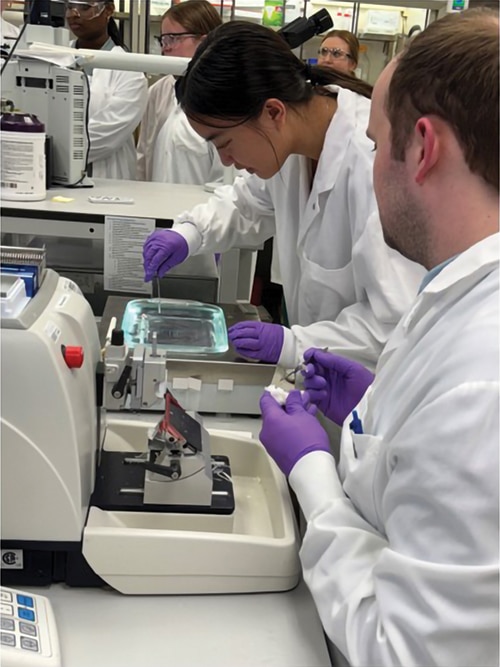
In the histology section, students are exposed to personal protective equipment “so they get the feel of a laboratory environment,” says Elizabeth Witty, MS, MT(ASCP), hematopathology supervisor. “They practice cutting embedded fake tissue, then walk through a staining process, and finally review what their final product would look like under a microscope,” Witty says.
To expose the students to the work of clinical laboratory scientists, laminated cards are used to teach them about blood types and screens. “There was a mock-up color change assay that allowed for the students to use a transfer pipette to make an example of what we would potentially see in a clinical laboratory setting,” Witty says.
They also learned about phlebotomy practice, using practice arms. “Students suit up in PPE so they understand its importance,” she says. “Then they get to stick a big arm with a needle to know what it feels like to draw blood.”
Michelfelder says there’s a “fine line between informing and inspiring students and throwing so much information at them that they feel overwhelmed and almost disengaged.” The experience is made as interactive and hands-on as possible, she says, adding, “We want the students to feel, see, touch, and explore a career in an experiential way.”
Though the experts the students talk to share information about their careers and what it takes, “we try to keep an eye on it to make sure you’re not speaking at them for too long,” Michelfelder says. “You have to move into that hands-on activity because that’s what they want.” The feedback from the survey students take at the end of the course confirms this. It asks: “What can we do more of? What could look different? Is there anything we could have done to improve this experience for you?” she says. The students said they want to see more careers and more hands-on activities. “So we made changes,” Witty says.
The staff who designed the three-hour program drew in part on the experience of other organized activities, among them career fairs.
The students are given single pages of information for each of the laboratory careers they learned about, including, for example, the skills or strengths that might make them well suited to that career. Listed are local resources to aid their moving forward locally in a particular career. A brochure details the career ladder in the department. And students are told what careers can be entered with a high school diploma and which ones require a two- or four-year degree or a master’s degree.
That information goes home in a bag that also contains stress balls, pens, and other playful items, Michelfelder says. Hand sanitizer was in the take-home bag the first year; the students thought it was “boring,” she says. This year the sanitizer was replaced with Mayo Clinic sunglasses.
The various schools are involved only in so far as they share the flyer with families. The program is free for all who attend.
Michelfelder says most local schools are “hungry for resources around STEM and around careers.” Her advice for others who want to take steps to introduce high school students to careers in their locales but not create a program: “Pick up the phone and reach out to local high schools and offer to do classroom presentations or ask them if they have an upcoming career fair you could have a table at.”
“Take it to students where they already are,” she says. “It’s a way to have that same connection and raise the visibility without hosting your own event.”
Apart from the Department of Laboratory Medicine and Pathology, Mayo Clinic hosts an annual school-day career festival for local high school students.
The schools bus the students to Mayo Clinic for the event. “Last year we had 50 departments attend and we served over 1,200 high school students,” Michelfelder says. Students interacted with personnel from multiple departments and experienced hands-on activities from all 50 areas. “Often after that event, some will say, ‘Phlebotomy was kind of cool,’” for example, “and then we’re able to direct them to these deeper experiences to continue that exploration,” she says.
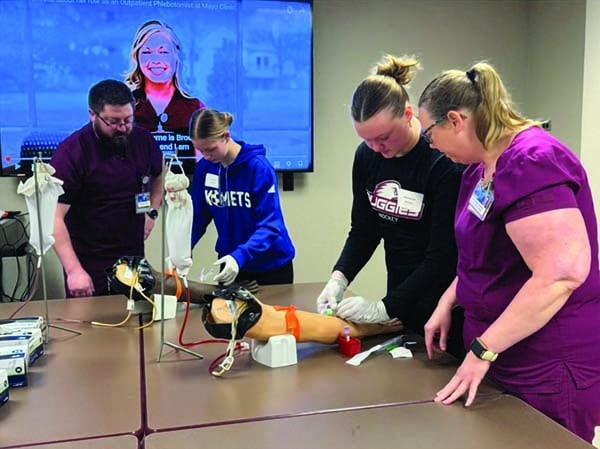
For those who want to pursue their interest in phlebotomy, Mayo just launched its Fast Forward to Work High School Phlebotomy Program. For this program, the School of Health Sciences is working with the local education department to bus in students from local high schools. “They’re earning high school elective credits while they’re also earning their phlebotomy certification, potentially leading to employment right after high school,” Michelfelder says.
Mayo offers various versions of this program. One is general; its focus is a variety of career options, from ambulance work to nursing to radiology. “We also offer a nursing-specific option where students rotate through various levels of nursing, and now we have the lab option as well,” she says.
Says Witty: “Getting out there and being present in middle schools and high schools is the first and most important step. Young people can’t think about doing these types of careers if they don’t hear about them in any real or meaningful way. And hands-on activities to reinforce their understanding is what makes this program so successful.” Witty herself heard about laboratory medicine when she was in college “and accidentally came across it.”
“Investing in young people matters,” she says. “Exposing them to options for careers is invaluable for them to be able to make decisions about the rest of their lives.”
When the Department of Laboratory Medicine and Pathology offered its first Saturday explorers program, it was open to middle school and high school students. And based on feedback and analysis, Michelfelder says, they decided to open the second program this year to high school students only. “We’re still interested in serving middle school students,” she says, but with a different approach.
“The group is looking at other ways we can bring similar but a little different developmentally specific experiences to those middle school students.”
Valerie Neff Newitt is a writer in Audubon, Pa.