


Karen Titus
December 2020—For opera lovers, few rituals are as satisfying as settling into one’s seat shortly before the performance begins. The mainstage curtain rises, signaling audience members to cough their last coughs. The lights dim, as do countless iPhone screens. The conductor makes a quiet entrance, almost unnoticed, at the back of the pit, then wends his way to the podium. A brief understanding passes between him and the orchestra, giving way to silence and stillness. Then he raises his arms, and, baton poised, pauses momentarily, before plummeting into the first notes of the overture.
If one is lucky, the delicious notes of Puccini might rise up, or a stern but stirring theme from Wagner. Or maybe something by Handel—less immediately recognizable, perhaps, but promising something gorgeous and thrilling.
But no one is lucky in a pandemic. Even if an opera fan could make it to the Met, the phantom season would feel ruined, a nonstop calendar filled with “Wozzeck” and “The Nose,” when one yearns only to frolic with Figaro again.
Laboratories are experiencing their own wrecked season—several of them, actually—as SARS-CoV-2 continues to test their patience. PCR molecular testing remains the war horse, but spread across multiple, spottily supplied platforms. And so they’ve moved to the lesser-known works, so to speak, including pooling and saliva.
It works. But it’s not the season anyone wants.
As with Berg and Shostakovich, these tests can be demanding.
In Colorado, Joan Coleman, MBA, MT(ASCP), and her UCHealth colleagues launched an expansive pooled testing program this summer that, after much work, worked well—until it didn’t, thanks to rising positivity rates in October.
Like the rest of the country, the lab was struggling to bring up any sort of SARS-CoV-2 PCR testing in March, says Coleman, director, clinical laboratory, University of Colorado Hospital, Aurora. They went live with the Roche Cobas 6800 on March 22. By the middle of May, the lab was running five platforms: Roche; Cepheid; BioFire; a Thermo Fisher KingFisher test done as a joint venture with two CLIA-certified research laboratories across campus (her lab did the extractions and created 96-well plates; these were then walked over to the labs, which performed the amplification and detection); and an in-house LDT for nontraditional specimens, such as bronchoalveolar lavages.
About the same time her lab ran out of swabs, Roche cut their allocation for SARS-CoV-2 testing in half, from 900 to 450 samples a day. With backlogs stretching endlessly, Coleman looked to the research labs for help. Though they were intended to serve only as a backup in case the Roche Cobas went down, she says, “All of a sudden they flipped into being our primary testing method.”
As Coleman and colleagues soldiered on with their Roche allotment and ramped up the Thermo Fisher—to the point where they were extracting 15 plates a day—they nevertheless fell behind. “By the end of the week, we’d be backlogged 700 specimens,” Coleman recalls.
Second of two parts. Last month: Making peace with saliva, pooled testing
Pressure was mounting on her lab, with “terrible” TATs, says Coleman, matched by pressure on the research labs to return to their primary mission. Coleman says she and her medical director, Ed Ashwood, MD, were trying to figure out, How do we dig ourselves out of this hole?
Dr. Ashwood suggested pooling, “But everybody was so busy, it just didn’t happen,” Coleman says. By July, however, the situation had become untenable. They were ready to take the plunge.
The initial experiments (Dr. Ashwood, she says, “is the brainpower; I’m the med tech who can do the work”) were encouraging. Additional studies, done throughout July, helped determine the proper number of constituents for the pool (N = 5) and prepared the lab to submit to the FDA for EUA. (The FDA has subsequently published a table suggesting the appropriate pool size given a laboratory’s positivity rate.)
Coleman began training the night shift, and pooling began at the start of August. It’s staffed by the core lab—another example of the seismic shifts that have been occurring in labs since March. “We’ve got people who would never have set foot in the molecular lab—they normally would be doing chemistry, hematology, urinalysis, blood gas, et cetera.” With the addition of this and other staff, the previously small molecular department “is bursting at the seams,” Coleman says.
The key to successful pooling has been managing the data in the computer system, Coleman says.
Her lab uses Epic Beaker, and Epic has a solution for pooling but not one suitable for UCHealth’s partnership with the research labs. When she and Dr. Ashwood decided they needed to begin pooling, they asked their LIS colleagues for help. Their response, says Coleman, was, We’re going to have to invent that wheel ourselves. “So they did.”
She credits Katie Hess, a UCHealth Beaker analyst who built the application for the lab. Hess’ work was impressive, Coleman says, noting that in her talks with a consortium of large, well-resourced institutions several weeks before Colorado went live with pooling, no one else indicated they were considering it, in large part because of the IT challenges. “And here’s Katie, crunching away—she figured it out.”
Here’s how it works at Colorado: Samples from five 200-mL specimens are pooled in one test tube, which becomes pool No. 1 and moves through the testing process. If the result is negative, all results are noted as such in the LIS, “and off they go to the patients’ charts,” Coleman says. A positive pool means at least one of the five samples is positive, of course, so the refrigerated native samples are retested individually.
Managing results within the LIS is hugely complicated, Coleman says, and the difficulties likely remain one of the reasons pooling hasn’t become more widespread.
The LIS is only one hurdle. Pooling is also labor-intensive, she says. A 92- or 94-well plate (depending on QC needs) takes about nine hours of intensive work, which explains her ongoing reliance on core lab personnel as well as others working overtime. The lab was pooling two to three plates daily as of mid-October. “We’re really, really busy,” she says. Without her large staff—about 220—“I wouldn’t be able to make these pools.”
Pooling addresses some supply chain issues but not all. Like nearly everyone else, Coleman is dealing with plastics back orders. “It takes a lot of pipettes to make a pool,” she says.
That fits into the larger picture of managing all testing to conserve supplies. When a clinician orders a SARS-CoV-2 test at UCHealth, the background algorithm will assign that test to a particular platform: Patients in the ED, for example, will be assigned to the Cepheid, while patients with less critical TATs will be sent to the Roche or Thermo Fisher. Daily calls about inventory help Coleman and her colleagues load balance supplies, including setting up their own allocations to other labs. “It’s innovative in a reverse way, which we don’t like, but it’s necessary to protect the inventory and take the best care of our patients.”
In large part, pooling has helped with allocation restrictions. By mid-October, the lab had pooled about 45,000 specimens. Without pooling, she says, “we would either be so far backlogged that the test result was useless, or we would have eroded our other allocations with the other vendors significantly.” The ordering algorithm ensures each vendor’s allocation is used. “With Roche, we’re allocated to do six runs a day. We absolutely make sure that we do those six.” It’s not a matter of stockpiling supplies, she says; rather, the lab needs the functionality that every instrument offers within the algorithm.
When they first began pooling, a 92-well plate would typically have five positive wells. They soon refined their approach, limiting pooling to specimens from collection sites with low prevalence rates. Sites were classified as green (optimal for pooling), yellow (OK for pooling but not preferable), and red (ineligible), based on a weekly review of data. Various hot spots frequently flip into the red zone. Occasionally a small town with a long history of low prevalence will suddenly turn red.
Pooling has also put the lab in fresh touch with patients, who, based on coverage they’ve seen in the lay media, will call the lab because they don’t trust their pooled result. She attributes this to media coverage of pooled testing, and likely other types of testing as well, including an infamous press conference from the White House Rose Garden.
Having managed to pull off pooling successfully, Coleman and her colleagues are now stepping away, albeit sooner than they planned.
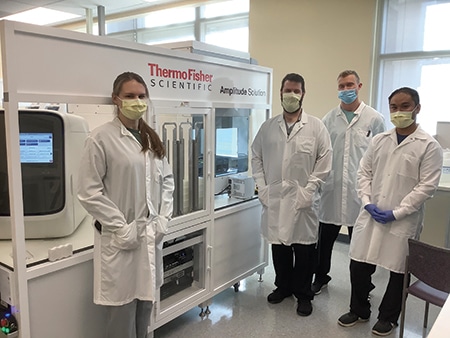
Hoping to quit the Cirque du Supplies once and for all, UCHealth leadership purchased Thermo Fisher’s robotic platform Amplitude. Since the normal routine of trade show viewings, vendor courtships, and site visits has been disrupted by the pandemic, Coleman’s lab bought it sight unseen. She got her first look when it was delivered, on Oct. 16, via two semis. “I took pictures,” she admits.
The platform can process 6,000 SARS-CoV-2 specimens a day, tripling the number of pooled specimens being done. And with that, the need for pooling should disappear. “Now, that doesn’t mean we won’t keep pooling in our back pocket,” she says. “If the demand goes up and we need to run 10,000 tests a day, heaven forbid, we could revert to pooling.”
“Our adventure into pooling,” as she calls it, appears relatively short-lived, though without leadership’s purchase of the Amplitude, “we would probably be continuing to pool indefinitely. Forever and forever.”
That was her thinking in mid-October, anyway, when she first spoke with CAP TODAY. By the first week in November, Coleman noted in a follow-up interview, positivity rates had risen to 15 percent in under two weeks, making the lab’s pooling strategy no longer viable. The lab first tried moving through a progression of smaller pool sizes. “And now there are no people in the pool. It’s just individuals being tested.”
As pooling came to an abrupt halt, testing capacity decreased, even as demand for it rose along with positivity rates. “We find ourselves in a bad situation—we’re falling behind again,” Coleman says. “It just looks so dismal, when you look at the wave that’s coming up. And it’s not going to get any better.”
And so, as they raced to put the Amplitude online, she and her colleagues have had to reconfigure their operations yet again.
The pre-op and pre-procedure specimens, which had previously been run individually on the Roche, are, in an about-face, being pooled (N = 5) and run on the Thermo Fisher KingFisher, since positivity rates for this population have remained low. If a pool does test positive, samples are returned to the Roche for individual testing. This enables the lab to return results within three days, though it’s usually less. Apart from these pools, the KingFisher is back to running individual specimens.
The lab had hired a dedicated workforce for pooling; their training was completed at the end of October. “They can pool independently,” Coleman says. “Of course, now they don’t need to,” apart from the small number of specialized pools.
Their skills are now being deployed elsewhere, including pre- and postanalytical work, such as transferring specimens from the initial tube into a secondary tube. “Every single specimen that goes onto the Roche requires a tap-off,” she says. So great is the workload that even she pitches in from time to time. She says it takes her almost 30 minutes to complete a rack of 20 tap-offs. “Others are faster, of course, but it’s still hugely time-consuming.”
They’ll be doing similar work with the Amplitude, which, it turns out, has a few surprises of its own.
The platform was set up within a week of its delivery, followed by IT work and water runs. Staff training was underway the first week in November. “We’re on a roll,” Coleman says. Validation and verification studies were set for the following week, along with “getting our IT battened down.” (They went live Nov. 16.)
Like the Roche, the Amplitude requires tap-offs. Coleman calls this “a rather unpleasant surprise, but we’re dealing with it.” And while the Amplitude promises a steady supply chain for running its tests, other steps in the process mean the lab still has to hunt down supplies. Doubling or tripling capacity means double or triple the tap-offs, which has sent the lab in search of tubes and matching lids. Even though the Amplitude is touted as all-inclusive, like a resort in Baja, “We still have to buy the ingredients they don’t provide.” Coleman likens it to a cake mix, where “everything is in the box except for the eggs and the oil.”
The biggest appeal of the Amplitude, Coleman says, is the company’s promise of an uninterrupted supply chain. The lab committed to purchasing half a million tests from Thermo Fisher, she says. In essence, it’s a palletized, everything-you-need kit: reagents, controls, standards, all the plastics (including those sought-after pipette tips), deep-well plates, and even ethanol for cleaning, as well as detergents for surfactants and film for sealing plates. Think of it as a highly sophisticated Costco run for labs. Every two weeks, a standing order will deliver supplies for another pallet of 40,000 tests.
As with everything else COVID-19, “It’s a whole different way of operating for us,” Coleman says. “We’re used to ordering 50 different line items to make a test work.”
Despite the early snags, Coleman welcomes the idea of lifting considerable supply chain stress off the lab’s shoulders. “If we can eliminate some of that struggle that we’ve been under since March, it will be a game-changer for us, mentally. We may have other things to worry about, but we’re not going to have to worry about that anymore.”
So on the eve of launching the Amplitude, Coleman said she was pleased to have this option. “I may have been a little ambivalent at first,” she says. If the need for SARS-CoV-2 testing diminished, would the device turn into a hugely expensive paperweight? She doesn’t rule out that possibility. But in the near term—especially with positivity rates rising—it looks like a smart move, one that could provide much-needed testing not only for patients in the UCHealth system, but throughout the state and region.
Without it, she says, “We cannot keep up using only our current platforms. We’re robbing Peter to pay Paul.”
Samuel Caughron, MD, also recalls his early days as a skeptic, though his concerns were focused on saliva testing.
Dr. Caughron, president, CEO, and director of the molecular pathology laboratory at MAWD Pathology Group, Lenexa, Kan., understood the appeal of saliva. The lab supports a number of hospitals primarily for cancer testing. When the pandemic hit, it soon became clear to him that hospitals were struggling to get SARS-CoV-2 results quickly. He also saw the waste of precious PPE.
Wanting to make things easier for their clients, in late spring the lab started considering saliva. Two questions needed to be answered, says Dr. Caughron, who is also chair of pathology for Advent Health Kansas City.
First, could the assay detect SARS-CoV-2 RNA in a saliva or sputum saliva sample? The lab has a robust platform, Dr. Caughron says, so “we were feeling confident.” Indeed, they were able to validate detection in samples fairly quickly.
The next question was, how well does saliva perform to answer the clinical question of whether the patient has COVID-19?
“That’s a much more challenging question to answer,” Dr. Caughron says. “It is essentially the question of clinical validation and could take a lot more effort.”
They began with a literature search to see what existing evidence supported. “It was fascinating—there’s a decent amount of literature on the use of oral secretory samples for respiratory viral pathogen testing,” Dr. Caughron says, all of it encouraging. And when the FDA indicated saliva was an acceptable sample, that was the final endorsement.
Dr. Caughron continued with efforts to bring it onboard. That included tracking down an adapter that would direct samples into their existing collection tubes. “It was hard to find. And we are a little worried about supply chain,” he says.
Yet he still was not entirely convinced of saliva’s viability.
Then one day he had an epiphany. “It dawned on me: The world was worried about how long SARS-CoV-2 exists on surfaces and in the air. And we in the lab were the only ones worried about how quickly it disappeared. I realized, if we believe it can be on a counter and it can live there a week, why am I worried about it in these samples?” Validation studies confirmed the viability and stability of the sample type, he says.
The other reassuring thought (from the lab’s perspective, anyway) was that the virus would, naturally, be present in samples because that’s how it spreads. “It’s not just from deep respiratory samples—it has to be in the oral cavity as well.”
He’s now done an about-face of his own, speculating that saliva samples may be one of the best samples to use. If the virus is still present in a saliva sample of someone known to be positive, he says, “that certainly suggests there’s a level of virus present” capable of spreading infection. And while some studies suggest saliva samples don’t offer the same sensitivity compared with those collected by swabs, concerns have also been raised that PCR tests might be too sensitive, Dr. Caughron says. Like many labs, in fact, they have seen patients who remain positive by PCR for weeks after recovering from infection.
Looking into saliva testing has opened up his mind in other ways as well. “I think we in the lab sometimes lose sight of the bigger picture,” he says, though the focus on laboratory details will always remain critical. “But it’s always important to back up and say, What am I doing with my test? How am I trying to help care for this patient? When you take off the lab coat, if you will, you can see the larger process.” A small loss in sensitivity may be worth the tradeoff for safer, more available collection of high-quality samples.
The transformation is complete. “I have become a believer that saliva does very well,” he says.
His own journey is being matched, albeit more slowly, by his patient-facing physician colleagues. MAWD offers saliva testing, though it did not represent a large percentage of its testing when he spoke with CAP TODAY in early October. “Some of it is, but not all of it by any stretch. It mostly depends on the comfort level of the physician overseeing the process.”
Their comfort level is variable, he says. Some have embraced it; others are working through their skepticism. “I don’t blame them.”
“It’s been interesting to watch my clinical colleagues and the attitudes they bring” to SARS-CoV-2 testing, he adds. “You have all sorts of armchair clinical pathologists, who have just a little bit of understanding of clinical pathology and use that to form opinions.” The question of saliva testing gives labs an unexpected opening to educate their colleagues about the differences between analytical and clinical utility of a test.
He echoes other pathologists in this regard. With the pandemic illuminating the lab’s role in unprecedented ways, saliva can be a useful test—and more. “We shouldn’t miss this opportunity to highlight the full picture of lab testing.”
Coleman sounds a similar note when she talks about pooled testing. While its role was shrinking drastically at her lab, the need for pooling will doubtless persist, if not at UCHealth, then for others still twisting themselves into pretzels to remain outfitted and stay ahead of testing backlogs.
Pooling’s utility, in other words, has never been in doubt for her; it’s merely being replaced, by “a big robot,” as she calls it. Furthermore, if pooling gets a boost from the federal government and its assurance of normal payment rates, it could be an even more attractive option. “It is risky, if you’re doing all this work, and no one’s going to pay for it,” Coleman says.
Risks aside, alternative testing methods remain onstage as winter approaches. In the ever-present past that is the pandemic, SARS-CoV-2 seems to be sticking around much longer than anyone thought, and not just on surfaces.
Coleman pauses to consider the year. “I think back to what I knew about COVID on March 1. I would have said, I’m hearing about that on the news. I wonder if I need to worry about that. I’ve come a long way.”
The path ahead also looks long. With the fall surge well underway, even labs with success stories find themselves making a Tosca-like leap into the next unknown.
Karen Titus is CAP TODAY contributing editor and co-managing editor. Part one, “Making peace with saliva, pooled testing,” is in the November issue.