

Editors: Raymond D. Aller, MD & Dennis Winsten
Coordinators key to new digital pathology program
February 2025—When NYU Langone Health began focusing on digital pathology last year, it also began focusing on people—those it would need to keep such a program humming along.
“When we were setting up this operation, it was pretty obvious to me that I wanted to have a dedicated team of people that are going to focus just on digital pathology,” says Rui Soares, anatomic pathology operations director at NYU Langone, a multisite system with approximately 80 pathologists at four hospitals. It would be “unfair,” he adds, to expect laboratory assistants to learn and perform such specialized tasks while performing other duties.
Second of two parts.
Part one in January issue.
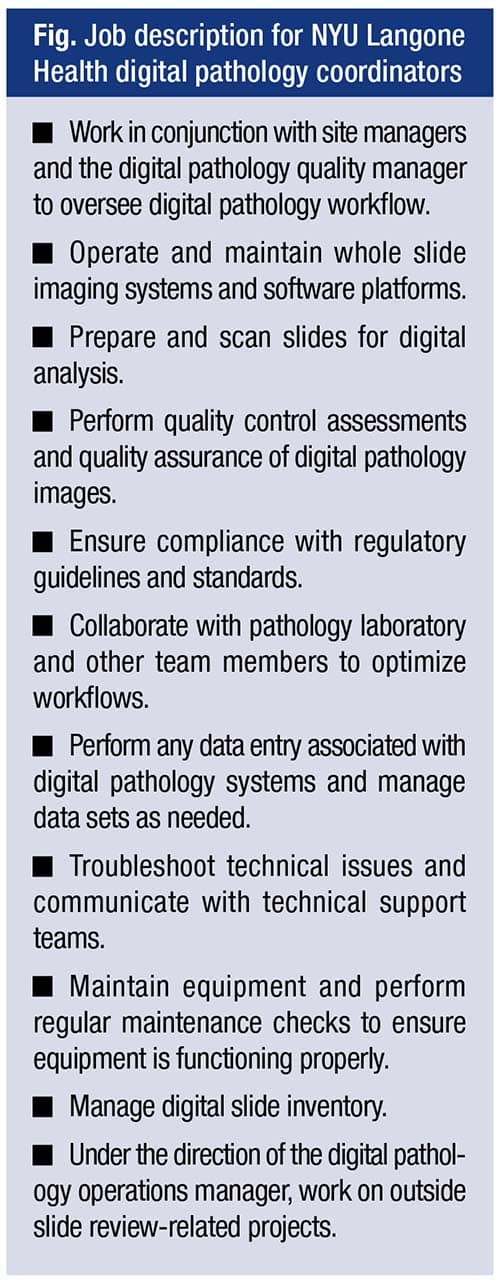
After getting approval to hire a staff assigned the title of digital pathology coordinators, Soares collaborated with Philips, its digital pathology system vendor; NYU Langone’s senior director of laboratory operations; and its human resources recruiters to create a job description (Figure).
The digital pathology coordinators are required to have, among other qualifications, a bachelor’s degree in biology, chemistry, or physical sciences; working knowledge of process-improvement methodology; strong communication skills; proficiency in Microsoft Excel; and project presentation skills. The preferred qualifications include a master’s degree; experience working in anatomic pathology; and attainment of CPHQ (Certified Professional in Healthcare Quality), CPPS (Certified Professional in Patient Safety), and Lean Six Sigma certification.
“We put together a set of requirements we thought would get us the best candidates for this position,” says Soares. “We wanted to get individuals who came in with a background that would allow us to train them more easily and retain them more easily and at a higher pay rate than if we had a lower educational requirement.”
By mid-January, NYU Langone had onboarded 18 coordinators and was in the process of adding two more. It has a budget for approximately 23 coordinators.
It’s the job of Sau Wong, digital pathology operations manager for NYU Langone, to interview the digital pathology coordinator applicants who pass human resources screening, oversee training of the new hires, coordinate staffing of their shifts, and oversee digital pathology system troubleshooting.
“We want three shifts—we want everything that comes out of the lab at night scanned before the pathologists get there in the morning,” says Joan F. Cangiarella, MD, explaining why the institution is hiring so many coordinators. “Decreased time to diagnosis is one of the goals of going digital.” Dr. Cangiarella is vice chair of clinical operations, Department of Pathology, NYU Grossman School of Medicine.
NYU Langone initially posted the coordinators position internally, as it does for all jobs, filling a few slots with internal candidates before seeking applicants from outside the institution.
“Typically, a new hire takes about two to three weeks to really get acclimated and understand the workflow and know how to use the system well,” Wong says. The local Philips representative, who works onsite at NYU Langone, conducts individualized training on how to prepare slides for scanning, load them into the scanner, and maintain and troubleshoot the scanners and Philips’ image-management system. An NYU employee who serves as the Epic Beaker trainer then trains employees on the digital pathology and various backend aspects of the institution’s Epic Beaker EHR. “After that, there’s training in the scanning room on the whole scanning process,” Soares adds.
Training of the pathology coordinators is very hands on, and newer employees spend a lot of time shadowing those who are already proficient at digital pathology. “They learn an element of what we do in the scanning room and then they start working in that area, whether it’s slide loading, prepping, ‘QC-ing,’” Soares explains. “Once they’re comfortable working in that area, then they get exposed to other areas.
“It’s actually a very complicated training process where folks have to learn how to use the hardware, they have to learn the basics of the IMS system, and they have to learn Beaker and how Beaker interfaces with the IMS system,” Soares continues. “Then it’s learning on the bench—learning the actual workflow of how slides flow out of the lab, how they get into the lab, how we load them onto the scanner, and how we move them out of the scanning room.”
NYU Langone’s Tisch Hospital, the institution’s main campus, implemented digital pathology in October, and, within a month, it was processing about 1,000 slides a day on its Philips SG300 scanners.
Digital pathology was set to go live at NYU Langone Hospital–Long Island by CAP TODAY press time. (The hospitals process histology for all NYU Langone sites.) As the digital pathology program ramps up to full capacity, glass slides continue to be available to pathologists.
“As with anything new, there have been some hiccups,” Wong says, citing the need for thorough training. “It’s high-capacity, high-precision machinery, so careful maintenance and troubleshooting training is needed.” If, for example, “there’s slide breakage because we didn’t perform a proper QC ahead of time and we load a slide that has a cover slip that’s a little bit offset, it can cause issues with the machine.”
Soares concurs. “It’s two very large software systems that are tied together with a two-way interface—there’s middleware software, there’s hardware, and there can be network connectivity issues,” he explains.
For reasons such as these, and because Wong can’t be everywhere at once, NYU Langone is establishing lead positions for the more tech-savvy coordinators. The intent is for the lead coordinators to be “the go-to people to deal with more complicated troubleshooting and problem resolution,” Soares says. As those positions are filled from the pool of existing coordinators, NYU Langone will fill the positions that are vacated.
“There are a lot of things happening at the same time,” Wong acknowledges. But “the doctors are excited, and my team is excited about being some of the first to do digital pathology.”
—Faith Reidenbach
Leica invests in Indica Labs to enhance digital path offerings
Digital and anatomic pathology solutions provider Leica Biosystems has announced that it is investing in Indica Labs, in part to create a diagnostic digital pathology platform that pairs Leica’s Aperio scanner portfolio with a customized version of Indica’s Halo AP image-management software.
The new platform will provide a full suite of enterprise-grade digital pathology workflow functionality that supports onsite and remote primary diagnosis. It will also offer customers the ability to integrate AI applications of their choice through application programming interfaces. The product will be available exclusively from Leica.
The companies also plan to open an AI applications marketplace, offering their applications and those of third parties. And Leica expects to integrate Indica into its companion diagnostics assay development program, allowing the companies to work together on next-generation AI-enabled versions of such assays.
Halo AP is CE-IVDR marked for in vitro diagnostic use in the European Union, United Kingdom, and Switzerland. It is available for research use only in the United States.
Leica Biosystems, 844-534-2262
Mayo Clinic launches digital pathology platform
Mayo Clinic has formed Mayo Clinic Digital Pathology to tap into the wealth of information generated by its archive of digital slides.
Pathology practices that use analog processes are not taking advantage of data that could be used to expand diagnostics and treatments and speed the creation of new therapies, according to a press statement from Mayo.
As of January, the institution’s digital pathology platform housed 20 million whole slide images linked to 10 million patient records that incorporate information pertaining to such areas as treatments, medications, imaging, clinical notes, and genomic data.
Mayo is using its large, diverse data sets to build artificial intelligence models for pathology using Nvidia’s Nvidia Clara health care-specific full stack computing architecture.
Erratum
In “Healthbit launches lab system for molecular diagnostics” (Newsbytes, December 2024; www.captodayonline.com), an incorrect link was provided for Healthbit. The correct link is www.healthbit.ai.
Dr. Aller practices clinical informatics in Southern California. He can be reached at rayaller@gmail.com. Dennis Winsten is founder of Dennis Winsten & Associates, Healthcare Systems Consultants. He can be reached at dennis.winsten@gmail.com.