


Editors: Raymond D. Aller, MD & Dennis Winsten
A health system’s user-based strategy for selecting an IMS
August 2026—Pathologists and other cross-departmental staff at Beth Israel Lahey Health, in Boston, recently used an “all for one and one for all” approach to decision-making in evaluating image-management systems for purchase.

Over the past year, Monika Vyas, MD, director of digital pathology at Beth Israel Deaconess Medical Center (part of Beth Israel Lahey Health), led a team that assessed various IMS platforms to identify the one that would best meet the laboratory’s needs as it transitions to digital pathology for primary diagnosis. And rather than relying solely on technical specifications to make this decision, the health system incorporated end-user experience via vendors’ software sandboxes and Likert scale ratings from the team.
“Pathologists will interact with image-management systems daily, for hours at a stretch, and even small differences in navigation, workflows, and overall design can significantly impact their efficiency and satisfaction,” so pathologist input was critical, Dr. Vyas says.
To create a selection team with an array of knowledge, Dr. Vyas convened 16 Beth Israel Lahey Health employees—11 junior and senior pathologists from various subspecialties and five administrative/technical staff, including a digital pathology coordinator, histology and gross room managers, and information technology experts—to assess nine IMS over nine months. The team comprised pathologists from various Beth Israel Lahey Health sites to ensure the needs of the broader institution would be met. The health system plans to implement the IMS in eight sites initially.
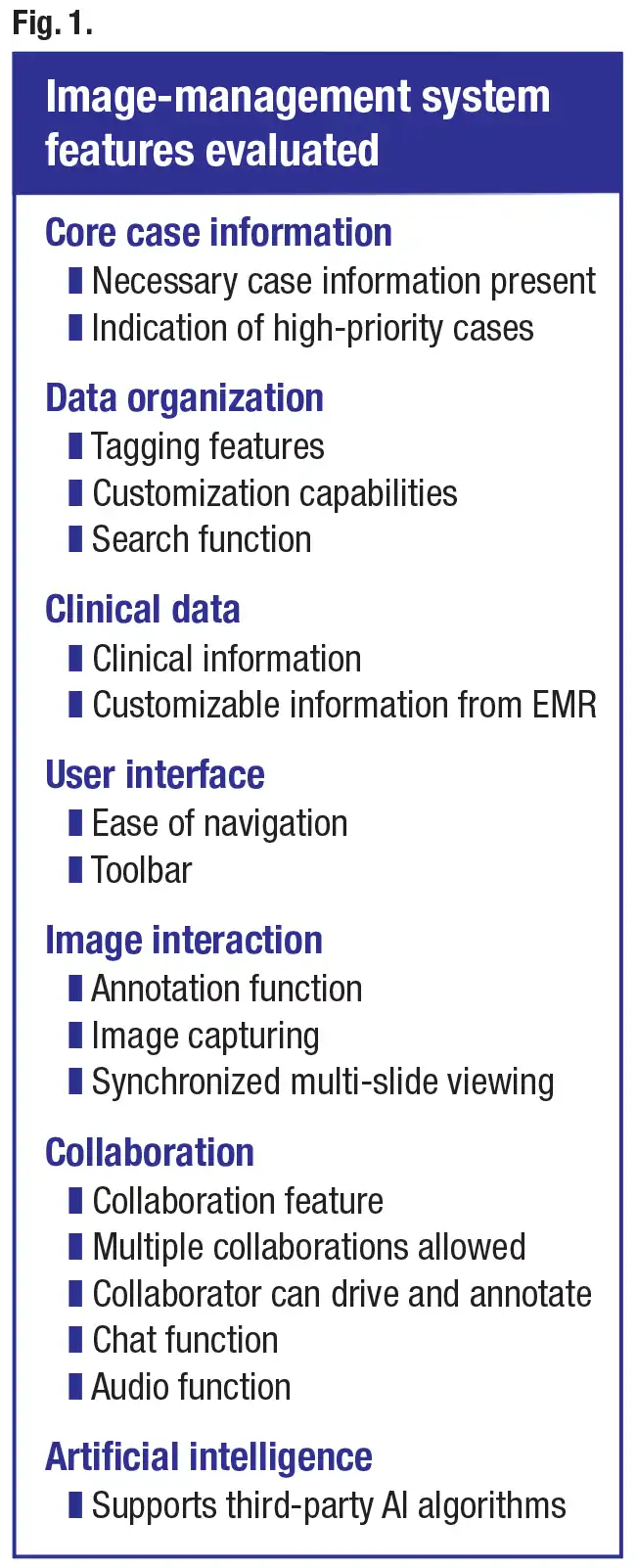
Dr. Vyas and administrative staff in the pathology department at Beth Israel Deaconess Medical Center wrote a preliminary checklist of features they needed in an IMS, which was based on typical tasks performed by pathologists. Working group members then contributed features they believed should also be evaluated as part of the selection process. Among them were collaboration tools, such as chat and audio functionality, and customizable slide tagging. The final list of features was approved by the working group (Fig. 1).
The team used a Likert scale to evaluate the desirable and necessary IMS features after employing candidate systems in sandbox environments. The features, broken down into categories, were scored zero to five, with zero indicating a feature that could not be assessed, one indicating “strongly disagree,” and five indicating “strongly agree.”
“Ultimately, at the end of nine months, you’re not going to remember every feature,” says Dr. Vyas, “so having a number placed on them was very useful for comparison at the end.”
Having pathologists assess their workflows by using systems in vendors’ sandbox environments was instrumental to the evaluation process, Dr. Vyas stresses. For example, she says, “Am I able to customize my worklist? Am I able to flag cases, tag cases, and filter cases based on priority? Can I bring rush or stat high-priority cases to the top of the worklist? How pathologists would manage their workflow and how it can be customized is what we focused on using these sandboxes.”

The team intentionally kept the checklist “fairly broad” so pathologists could easily evaluate features one by one in the sandbox, says Quinn Rainer, MD, a third-year anatomic and clinical pathology resident at Beth Israel Deaconess Medical Center, who helped finalize the evaluation project. Dr. Rainer gave a platform presentation on the IMS selection process at the 2026 United States and Canadian Academy of Pathology meeting last spring.
At the end of sandbox testing with a vendor, the whole group would meet to discuss the findings. (Questions related to cybersecurity or IT issues were addressed separately as the project advanced.)
“We would walk through the entire workflow together and answer the questionnaire together in a consensus-based way so everyone was in agreement as to how we were scoring,” explains Dr. Vyas. “People [could] voice their opinions and discuss things they may not think of when evaluating something by themselves. We did a lot of these group sessions—talking and walking through the workflow.”
Finally, the pathologist team members evaluated the overall performance of each system on a scale of zero to 10, based on the ranking of individual features and the group discussions.
Through this process, the team whittled down the field to three finalists. Each of the three was then re-evaluated using upgraded sandboxes and vendor demonstrations.
“These upgraded sandboxes [included] features that were not available in the initial version, such as advanced collaboration tools, slide sharing, et cetera,” says Dr. Vyas. This stage of evaluation also focused on assessing how responsive vendors were to feedback and if they were able to make adjustments to their platforms. “Some vendors were more proactive in incorporating suggestions from pathology faculty than others,” Dr. Vyas notes.
“The final platform selection was made through group consensus, taking into account major factors,” adds Dr. Rainer, “including user experience, workflow requirements, technical and IT compatibility, including interoperability with both scanners and AI tools, and vendor engagement, including responsiveness and willingness to work with institutional needs.”
The selected IMS was one of the top-ranked platforms and the strongest when taking all factors into consideration, says Dr. Rainer. “This highlights the importance of a dynamic review process rather than a static one-time evaluation.”
Beth Israel Lahey Health expects to launch its new IMS in November, but work remains to be done in the meantime. “We are recruiting a group of pathologists and staff who will be trained early and provide testing, troubleshooting, and support when we go live,” explains Dr. Vyas. “We are customizing the IMS to our preferred institutional interfaces and lab information system, determining our best workflow—simulating the work and seeing how the system functions on a day-to-day basis. We will also be installing firewalls and other security features, covering all bases for a successful launch.”
“Pathologists should be excited,” says Dr. Rainer, “as this system can fundamentally change how they work.”
—Brenda Lange
Linux Foundation initiative to advance open-source digital health innovation
The nonprofit Linux Foundation has launched the Open Health Stack Software Foundation, a vendor-neutral site featuring open-source software that developers can use to build artificial intelligence-enabled digital health applications.
The site organizes technical offerings into three pillars for engagement purposes: FHIR Foundations, which provides standards-based building blocks, including foundational libraries and software development kits, that make it easier to build using HL7 Fast Healthcare Interoperability Resources; OHS Player, a reference toolkit that shows how to assemble FHIR Foundations components into solutions that can be developed on Android, iOS, and Web platforms; and AI Commons, a neutral space for enabling safe, verifiable AI in global health via model-agnostic collaboration, codeveloped with the World Health Organization.
The new foundation will “build interoperable health applications, drive local innovation, and help close health equity gaps—particularly in resource-constrained areas,” according to a press release from the Linux Foundation.
Google, which launched the Open Health Stack suite of building blocks in 2023, transferred the project, including the code and underlying assets, to the Linux Foundation. Google is also providing a $3 million grant to drive long-term growth and implementation.
“We built Open Health Stack because we wanted to put the developers and community health care workers serving people on the edges of care back at the center of development and give them access to world-class tools for building next-gen digital health solutions,” said Kat Chou, vice president of Google Research, in the press release. “Contributing OHS to the Linux Foundation, with the support of WHO and a growing global community, ensures these building blocks will continue to evolve—now extending into AI for global digital health—under governance that reflects the diversity of the communities they serve.”
More than 20 organizations have expressed support for the site, including Anthropic, the Center for Global Digital Health Innovation at the Johns Hopkins Bloomberg School of Public Health, the Digital Initiatives Group at the University of Washington, Medtronic Labs, and Microsoft.
The new foundation is open for participation and membership. Project repositories are available at github.com/ohs-foundation.
LigoLab offers clients AI-powered OCR from MarginLogic Health AI
The laboratory information system and lab billing solutions provider LigoLab has entered an agreement with MarginLogic Health AI, a company specializing in artificial intelligence-powered optical character recognition, intelligent document processing, and workflow automation.
The partnership allows clinical and reference labs and pathology groups to integrate MarginLogic’s OCR technology with LigoLab’s all-in-one LIS and revenue cycle management platform, automating requisition processing and accessioning.
The OCR solution “uses artificial intelligence to capture, interpret, validate, and route data from requisitions, physician orders, insurance cards, patient demographics, and supporting documentation before automatically transmitting validated orders into the LigoLab platform,” according to a LigoLab press statement. The tool can recognize handwritten and printed requisitions, flag ambiguous fields for human review, and continuously improve through user feedback.
The LigoLab–MarginLogic integration complements existing laboratory interfaces. Electronic orders transmitted directly from provider EHRs continue to flow through established connections, while MarginLogic automates the processing of paper-based and nonintegrated requisitions that would otherwise require manual entry.
LigoLab, 800-544-6522
Tecan and Nvidia take next step in AI platform collaboration
Tecan, a global provider of laboratory automation solutions, has integrated Nvidia’s BioNeMo agentic artificial intelligence capabilities into its Introspect lab analytics platform.
The integration of BioNeMo is part of a collaboration between the two companies, announced last spring, that centers on providing AI-enabled platforms. “This agentic AI development demonstrates advancement of Tecan and Nvidia’s shared vision of enabling data-driven laboratories with AI-powered platforms designed to accelerate scientific discovery and improve laboratory productivity,” according to a press release from Switzerland-based Tecan.
Early access to the enhanced Introspect platform, with applications focused on the clinical laboratory, pharmaceutical, and biotechnology environments, is available.
Mayo Clinic implements Techcyte Fusion AP
Mayo Clinic has deployed Techcyte Fusion AP, a digital pathology solution developed by Techcyte with input from Mayo pathologists and other laboratorians under an intellectual property licensing agreement between the organizations.
“Through the agreement, Techcyte has licensed Mayo Clinic-developed intellectual property, enabling the organizations to further develop and broaden access to innovations originating from Mayo Clinic’s digital pathology program,” according to a press release from Techcyte.
Techcyte Fusion AP provides whole slide image viewing, case information, workflow tools, and artificial intelligence to support anatomic pathology.
The solution offers users at Mayo enterprise-wide access to millions of whole slide images. It is integrated with the organization’s EHR and laboratory information systems.
Techcyte Fusion AP is available for research use only in the United States.
Techcyte, 888-878-3249
India introduces terminology and codes for health data exchange
India’s Ministry of Health and Family Welfare has rolled out data standards to standardize and unify its digital health ecosystem.
The initiatives include deployment of the Bharat Health Terminology Service, developed by India’s National EHR Standards Resource Centre, which will provide standardized health care terminologies, coding systems, and value sets to support consistent interpretation and exchange of digital health data. The service is built on the Snowstorm open-source Fast Healthcare Interoperability Resources platform and provides comprehensive support for SNOMED CT, LOINC, ICD-10, and India-specific extensions.
The National EHR Standards Resource Centre also developed Common Lab Codes for India, a curated reference of commonly used laboratory tests and measurements mapped to LOINC, to support the standardized exchange of laboratory observations and clinical information across hospitals, labs, and digital health platforms.