

Anne Ford
August 2016—Poverty, unemployment, crime, dropout rates: In some categories, no community wants to be No. 1. And in some categories, no hospital wants to be No. 1 either. High on that list: hemolysis.
“Hemolysis is a big issue,” Michael Phelan, MD, said at the Executive War College meeting this spring. In fact, “it’s the leading cause of unsuitable specimens” at the Cleveland Clinic’s main campus, where Dr. Phelan is an emergency medicine physician.
As he discovered at the start of a CDC-funded project to study and reduce hemolysis at his hospital between 2014 and 2015, his emergency medicine department led all other departments in hemolysis rates. Over the course of one week, 18.5 percent of chem-lab tests in the ED were found to be moderately hemolyzed, compared with 2.3 percent for all other draws at the main campus. For grossly hemolyzed specimens, the ED’s rate was 4.3 percent compared with 0.8 percent for all other locations.
Happily, over the course of the project, Dr. Phelan and his colleagues succeeded in reducing the ED’s hemolysis rate from about 13 percent to the American Society for Clinical Pathology’s recommended rate of two percent.
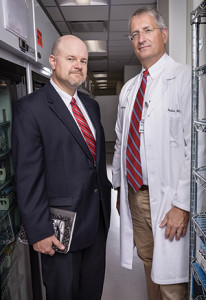
In a talk at the War College and in interviews with CAP TODAY, Dr. Phelan and colleague Ed Reineks, MD, PhD, explained how capturing blood collection methods and correlating them with hemolysis measures yielded dramatic improvement.
Serving as a sort of jumping-off point for the Cleveland Clinic’s project was a best practices systematic review and meta-analysis, “Effectiveness of practices to reduce blood sample hemolysis in EDs” (Heyer NJ, et al. Clin Biochem. 2012;45:1012–1032).
The authors of the 2012 paper found strong evidence that using straight needles rather than IV starts for venipuncture reduces hemolysis. They found similarly strong evidence that using antecubital sites as draw sites also reduces hemolysis. They examined, but found no evidence for the efficacy of, using syringes rather than vacuum tubes, using larger (≤21 gauge) needles, and using partial vacuum tubes. Finally, they said they found no studies of tourniquet time and hemolysis for the ED setting.
“We looked at the Heyer [publication], and we tried to replicate it in our ED,” said Dr. Phelan, who is also an associate professor at the Cleveland Clinic Lerner College of Medicine at Case Western Reserve University. That meant first trying to clear up an incorrect perception among the nurses and paramedics who draw the blood that it was the laboratory that was responsible for the hemolysis that might occur.
“I still get calls from people asking, ‘Why are you hemolyzing my specimens?’” said Dr. Reineks, medical director for automated chemistry at the Cleveland Clinic main campus and section head for point-of-care testing across the Cleveland Clinic Health System. “I think people, generally speaking, aren’t aware of the amount of data out there that implicates preanalytical errors as a major factor in the quality of laboratory results.”
Then, too, rumors floated that it might be the hospital’s pneumatic tubes causing the problem. “It’s not the pneumatic tubes, at least at our institution,” Dr. Phelan said. “We compared hand-carried samples to standard practice with the pneumatic tubes, and we had the exact same hemolysis rate.”
With those questions settled, Drs. Phelan and Reineks partnered with Annmarie Kovach—who was then the ED’s nurse manager and who is now assistant nursing director for the Cleveland Clinic’s Respiratory, Glickman Urological, and Head and Neck institutes—to uncover common blood-draw practices and to determine which of them might be contributing to hemolysis.
It became apparent quickly that inconsistency was rampant. “Of course, they made sure they followed standard precautions, cleaning the site and so forth,” Kovach tells CAP TODAY. “But tourniquet time, the order of draw, the tube size—there was a lot of disparity as far as things like those were concerned. I guess the biggest wakeup call for the frontline staff, and for myself as a longtime ER nurse, was to learn that there is something to be said for technique.”
The team soon discovered that in their ED, the use of a straight needle in the antecubital location was somewhat associated with reduced hemolysis. Therefore, “I said, ‘Why aren’t we just straight-sticking all these people?’” Dr. Phelan recalls. “That’s where my push was. Let’s straight-stick everyone,” rather than use a patient’s IV to collect a blood sample.
However, the frontline staff pushed back. “My nursing colleagues were not very keen on the idea of having to do two pokes on a patient,” he said. “There was a lot of resistance.”
And with good reason. The Cleveland Clinic sees many patients in whom it’s difficult to get an IV started or from whom it’s difficult to collect a blood sample. It would be ideal to avoid sticking those patients twice if possible. “Those are factors that make it really difficult to say we’re just going to straight-stick everyone,” Dr. Phelan said. So for now, the IV draw remains standard practice in the ED.
“In addition, we found that shorter tourniquet time and larger gauge among IV draws had a pretty significant reduction in hemolysis,” Dr. Phelan said. They found no association between syringe versus vacuum tubes for IV draws in regard to hemolysis measures.
The intervention that saw the biggest associated drop in hemolysis rates was the switch to smaller-volume collection tubes. The implementation of 2-mL lithium heparin plasma tubes reduced the ED’s hemolysis rate from about 12 percent to two percent. “Just implementing a small-volume tube significantly reduced our hemolysis,” Dr. Phelan said.
He hypothesized that because the reduced vacuum in the smaller tubes creates a reduced pressure gradient as the blood moves through the collection setup, there is less turbulent flow, resulting in less cellular damage and hemolysis. Regardless of the mechanism, he called switching to smaller tubes “a very simple fix,” one that other institutions should consider regardless of the other measures they’re able or not able to take.
The switch to smaller tubes did require adjustment on the laboratory side of things, said Dr. Reineks, who is the CLIA laboratory director for five ancillary, CAP-accredited laboratories in Cleveland Clinic’s Robert Tomsich Pathology and Laboratory Medicine Institute. “Obviously we had less blood and plasma to work with, so it was harder for the technologists to see how much blood was in the tube. The labels typically covered the portion of the tube where the blood was, and there were instances where we ended up loading tubes on the automated instruments that had very little specimen in them.
“That created some problems for us,” he added. “But the technologists learned how to try to better assess the contents of the tube, and we engaged the central processing area to try to have them look at the tube before they covered it with the Sunquest label.” The tubes would come from the ED with a patient label already affixed but then central processing staff would generate a Sunquest label that would make the tubes instrument-ready. “We asked them to check the tubes before putting that second label on them to see if there was enough blood in there. So we did have to modify our process a little bit.”
How did Dr. Phelan and Dr. Reineks go about figuring out which interventions were associated with drops in hemolysis? Before they could even begin doing that, Dr. Reineks had to transition the laboratory to new instruments.
At the time the CDC grant started, the automated chemistry lab was upgrading from two-generations-old Roche modular automated platforms to the Roche Cobas 8000 systems, Dr. Reineks said. “So one of the things we did was to compare the hemolysis index with the old platforms and the new platforms, because our hemolysis index and the other serum indices that we measure for quality purposes aren’t really considered a test, and so those might not be validated in the way you would validate potassium or albumin or something else.” They did a comparison of the previous instrumentation with the new instrumentation to make sure that the hemolysis index was comparable on the new platforms. “And then we could maintain our cutoffs for flagging specimens.”
“Labs define their own level of hemolysis,” he noted. “If we get a hemolysis index of 80, we add a comment to the result. If we get a hemolysis index above 300, we reject the sample and don’t give them a result; we call it grossly hemolyzed. But those settings are not something that’s uniform across the country. There are CLSI guidelines that will assist with making those determinations, but other directors can set up levels as they see fit. I know that with a hemolysis index of 300, it’s impossible to get a normal potassium on that sample, so I’m very comfortable with that cutoff as a rejection level.”
To improve the standardization, they took hemolyzed samples of various hemolysis indices and sent them to a reference lab for a measurement of the plasma hemoglobin content. “So I was now able to correlate a hemolysis index to a concentration of hemoglobin, and I think that will be useful. These were some fundamental good practices to put in place before relying on this as a quality indicator going forward.”
Also at about the time the grant started, the laboratory acquired a business intelligence system called Altosoft, which allows Dr. Reineks to download data from the Sunquest LIS, then reorganize it, search it, create dashboards, and export it to Excel, all without coding.
To obtain Sunquest data before Altosoft was available, Dr. Reineks had to “fill out a form with our informatics people, submit it, and have them write a search statement,” he said. “They would prioritize it, and anywhere from a day to two weeks later you could get some results. When we originally got Altosoft, it updated every six hours from the Sunquest system. Since then, they’ve refined it. We can look at some delays in ED specimens in real time.
“It’s really changed the way the laboratory can operate, at least from my perspective. Someone calls me with a question, and within a few minutes I can download the data, organize it, and address their issues.”
Having such excellent access to data has made it possible for the team to understand how hemolysis affects laboratory test turnaround time and patient length of stay. For example, it has become evident that discharge patients with a hemolyzed specimen have a 49-minute-longer visit, and admitted patients with a hemolyzed specimen have a 23-minute-longer visit. And by the team’s calculations, reducing hemolysis rates to two percent will save the hospital about $73,000. “And we’re a nine- or 10- or 12-hospital system,” Dr. Phelan said. “It keeps getting bigger every time I open the paper. But if you multiply that across a health system, say 10 hospitals with the potential to have the same hemolysis rate, the savings start building up a little bit.”
The number-crunching part of the project was not without its difficulties. “The biggest problem we addressed was the idea of how the nurses were actually drawing the blood. There was no nursing module that collected that data,” Dr. Phelan said. “From a research point of view, that was very difficult, because it was only free text. So we had to build a nursing module that easily collected the data with radio dials—you know, where they drew the blood, what kind of equipment they used—and it had to be easy for them to use. So using our nursing colleagues to help develop a nursing module that would help us identify how the labs were drawn was critical.”
During and after all of this analysis, Dr. Phelan, Dr. Reineks, and their team worked to educate nurses and medics about hemolysis. Dr. Phelan’s takeaway? “Working on preanalytical processes had far more impact than education alone,” he said. Still, education was important in getting the team geared up to talk about what hemolysis is and what the causes are. “There was some reduction with education, but [there was] a real significant reduction with the small-volume, small vacuum tubes.”
As for what the team would like to have done differently or would like to do in the future, Dr. Phelan said, “Getting data on our 12 EDs and what their hemolysis rates are, trying to get the message across about small tubes—that takes time and resources, which are in short supply.”
His focus now has been trying to get a National Quality Forum measure developed for trial use. “We submitted a trial use measure on ED hemolysis, and I’ve got to walk it through that process, because I think in order to make it impactful, it’s got to be more than coming from a single researcher on our main campus. It has to be something that everyone in the country follows. If there was a national quality metric endorsed by NQF on the topic of ED hemolysis, I think I’d get more traction than just trying to individually go to each of these hospitals to impact our practice.”
[hr]
Anne Ford is a writer in Evanston, Ill.