

In rare instances, NIPT finds mother’s cancer
BioFire submits de novo application for fourth panel
How patients want to get their skin biopsy results
FDA clears automated digital IFA microscope
Molecular group A strep direct test OK’d
i-Stat Total β-hCG test cleared
In rare instances, NIPT finds mother’s cancer
Sequenom Laboratories, providers of MaterniT21 Plus and other lab-developed noninvasive prenatal tests, is telling the public about a tiny proportion of cases in which its best-known test has revealed a genetic profile suggestive of cancer in the mother. The cases highlight the importance of ob-gyns working with laboratories to order follow-up testing as well as proper genetic counseling, Sequenom officials say.
Of the approximately 400,000 patient samples accessioned by Sequenom since the MaterniT21 test was launched in October 2011, 0.01 percent of the tests—40 cases—showed a genomic profile so anomalous that a nonreportable result was issued. In a joint statement to CAP TODAY, Sequenom executives Dirk van den Boom, PhD, and Daniel H. Farkas, PhD, HCLD, explain how the company’s CAP-accredited clinical laboratory has handled these unexpected findings. Dr. van den Boom is Sequenom’s executive vice president and chief scientific and strategy officer, while Dr. Farkas is the company’s vice president of clinical diagnostics.
“In each of these cases, one of our clinical laboratory directors called the ordering physician to discuss these nonreportable results in the contexts of pregnancy management,” Drs. van den Boom and Farkas say. “As part of the process, it became apparent that in many of these nonreportable cases, the patient was known to the referring physician to have a history of neoplasia at the time the test was ordered, or the patient was diagnosed with neoplasia as a result of additional testing triggered by the nonreportable NIPT.”
In about 10 cases the abnormal MaterniT21 Plus test result “led to primary diagnosis,” according to slides presented by Sequenom laboratory director Nilesh Dharajiya, MD, at the Future of Genomic Medicine Conference this spring. He added that a Sequenom research-and-development initiative is focused on analyzing 30,000-plus research-consented samples to better estimate the incidence of these unexpected findings. Nearly 30 percent of the neoplasms observed were cases of uterine leiomyoma, Dr. Dharajiya’s presentation said. Breast carcinoma accounted for another nine percent of cases. In 31 percent of cases, there were no clinical signs or symptoms and follow-up is ongoing, Dr. Dharajiya, Dr. Farkas, and their colleagues said in an abstract.
In his presentation Dr. Dharajiya explained that about 90 percent of DNA fragments in a pregnant woman’s blood sample come from the mother, and that is how the sequencing can reveal global genomic changes caused by cancer. Sequenom officials note, however, that cancer is not necessarily the culprit.
“Published work has shown that systemic lupus erythematosus could cause similar genome-wide anomalies, as can certain preanalytical issues with the specimen,” Drs. van den Boom and Farkas say. “As such, highly anomalous genomic profiles ‘suggestive’ of neoplasia can in fact have multiple causes, with widely varying clinical implications.”
This reality makes it vital that ordering physicians understand how to proceed with follow-up testing in these rare cases and explain the possibility of incidental findings to patients.
“It is important to recognize that screening tests, including NIPT, are not diagnostic and follow-up confirmatory studies are necessary for positive screening results,” Drs. van den Boom and Farkas tell CAP TODAY. “Further, NIPT could involve potential discovery of both fetal and maternal abnormalities, including those that may be of important, minor, or no clinical significance.
“Pre- and post-test information and genetic counseling should describe the risks and benefits of NIPT,” the Sequenom executives add. “This includes the scope of the disorders being tested, the detection rate, the false-positive rate, and the no-call rate. We also communicate the need to confirm positive test results through additional, invasive diagnostic testing.”
It is critical, they added, for clinicians to take the unexpected news in stride for patients’ sake.
“Health care professionals who receive nonreportable NIPT results should familiarize themselves with the various causes for such findings, with help of a laboratory director, and should use caution in their subsequent clinical management to avoid unnecessary patient anxiety,” Drs. van den Boom and Farkas say. “Based on the limited experience to date, it is important to remember that not all nonreportable cases are related to neoplasia, and not all instances of neoplasia are malignant.”
—Kevin B. O’Reilly
BioFire submits de novo application for fourth panel
BioFire, a BioMérieux molecular biology affiliate, has submitted a de novo classification request to the FDA for the FilmArray meningitis/encephalitis panel. The submission of the ME panel comes after the completion of a clinical study that included more than 1,500 prospective samples analyzed at 11 sites across the U.S., including a representative mix of pediatric and adult patients. The panel will be the fourth clinical diagnostic test to run on the FilmArray system.
How patients want to get their skin biopsy results
Two-thirds of patients say their first choice for learning about their skin biopsy results is to speak directly with their dermatologist on the phone, while just one in five patients wants a face-to-face meeting to get their results. A survey of 301 patients at UCSF, UPenn, and Duke clinics found that five percent want to get the biopsy news by voicemail, and another five percent prefer to view the results through a secure online portal (Choudhry A, et al. JAMA Dermatol. Epub ahead of print April 1, 2015. doi:10.1001/jamadermatol.2014.5634).
About 60 percent of patients say they want to get the news the same way regardless of whether the result is normal or abnormal. The other 40 percent of patients leaned toward talking on the phone about abnormal results, and for normal results they wanted to learn by voicemail, email, or secure online portal, the study said. College-educated patients and those between 18 and 35 years old were likelier to favor getting normal results electronically, but they were just as likely as other patients to prefer receiving abnormal results on the phone or in person.
“The results of our study are likely relevant to biopsies performed by other specialists,” the study’s authors conclude. “Patients are not often asked about their preference for test result notification. We recommend asking about patients’ notification preference by including this question on the biopsy consent form.”
FDA clears automated digital IFA microscope
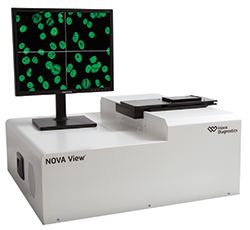
Inova Diagnostics announced the FDA has cleared Nova View, an automated digital indirect fluorescent assay microscope, through the de novo classification process. Nova View is the first FDA-cleared automated digital IFA microscope in the U.S. The Nova Lite DAPI ANA Kit, an IFA reagent indicated for use with Nova View, received 510(k) clearance at the same time.
Inova Diagnostics says Nova View addresses many shortcomings of the manual IFA process by reducing hands-on time, providing consistent reading and interpretation conditions, and generating digital images that can be archived. It provides patient sample traceability with positive patient identification and improves assay integrity by using Nova Lite barcoded IFA slides.
Molecular group A strep direct test OK’d
Focus Diagnostics, the clinical-laboratory products business of Quest Diagnostics, recently announced FDA 510(k) clearance and CLIA moderate-complexity categorization for its Simplexa Group A Strep Direct Kit that detects the strep bacteria directly from throat swabs.
Simplexa tests, designed for use on the 3M Integrated Cycler, employ real-time PCR technology to detect DNA or RNA in viruses, bacteria, and other analytes. Using a proprietary chemistry technique that eliminates the nucleic acid extraction process, Simplexa tests can produce results in one hour.
The test was CE marked for distribution in the European Union in February. The test kit is available directly in the U.S. and internationally through the global distribution network of Focus Diagnostics.
i-Stat Total β-hCG test cleared
Abbott’s i-Stat Total β-hCG test has received FDA clearance. It can detect if a woman is in the early stages of pregnancy by measuring very low levels of hCG in whole blood or plasma.