
Webinars and Sponsored Roundtables — Register Now

Thursday, October 1, 2026, 1 PM-2 PM ET
This presentation will explore the value of in-house CGP, offer insights into the benefits and drawbacks of incorporation, and provide information about important practical factors when considering in-house implementation of CGP.

Webinar presenter Allison M. Cushman-Vokoun, MD, PhD, FCAP, Medical Director, Molecular Diagnostics and Personalized Medicine Laboratory, Director, Division of Diagnostic Molecular Pathology and Human Genetics, Henry F. Krous Professor of Pathology, University of Nebraska Medical Center

CAP TODAY does not endorse any of the products or services named within. The webinar is made possible by a special educational grant from Illumina.

Moderated by: Bob McGonnagle, Publisher, CAP TODAY

Tuesday, October 20, 2026, 11 AM-12 PM ET
Hear experts review the biological and clinical significance of the HER2 expression continuum in breast tissue, providing a clearer understanding of how these variations might impact diagnosis, and discuss the emerging importance of documenting HER2-low and HER2-ultralow categories using a validated IHC assay.

Webinar presenters Keith Wharton, MD, PhD, Global Medical Affairs Leader–Pathology, Roche Diagnostics Solutions, and Hannah Y. Wen, MD, PhD, Director, Breast Pathology Fellowship, Associate Team Leader, Breast Pathology Team, Attending Pathologist, Memorial Sloan Kettering Cancer Center

CAP TODAY does not endorse any of the products or services named within. The webinar is made possible by a special educational grant from Roche.

Moderated by: Bob McGonnagle, Publisher, CAP TODAY

Thursday, October 29, 2026, 1 PM-2 PM ET
Hear an expert discuss the evolving role of PD-L1 testing in HNSCC and ovarian cancer.

Webinar presenter Georgios Deftereos, MD, Professor of Pathology, Associate Director of the Clinical Cancer Genomics Laboratory, Director of Molecular Cytopathology, University of California, San Francisco

CAP TODAY does not endorse any of the products or services named within. The webinar is made possible by a special educational grant from Agilent.

Moderated by: Bob McGonnagle, Publisher, CAP TODAY

Tuesday, November 3, 2026, 1 PM-2 PM ET
Hear an expert discuss the challenges of detecting NRG1 fusions and how RNA-based testing can support more comprehensive fusion identification in clinical practice.

Webinar presenter Benjamin Weinberg, MD, Associate Professor of Medicine and Attending Physician
specializing in gastrointestinal medical oncology

CAP TODAY does not endorse any of the products or services named within. The webinar is made possible by a special educational grant from Diaceutics.

Moderated by: Bob McGonnagle, Publisher, CAP TODAY

Monday, November 16, 2026, 12:30 PM-2 PM ET
Hear experts discuss a multidisciplinary approach to oncopathology for HER2
assessments for solid tumors in the absence of a companion diagnostic.

Webinar presenters Funda Meric-Bernstam, MD, Chair, Department of Investigational Cancer Therapeutics Medical Director, Institute for Personalized Cancer Therapy, The University of Texas MD Anderson Cancer Center, Houston, Texas, and Emina E. Torlakovic, MD, PhD, College of Medicine, University of Saskatchewan, Canadian Biomarker Quality Assurance, Saskatoon, Saskatchewan, Canada, and Carol Cheung, MD, PhD, JD, FRCPC, Deputy Director, Canadian Biomarker Quality, Assurance—Programme canadien d’assurance de la qualité des biomarqueurs

CAP TODAY does not endorse any of the products or services named within. This program is being sponsored by Daiichi Sankyo, Inc. and AstraZeneca. The speaker is being compensated for the presentation. The program is not CME accredited and may not be used for CME accreditation.

Moderated by: Bob McGonnagle, Publisher, CAP TODAY

Subspecialties

Interactive Product Guides

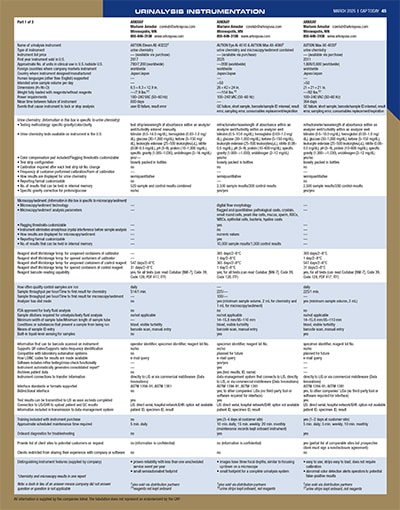
Urinalysis instrumentation, 2025

[one_third]

[/one_third]

[one_third]

[/one_third]

[one_third_last]

[/one_third_last]

[wpdatatable id=120]

[one_third]
[/one_third]
[two_third_last]

On value, preanalytics, and personnel in urinalysis

March 2025—Urinalysis reflex rules, reimbursement, instruments, research, and specimen handling and transport are some of what came up in the Jan. 15 roundtable with eight participants online and CAP TODAY publisher Bob McGonnagle leading the discussion. What they told CAP TODAY begins here, and our revised guide to urinalysis instrumentation is here.

In our urinalysis roundtable last year there was emphasis on reflex testing as a solution to some of the need for efficiency in the urinalysis workflow. Of course, people in pharmacy and the infectious disease physicians have different views about reflex criteria in urinalysis. We also talked about the need for working rules in the interest of efficiency and workflow amid automation and artificial intelligence. Lastly, we talked about the science of urinalysis, which seems to be underappreciated in the United States. Jason Anderson, can you comment on the current relevancy of those themes?

Jason M. Anderson, MPH, MT(ASCP), senior product manager, urinalysis solutions IVD product marketing, Sysmex America: Reflex testing, when done appropriately, can provide a host of benefits, from improved laboratory efficiency to more timely information for clinicians and ultimately a higher standard of patient care. Determining optimal reflex algorithms can be a challenge. Laboratory practice in urinalysis is not always standardized. Even within an integrated health network, you might see the use of different cutoffs or reflex rules at different facilities. Establishing reflex rules, agreeing on those with the various stakeholders, and making sure they’re optimized and evidence-based to the specific patient populations served are key.

With the progress of AI, machine learning, and expert system disciplines, in conjunction with increasing evidence-based outcome data, I believe we’ll see a strong emphasis on developing even more powerful and advanced reflex testing algorithms that are population specific in many cases. Add to this that analyzer technology is allowing for greater standardization, sensitivity, and specificity in laboratory testing and I see a recipe for making a positive impact on patient care.

Continue reading …
[/two_third_last]