

Samir Atiya, MD
Rebecca Reese, BS
Curtiss Johnson, DO
Julia Rankenburg, MT(ASCP)
Aadil Ahmed, MD
July 2026—A medical student walks into the CAP annual meeting for the first time, nervous and not sure what to expect. She’s there because of a Medical Student Travel Award she almost didn’t apply for. By the end of the week, she has an interest in pursuing pathology.
That is what the CAP Foundation had in mind when it began in 2018 to offer that student travel award. Now, for the first time, after an analysis of CAP Foundation data and a long-term survey of past recipients of that award and others, we have the data to report their impact.
Here is an overview of findings from a study reported in full in Archives of Pathology & Laboratory Medicine (Atiya S, et al. Arch Pathol Lab Med. 2026;150[5]:391–402):
- 744 applicants submitted 760 applications from 2015 through 2024.
- 355 awards were granted across 14 categories.
- Total yearly funding increased by 357 percent (from $18,400 in 2015 to $84,098 in 2024).
- $480,000-plus were awarded since 2015.
- Applications grew more than eightfold since 2015, peaking in 2023. Even during the pandemic, the number of applications continued to climb.
- Medical student applications grew 76 percent annually.
- 75 percent of Medical Student Travel Award recipients entered pathology residency.
- Up to a decade after receiving their award, 81 percent of awardees reported a strong positive career impact, and 83 percent of awardees said the award reinforced their engagement with the CAP.
- Based on the question “How likely would you be to recommend to a colleague that they apply for a CAP Foundation grant/award?” a net promoter score of 83 was achieved, representing the percentage of promoters minus the percentage of detracters. An NPS score above 80 is considered a world‑class satisfaction score.
The growth in yearly funding of 357 percent and the eightfold growth in the number of applications didn’t happen by accident. That kind of growth happens when word gets out that something is worth applying for.
Below is a breakdown of where that funding has gone across all award categories.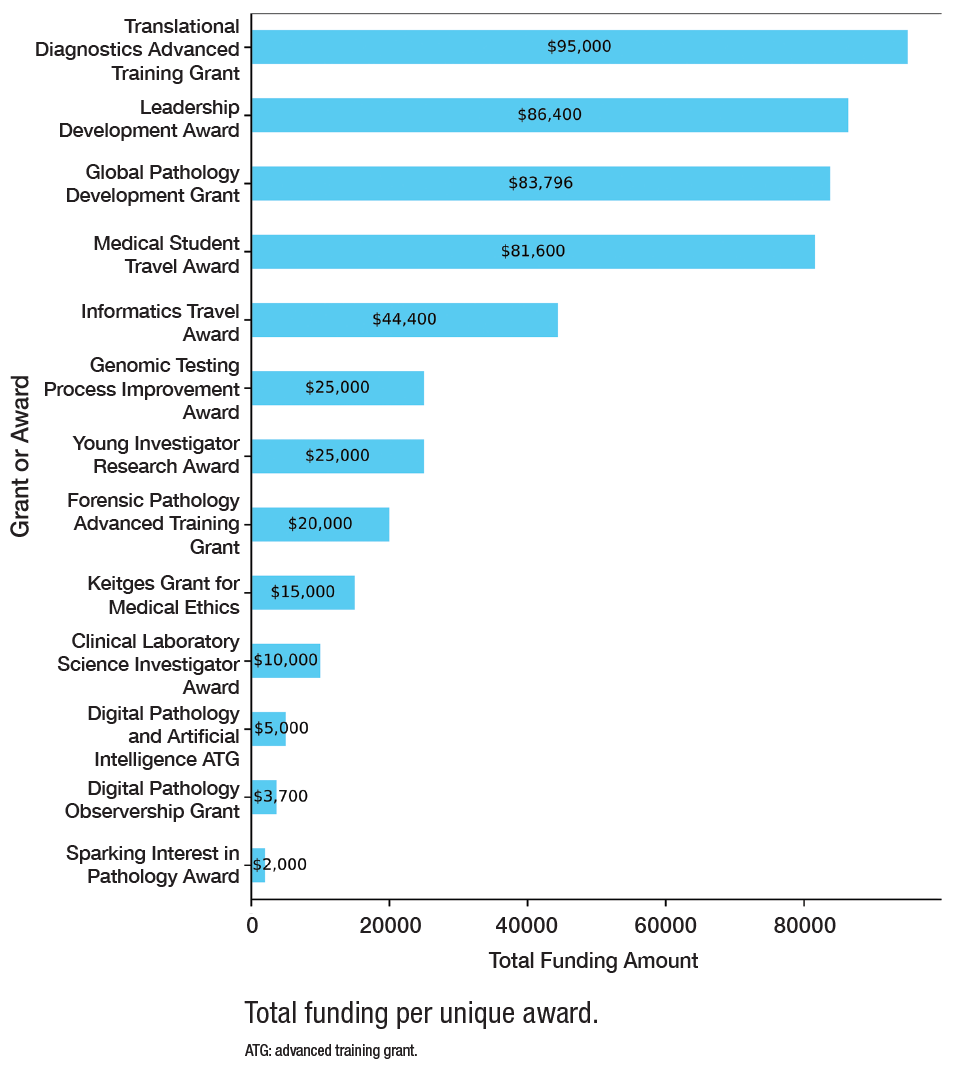
For many medical students, pathology is still the specialty they don’t quite understand, the one that doesn’t come up much on rounds and gets little screen time in the third-year curriculum. A funded trip to a national meeting changes that picture. There, students see pathologists as leaders, innovators, global health contributors, and advocates, not just the people who “read slides in the basement.”
We surveyed past recipients to find out what these awards meant to them, immediately after receiving them and years later. The responses from 174 past recipients are as follows:
- 74 percent said the award opened meaningful networking opportunities.
- 73 percent pointed to significant learning experiences.
- 57 percent described meaningful mentorship connections.
- 81 percent said the award had a strong positive impact on their career—up to a decade later.
- 83 percent said it deepened their engagement with the CAP.
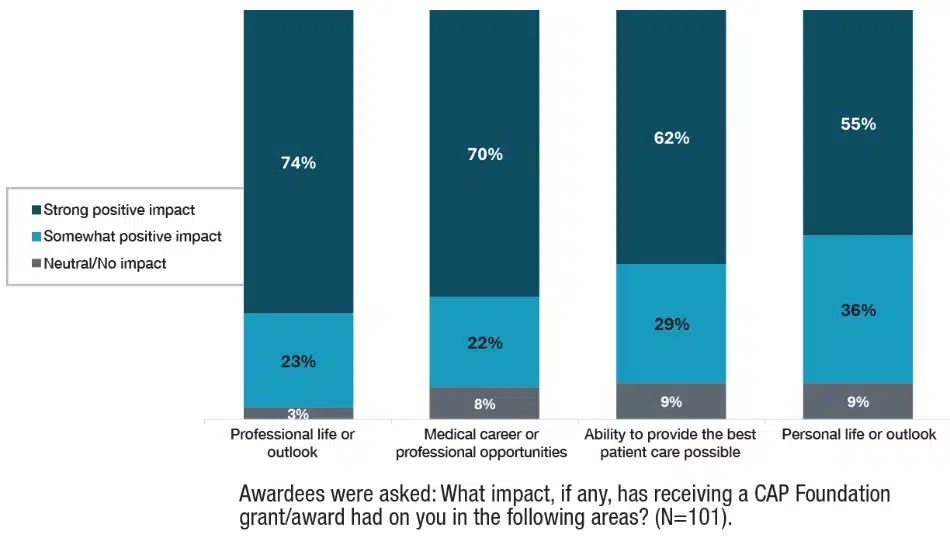 One awardee put it simply: Attending the CAP Policy meeting through a Leadership Development Award was “a perfect place to plant seeds for leadership and advocacy.” Another described learning to engage with congressional representatives and bringing those skills home to their residency program and their state.
That’s the quiet power of the awards. They don’t just teach skills; they shift how people see themselves in the profession. Recipients come away understanding that pathology isn’t behind the scenes. It’s at the center of everything from quality, patient safety, and diagnostics to public health. And they report that their experiences change how their colleagues view the CAP.
No gender differences were found in award rates. In a medical landscape where recognition and opportunity have historically skewed toward men, that’s important. It appears to be a direct result of the CAP Foundation’s structured, rubric-based review process.
Geography tells a more nuanced story. Texas and Illinois produced the most awardees by raw numbers, but when you look at applications per trainee, smaller programs in states like Mississippi and West Virginia led the pack. It turns out that awareness and institutional culture, not just program size, drive engagement. That’s an insight the CAP Foundation can use to reach even more people in the years ahead.
Awards like the Global Pathology Education Award and the Global Pathology Development Grant are extending the Foundation’s reach to pathologists in resource-limited settings around the world. From 2020 to 2025, 149 global pathology awards and grants were given to support practicing pathologists and projects in 31 countries.
Mentorship keeps showing up as a highlight right after an award is received. However, in long-term follow-up, only 28 percent of awardees said that mentoring relationships lasted. That gap is an opportunity. Mentorship doesn’t sustain itself; it needs structure, intention, and follow-through.
Similarly, awards in areas like informatics and digital pathology generate excitement and learning. But only 20 percent of those recipients went on to implement new technologies at their home institutions. That’s not a failure of motivation; it’s a signal that implementation requires more than inspiration. It takes resources, buy-in, and support.
The CAP Foundation is paying attention. Future directions include structured mentorship tracks, post-award implementation resources, and programming to help translate learning into lasting change.
Most exciting may be what comes next. With a stronger mentorship structure, better support for putting new knowledge into practice, and continued commitment to equitable access, the program is poised to do even more.
Dr. Atiya is a clinical informatics fellow, Department of Pediatrics, and instructor, Department of Pathology, University of Chicago Medical Center, and recipient of a 2022 Leadership Development Award. Dr. Atiya is a member of the CAP Informatics Committee. Rebecca Reese, of Wright State University Boonshoft School of Medicine, is a 2024 Medical Student Travel Award recipient. Dr. Johnson is a resident, Department of Laboratory Medicine and Pathology, Mayo Clinic, Rochester, Minn., and recipient of a 2022 Medical Student Travel Award. Julia Rankenburg is senior manager, program and fund administration, CAP Foundation. Dr. Ahmed is assistant professor, Department of Pathology and Laboratory Medicine, Loyola Stritch School of Medicine, Maywood, Ill., and a member of the CAP Foundation Board of Directors and 2018 recipient of the Leadership Development Award. For information on how to apply, go to foundation.cap.org.