

From concept to curriculum: PIER going strong five years later
August 2019—In the five years since its launch, Pathology Informatics Essentials for Residents, or PIER, has continued to serve as a much-needed guide for pathology residents and program directors who otherwise would be navigating the waters of informatics training without a compass.
The curriculum, which celebrates its fifth birthday next month, is a joint effort of the Association of Pathology Chairs, Association for Pathology Informatics, and College of American Pathologists. The organizations came together to develop a product to fill gaps in the structure and depth of informatics training in pathology residency programs.
“Informatics is a challenging area to teach in residency programs, yet it’s an increasingly important part of pathology practice,” says Walter Henricks, MD, vice chair of the Pathology and Laboratory Medicine Institute and medical director of the Center for Pathology Informatics at Cleveland Clinic. Recognizing this, the three associations created the joint work group to address such challenges as the absence of a standardized informatics curriculum, limited number of informatics experts on the faculty of pathology programs, time constraints, and rapid pace of technological and regulatory changes. Previous attempts to publish a curriculum did not achieve much traction, leaving residency programs without a structured way of teaching standard concepts and skill sets in informatics, explains Dr. Henricks, who was a co-leader of the original PIER work group, which was made up of 20 pathologists with expertise in informatics and graduate medical education. Dr. Henricks is currently chair of the CAP Informatics Committee.
The PIER curriculum and an instructional resource guide can be accessed from the APC website at no charge. The goal was to design a product that is easy to implement in any pathology residency program, regardless of size or availability of trained pathologist informaticists among the faculty, Dr. Henricks says.
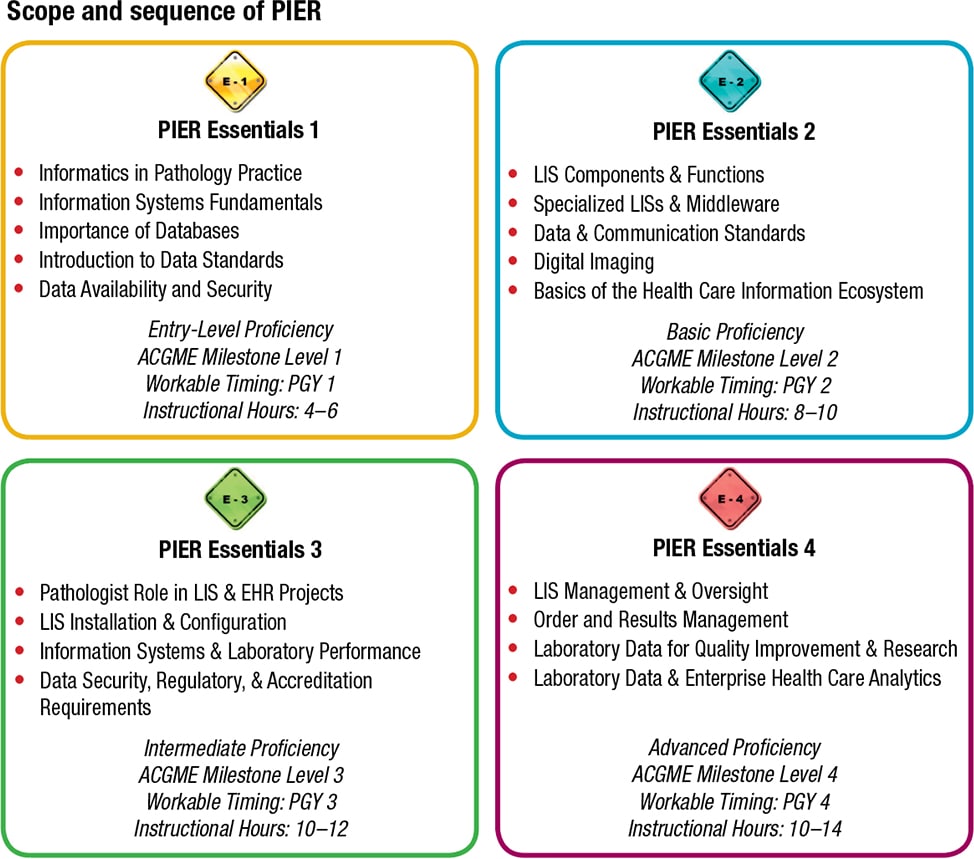
The PIER work group identified the most important topics for pathology residency informatics training and organized those into four groups, known as the PIER Essentials (figure). These reflect the scope of PIER and provide the sequence for building pathology informatics knowledge and skills over time and in tandem with other areas of pathology training, such as lab management, quality assurance and control, and accreditation and regulation. The PIER Essentials were mapped to the Accreditation Council for Graduate Medical Education Milestones, a set of core competencies that all pathology residents are expected to achieve in the course of their training, says Dr. Henricks.
The topics in PIER Essentials range from basic concepts about databases and data security to laboratory information system management, digital pathology, and data analytics. Each topic comes with recommended resources, such as books, journals, and online training modules, as well as practical exercises that allow residents to apply what they’ve learned to real-life scenarios to reinforce their understanding. The resource library and exercises are part of the PIER Resource Toolkit, an interactive downloadable guide that contains the information and documentation necessary for program directors and residents to customize the PIER Essentials to their own curriculum structures. For example, users can customize self-study modules and lecture series based on the PIER curriculum and maintain the content in electronic files.
About 40 percent of the approximately 142 U.S. pathology residency programs are using PIER, according to the program’s latest annual survey of residency program directors, conducted in May. The rate of adoption has tripled over the past five years, from 20 programs the first year to 60 programs today, according to the May survey.
 Despite this upward trend, PIER usage has not reached the initial target of 100 programs by 2019. Although PIER was designed to support self-directed learning, the program requires the involvement of faculty who are willing and able to use the PIER Toolkit for planning and to guide residents in using the curriculum, says Scott Anderson, MD, director of the pathology residency program at the University of Vermont Medical Center and chair of the PIER Leadership Committee. This has proven to be a challenge for smaller residency programs, in particular, he adds. Another factor affecting adoption is that informatics competes with many other subject matters during residency training. “There is more to learn every year in pathology education,” Dr. Anderson says. “Putting another curriculum in the middle of an already full curriculum can be a challenge as well.”
But those who are making room for the curriculum are finding it beneficial. Yonah Ziemba, MD, a third-year resident at Northwell Health, Lake Success, NY, and a member of the PIER Leadership Committee, says PIER has been a valuable resource for the 16 residents in his program who are using the curriculum in a team-based learning approach. Residents use the PIER Toolkit for individualized learning and meet once a month for a one-hour session to discuss some of the dozens of topics from the toolkit, such as hardware and software fundamentals, the importance of databases, and data standards. Each session begins with small-group discussions, during which residents test their knowledge by engaging in real-life scenarios and answering questions about those scenarios. Afterward, a member of each group shares that group’s ideas with all session attendees under the oversight of a faculty member who serves as a moderator for the session. The program is a “powerful model” that is flexible and provides tools to accommodate residents with different levels of knowledge and experience, Dr. Ziemba adds.
To keep PIER relevant, it undergoes periodic updates, Dr. Anderson says. Every two years, PIER stakeholders from the CAP, APC, and API, as well as a resident who acts as a liaison between the PIER Leadership Committee and fellow residents, review the curriculum and suggest minor changes. They also revise the links to outside resources by adding and deleting publications, online courses, lectures, and presentations from informatics meetings, among other content. The latest version of PIER, released in July 2018, includes curated presentations from API’s annual Pathology Informatics Summit, which are mapped to the four PIER Essentials and cover more than 80 percent of the PIER curriculum. Faculty and residents can use the files to teach and learn informatics concepts identified in PIER. The presentations reside on a special Web page on the API site. (API membership is required to access the files.) “This prepared content is an especially helpful resource for smaller residency programs that may not have informatics experts on staff to teach this topic and for programs looking for prepared content to deliver training,” says Sue Plath, education manager for CAP Learning.
More recently, the PIER Leadership Committee has undertaken a major five-year review. “The major revisions will look at the content of the curriculum, knowing that informatics is a rapidly changing field that needs to be updated on a regular basis,” Dr. Anderson says. The update could involve redesigning the curriculum and switching to a more technology-based delivery system. However, plans are still in the early stages, he adds.
PIER remains a work in progress, but it has “raised the profile of informatics within residency programs and within the conversation of postgraduate training in pathology,” says Dr. Henricks. “I think it raised awareness that informatics is not just information technology, that it really is a multifaceted topic and has an impact throughout various areas of pathology practice and lab operations.” —Iulia Filip
Proscia launches AI solution for dermatopathology
Proscia has released DermAI, an artificial intelligence-based module for its Concentriq digital pathology platform that leverages deep learning to prescreen and classify skin biopsies.
DermAI provides the following:
-
- Intelligent workload balancing and case prioritization to sort and triage cases. Cases can be distributed to dermatopathologists in a lab based on subject matter expertise, order of arrival, or other criteria.
- Automated quality assurance and complete re-review of a lab’s caseload. “Running in the background before or after pathologist review, DermAI provides an automated second layer of quality review across the lab,” according to a press statement from Proscia.
- Enhanced technical component reporting.
DermAI seamlessly integrates with most laboratory information systems, Proscia reports. It is available for research use only.
Proscia, 877-255-1341
Inspirata and Indema enter joint venture in Europe
The Tampa, Fla.-based digital pathology and cancer informatics company Inspirata recently announced a partnership with the Zurich, Switzerland-based digitalization support vendor Indema to create Inspirata (Europe) AG.
The new entity, also based in Switzerland, combines Inspirata’s technologies with Indema’s offerings in information technology assessment, project design, and program management to help hospitals and universities across Europe with data processing, including interinstitutional processing. “The aim of the partnership is to improve integration in the unique IT systems of university hospitals in continental Europe,” according to a press release from Inspirata.
Adding digital and computational pathology products to Indema’s portfolio “significantly expands the value we can bring to our clients,” Inspirata CEO Satish Sanan said in the press statement.
Inspirata, 813-570-8900
Scientists create ‘vaccine’ for cyberattacks on algorithms
A team of researchers from Data61, the data and digital arm of Australia’s national science agency, have developed techniques to protect algorithms against cyberattacks.
“Our new techniques prevent adversarial attacks using a process similar to vaccination,” said Richard Nock, PhD, machine learning group leader for the Commonwealth Scientific and Industrial Research Organisation’s Data61, in a CSIRO press release. “We implement a weak version of an adversary, such as small modifications or distortion to a collection of images, to create a more ‘difficult’ training data set. When the algorithm is trained on data exposed to a small dose of distortion, the resulting model is more robust and immune to adversarial attacks.”
Researchers at Data61 claim the “vaccine” is a significant contribution to the growing field of machine learning. The techniques “will spark a new line of machine learning research and ensure the positive use of transformative AI technologies,” said Data61 CEO Adrian Turner in the press release.
Dr. Aller teaches informatics in the Department of Pathology, University of Southern California, Los Angeles. He can be reached at raller@usc.edu. Hal Weiner is president of Weiner Consulting Services LLC, Eugene, Ore. He can be reached at hal@weinerconsulting.com.