

CAP TODAY and the Association for Molecular Pathology have teamed up to bring molecular case reports to CAP TODAY readers. AMP members write the reports using clinical cases from their own practices that show molecular testing’s important role in diagnosis, prognosis, and treatment. The following report comes from the University of Missouri-Kansas City School of Medicine and the University of Kansas School of Medicine. If you would like to submit a case report, please send an email to the AMP at amp@amp.org. For more information about the AMP and all previously published case reports, visit www.amp.org.
Sobrina Mohammed, MD
Daniel J. Mettman, MD
September 2025—A 68-year-old male with a history of multiple myeloma was discovered to have a 3-cm carotid body mass on PET/CT. Surgery was consulted and determined that the lesion was not amenable to surgery. Radiology favored the lesion to be a paraganglioma, so plasma metanephrine and normetanephrine were tested and were negative. With paraganglioma as the working diagnosis, germline genetic testing was performed.
The general recommendation is that germline genetic testing be considered when the likelihood of detecting a heritable variant is greater than 10 percent. With the rate of heritable variants as high as 50 percent with a paraganglioma diagnosis, germline genetic testing is warranted and generally recommended.1,2 The testing revealed an SDHC c.377G>A variant that is likely pathogenic per the testing company and pathogenic/likely pathogenic in ClinVar with nine of 11 submissions contributing to the classification. Of note, the patient’s family history is negative for any cancers other than breast cancer in his mother and sister, but SDH mutations are known to have variable penetrance, with SDHC having a particularly low penetrance.3 It was decided to manage the patient conservatively with imaging surveillance.
A right lateral neck mass was detected on surveillance imaging for the paraganglioma. The mass was followed for five years until growth of the mass prompted ultrasound-guided fine-needle aspiration. The FNA revealed papillary thyroid carcinoma (PTC). Because the patient had metastatic papillary thyroid carcinoma, comprehensive genomic profiling (CGP) of the tumor was performed to search for a potential variant that would make the patient a candidate for targeted therapy. CGP testing revealed a CCDC6-RET fusion, making the patient a candidate for a RET inhibitor. The patient underwent total thyroidectomy with right neck dissection and postoperative radioactive iodine. Thyroglobulin levels and follow-up imaging have been negative for evidence of recurrence.
Most remarkable—or at least what makes this case noteworthy from a molecular testing standpoint—is that the CGP testing was negative for an SDHC variant. Since the SDHC variant was identified on germline testing, one would expect it to be present in the tumor as well. There are several potential explanations for such a discrepancy between germline and somatic test results that are worth mentioning.
One explanation could be that the variant is truly not present in the tumor tissue. This can be seen when there is loss of heterozygosity (LOH) in the tumor at the variant locus. Cancer is associated with genomic instability, which results in gains and losses of genetic material that can result in LOH (i.e. presence of a single allele where there were two different alleles due to loss of one allele). The testing company can detect this from library preparation copy number plots or analysis of sequencing data. A second explanation for a variant being absent in a tumor sample but present in a germline sample is mosaicism. When mutation occurs early enough in development, it can result in some tissues containing a variant and others containing the wild-type sequence. One can assess for this by testing another tissue type.
Discrepant somatic and germline test results can also be seen when a variant is actually present in the tumor tissue but is not detected by the CGP assay. This can be seen when the variant is present at a level below the analytical sensitivity of the assay, which can occur when there is a small absolute amount of tumor or a low proportion of neoplastic cells relative to non-neoplastic cells. The latter can be overcome with microdissection for tumor enrichment. This can also be seen with nucleic acid degradation, as with bone specimens that have been decalcified.
A final explanation, and the one that applies in this case, is that the assay detected the variant in the tumor sample but it was not reported. As other companies do, this testing company has programmed its bioinformatic pipeline to assess the likelihood that a detected variant is germline in origin. If a variant is interpreted as likely germline, it is reported only when a blood sample is concurrently tested for comparison and more accurate determination of germline status. Additionally, the companies report such variants only when the variants meet the American College of Medical Genetics and Genomics/Association for Molecular Pathology interpretive criteria for “likely pathogenic” or “pathogenic”; this is in contrast to somatic variants, for which they report “variants of uncertain significance” (VUS). Furthermore, it is important to understand that their interpretations may be different from those of ClinVar or other labs because, as the technical experts at this company explained to us in response to our inquiry about this case, they may not be able to use internal data for variant classification. Thus, while the company’s assay detected the variant, the company did not report the variant because they interpreted it to be a VUS and the company’s practice is to not report germline VUSs.
In summary, it is imperative to consider that a negative molecular testing result does not equate with absence of variation. More specifically, detected results may not be reported, especially when they could be germline. Since it is not feasible to be familiar with the nuances of the bioinformatic pipelines for every test you may order, one should not hesitate to reach out to a testing company with questions, particularly for unexpected results. The testing company can serve as the go-to in initiating an investigation of unexpected results. For the case of discrepant somatic and germline results, the testing company can identify when LOH, assay sensitivity, or assay reporting is the explanation. When mosaicism is the explanation, it can suggest this possibility and assist with the workup if indicated.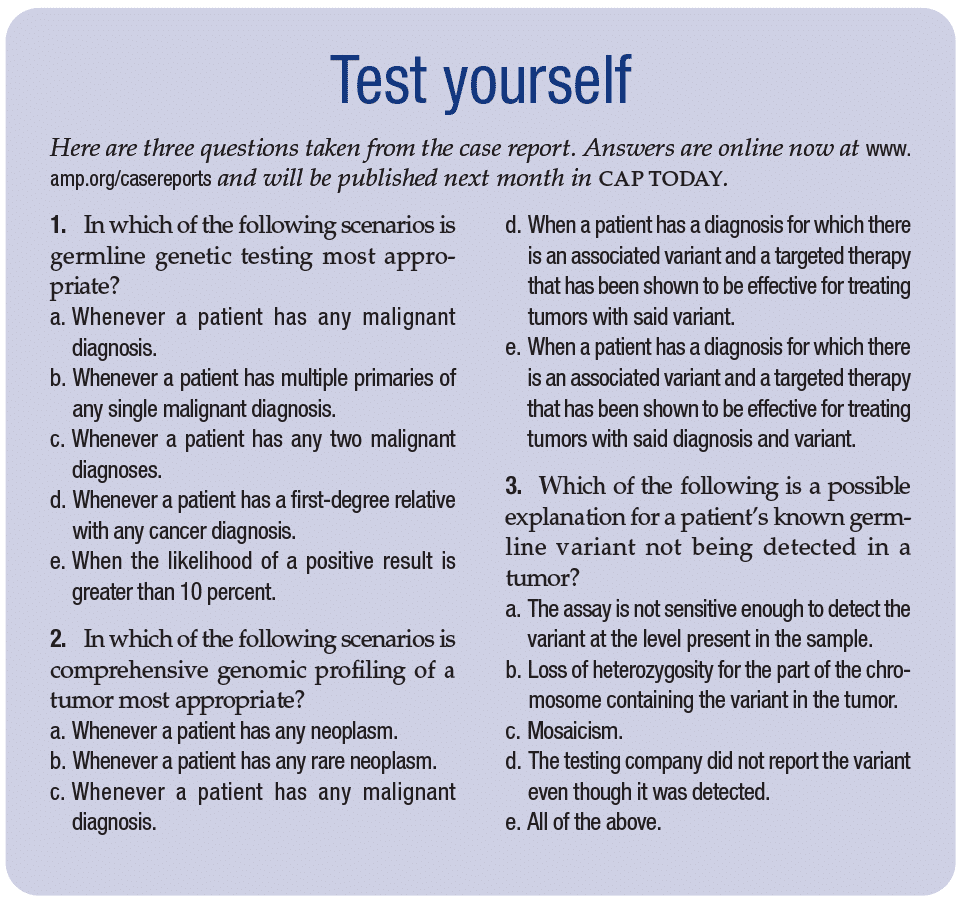
-
- Burnichon N, Rohmer V, Amar L, et al. The succinate dehydrogenase genetic testing in a large prospective series of patients with paragangliomas. J Clin Endocrinol Metab. 2009;94(8):2817–2827.
- Fishbein L, Merrill S, Fraker DL, Cohen DL, Nathanson KL. Inherited mutations in pheochromocytoma and paraganglioma: why all patients should be offered genetic testing. Ann Surg Oncol. 2013;20(5):1444–1450.
- Else T, Marvin ML, Everett JN, et al. The clinical phenotype of SDHC-associated hereditary paraganglioma syndrome (PGL3). J Clin Endocrinol Metab. 2014;99(8):E1482–E1486.
Dr. Mohammed is an endocrinology fellow, Division of Endocrinology, Department of Internal Medicine, University of Missouri-Kansas City School of Medicine. Dr. Mettman is staff pathologist, Pathology and Laboratory Medicine Service, Kansas City VA Medical Center, and assistant professor, Department of Pathology and Laboratory Medicine, University of Kansas School of Medicine.