Webinars and Sponsored Roundtables — Register Now

Wednesday, September 30, 2026. 1 PM-1:30 PM ET
Roundtable presenters John Longshore, PhD, Head of Scientific Affairs, Global Oncology Diagnostics, AstraZeneca, and Flora Berisha, MS, Executive Director, Global Head of Diagnostic Partnering and Development, Johnson & Johnson Innovative Medicine, and Mark D. Ewalt, MD, Associate Medical Director for Laboratory Operations, Diagnostic Molecular Pathology, Molecular Diagnostics Service, Department of Pathology and Laboratory Medicine, Memorial Sloan Kettering Cancer Center, and Isabel Preeshagul, DO, MBS, Thoracic Medical Oncologist, Memorial Sloan Kettering Cancer Center

CAP TODAY does not endorse any of the products or services named within. The roundtable is made possible by a special educational grant from Pillar Biosciences.

Moderated by: Bob McGonnagle, Publisher, CAP TODAY

Thursday, October 1, 2026 1 PM-2 PM ET
This presentation will explore the value of in-house CGP, offer insights into the benefits and drawbacks of incorporation, and provide information about important practical factors when considering in-house implementation of CGP.

Webinar presenter Allison M. Cushman-Vokoun, MD, PhD, FCAP, Medical Director, Molecular Diagnostics and Personalized Medicine Laboratory, Director, Division of Diagnostic Molecular Pathology and Human Genetics, Henry F. Krous Professor of Pathology, University of Nebraska Medical Center

CAP TODAY does not endorse any of the products or services named within. The webinar is made possible by a special educational grant from Illumina.

Moderated by: Bob McGonnagle, Publisher, CAP TODAY

Tuesday, October 20, 2026 11 AM-12 PM ET
Hear experts review the biological and clinical significance of the HER2 expression continuum in breast tissue, providing a clearer understanding of how these variations might impact diagnosis, and discuss the emerging importance of documenting HER2-low and HER2-ultralow categories using a validated IHC assay.

Webinar presenters Keith Wharton, MD, PhD, Global Medical Affairs Leader–Pathology, Roche Diagnostics Solutions, and Hannah Y. Wen, MD, PhD, Director, Breast Pathology Fellowship, Associate Team Leader, Breast Pathology Team, Attending Pathologist, Memorial Sloan Kettering Cancer Center

CAP TODAY does not endorse any of the products or services named within. The webinar is made possible by a special educational grant from Roche.

Moderated by: Bob McGonnagle, Publisher, CAP TODAY

Tuesday, November 3, 2026 1 PM-2 PM ET
Hear an expert discuss the challenges of detecting NRG1 fusions and how RNA-based testing can support more comprehensive fusion identification in clinical practice.

Webinar presenter Benjamin Weinberg, MD, Associate Professor of Medicine and Attending Physician
specializing in gastrointestinal medical oncology

CAP TODAY does not endorse any of the products or services named within. The webinar is made possible by a special educational grant from Diaceutics.

Moderated by: Bob McGonnagle, Publisher, CAP TODAY

Subspecialties

Interactive Product Guides

ARTICLES

Cytopathology in focus: ABPath CertLink pilot open to all

January 2019—The American Board of Pathology subspecialty certification examination in cytopathology is given each fall at the ABPath office in Tampa, Fla. Cytopathology has the largest number of examinees of the 11 pathology subspecialty examinations.

Daniel J. Hanson, MD, 1928–2018

January 2019—Daniel J. Hanson, MD, a member of the CAP Board of Governors from 1993 to 1999, died on Nov. 2, 2018. Dr. Hanson was president and medical director of Pathology Laboratories in Toledo, Ohio, until he retired in 2005. He was also clinical professor of pathology emeritus at the University of Toledo College of Medicine.

Rapid PCR rules as labs ready flu arsenal

December 2018—With the memory of the 2017–2018 “high-severity” influenza season fresh in mind—49 million cases, 960,000 hospitalizations, a marginally effective vaccine, 79,000 deaths—clinical laboratories have been bracing for the customary annual surge in emergency room, outpatient clinic, and physician office influenza test orders. Although flu admissions have been rising somewhat, it is too soon to know how the season will play out, but laboratories are hoping for a season closer to average. Avoiding a repeat of last year’s travails—lengthy turnaround times, supply shortages, and the need to triage patients for testing—is a must, many laboratory directors say. “We had difficulty keeping up with last year’s demand. It was extremely time-consuming,” says Mary Kay O’Connor, national laboratory director at Summit Health Management, the management arm of the Summit Medical Group, an 800-provider practice on the East Coast.

Multiplex for allergy dx: powerful, but it has its place

December 2018—In allergy testing, microarray technology offers speed and the benefit of smaller sample volumes, but it has a lower sensitivity and is unable to detect IgE antibodies of all specificities in a given extract unless all allergens are on the chip. For routine use, singleplex assays are here to stay.

Could CGM dethrone HbA1c for office-based diabetes care?

December 2018—A glucose sensor the size of a quarter placed on the body and a sensor filament inserted under the skin could potentially disrupt traditional diabetes care with its continuous monitoring of glucose almost 300 times a day. Blood glucose can fluctuate widely during the day even in completely healthy people, said David Sacks, MB, ChB, in an interview with CAP TODAY.

Drug overdose deaths and toxicology tests: Let’s talk

December 2018—Drug overdose deaths in the United States continue to rise, and recently many of these deaths have been attributed to opioids, including fentanyl, fentanyl analogs, and other opioid receptor agonists. The rise in drug overdoses and drug-related deaths, and the devastating effects of the opioid crisis, highlight the need for communication and coordination among forensic pathologists, hospital clinicians, and laboratorians.


Higher pay for fibrinolysins interpretation in ’19 fee schedule

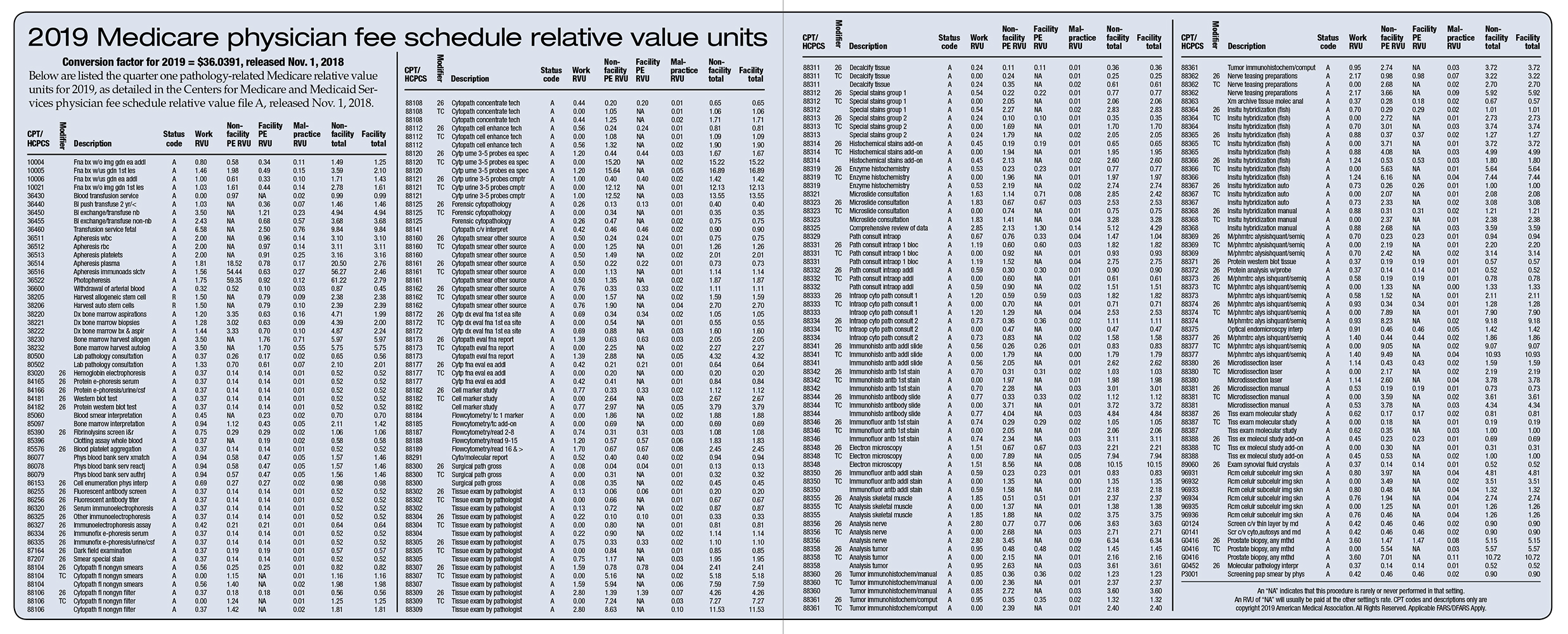
December 2018—The CMS finalized its 2019 Medicare physician fee schedule and its response to the CAP’s recommendations to raise payment for fibrinolysins interpretation and reporting and to forgo a proposed decrease to the physician work value for blood smear interpretation. The Centers for Medicare and Medicaid Services on Nov. 1 published the 2019 physician fee schedule. Services on the physician fee schedule are composed of three relative value units designated by the CMS: physician work, practice expense, and malpractice liability RVUs. Each RVU is separately valued and summed to equal the total RVU for each physician service on the fee schedule. The CAP advocates for the appropriate valuation of pathology services through its representation on the advisory committee of the AMA/Specialty Society Relative Value Scale Update Committee, known as RUC.