

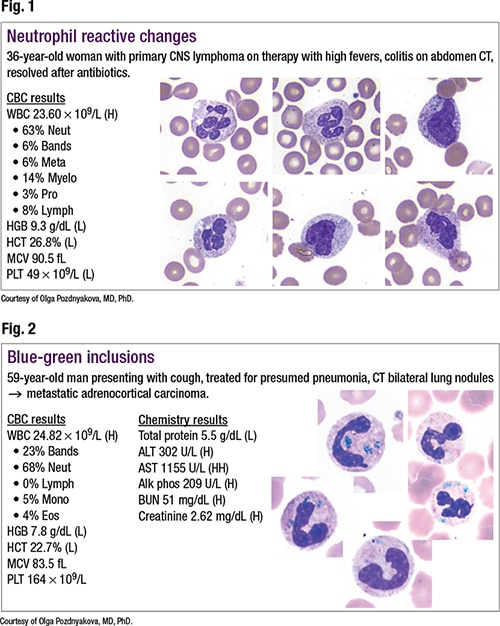
In another case, a 59-year-old male presented with extensive metastatic adrenocortical carcinoma (Fig. 2). “The patient had significant leukocytosis of greater than 20,000,” and bandemia with neutrophilia, Dr. Pozdnyakova said. “And on review of the peripheral blood smear we noticed that some of the neutrophils contained blue-green inclusions indicative of liver failure.” Chemistry results were consistent with multisystem organ failure, with elevated ALT, AST, BUN, and creatinine. These inclusions have been “unfortunately termed ‘death crystals,’” she said, because their emergence is usually associated with imminent death. The patient died soon after presenting.
Dr. Pozdnyakova reported the case of a 64-year-old male admitted with respiratory failure and hypertension after three weeks of low-grade fever, cough, headache, and periodic sweating (Fig. 3). He was a hunter who resided in New England and his wife reported several tick bites. His WBC count of almost 20,000, with 84 percent neutrophils, was associated with cytoplasmic inclusions consistent with Anaplasma morulae, a rickettsial bacterium.
“The morphologic impression, once we reviewed the smear, was confirmed by the PCR test,” Dr. Pozdnyakova said. “Presentation of leukocytosis in this particular case was unusual because most of the patients present with leukopenia and thrombocytopenia. And presence of leukocytosis may indicate coinfection with babesiosis, since the same tick transmits all three pathogens. (Fig. 3, lower left: Babesia within red blood cells with a characteristic Maltese cross.) She reported that their patient hadn’t contracted other pathogens.
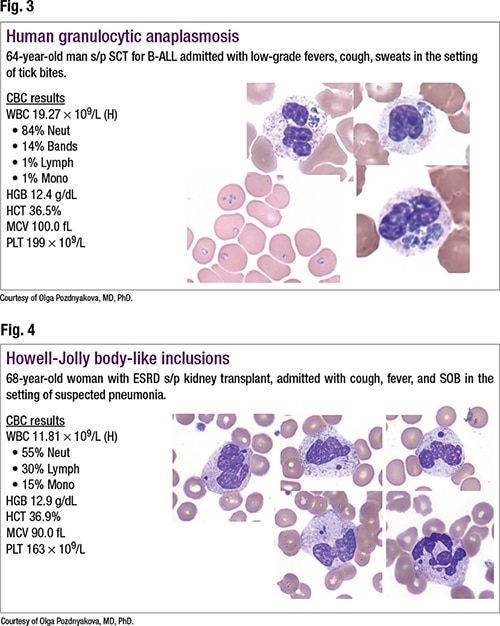 Howell-Jolly body-like inclusions (Fig. 4) can imitate intracytoplasmic organisms. These are nuclear fragments that could be seen in connection with antiviral medications, immunosuppression, and sometimes with myelodysplastic syndrome, Dr. Pozdnyakova reported, pointing out the “spherical nuclear fragments where they are usually peripherally placed” in the neutrophils. “In this case, with a patient with end-stage renal disease status post-kidney transplant, those Howell-Jolly body-like inclusions were likely associated with an ongoing infection because you can also see toxic granulation and some vacuolation in neutrophils.”
In another case, a 62-year-old female with relapsed diffuse large B-cell lymphoma had an ongoing infection (Fig. 5). “The CBC shows neutrophilia with some left shift, six percent myelocytes, microcytic anemia, and very low platelets of 22,000,” Dr. Pozdnyakova reported. “Review of the neutrophils shows some of the changes we have already seen and associated with infection, such as toxic granulation, cytoplasmic vacuolization, Dohle bodies, and Howell-Jolly body-like inclusions.” Yet the cells also display prominent nuclear dysplastic changes, abnormal nuclear lobation in the form of hypolobated nuclei, she said.