

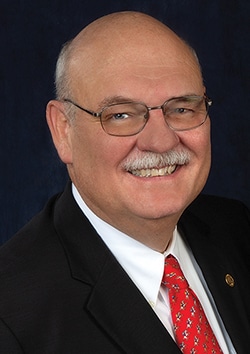
Patrick Godbey, MD
August 2020—In the past six months, many of us have developed video conferencing skills to an extent we never imagined we would need. Until the COVID-19 pandemic led to lockdowns in several states, a great deal of expertise in Zoom and other similar platforms was not a high priority among many pathologists. I am proud that our community adapted quickly and skillfully to continue providing the best care possible to our patients.
That said, I truly hope that virtual meetings—whether for conferences or check-ins with lab staff—do not become the default way that pathologists practice medicine. I understand that this approach has been necessary to fight the pandemic, and I appreciate the ways that technology has allowed us to connect in a crisis. In fact, the measures we have taken since COVID-19 came to our shores have led to positive developments. The federal government allowing remote sign-out, made possible by the CAP’s actions, is a real plus. The increased use of digital pathology has also been advantageous along with a greater emphasis on the practical use of artificial intelligence, and the CAP has been active here as well. These have been important and welcome changes for pathologists.
But virtual meetings have been a mixed blessing. This year, the CAP annual meeting will happen virtually. There will be more than 50 sessions in which registrants will engage with expert faculty in real time, and registrants will have access to on-demand CME after the meeting. For me, the virtual meeting means I can attend these world-class presentations in the morning, then go out on my dock during the lunch break and visit with the manatee, otter, dolphin, and alligators that make frequent appearances there. Other CAP members can spend those valuable minutes between presentations checking on their kids or replying to emails. In a live event, though, the time between sessions would allow for serendipitous encounters with colleagues. Lunch would be an opportunity to catch up with fellow pathologists and their families. These are people we might get to see only at this one conference each year. Many a scheme has been hatched at the CAP annual meeting. We will leave it at that.
I do not miss the burden of travel for all of the conferences that have been forced to go virtual this year, and I suspect many of you feel the same. But I do not believe that a complete lack of face-to-face meetings best serves the needs of our community in the long run. Acknowledging the limitations of virtual meetings is important. They just aren’t the same as in-person meetings.
There are studies showing that young students do not get as much from remote schooling as they do from in-class studies, and it is likely that education at other levels is no different. So much of the information conveyed in training sessions, hospital rounds, and classes is gleaned through an in-person experience. I worry about how well our residents are learning with less face-to-face contact with their attendings and other physicians. The unscheduled but valuable meetings (“Just ask Dr. Z about this and see what she thinks”) are fewer because Dr. Z’s contact with the resident is now, of necessity, limited.
Beyond education, professional uses of virtual meetings have limitations too. At many health care institutions, meetings such as tumor boards went virtual to overcome pandemic challenges. I attended many of these and can say with certainty that they are simply not the same. They are not as informative or as comprehensive when conducted remotely because the give-and-take between physicians is not what it was.
When COVID-19 struck, we were forced to shift gears. The CAP stepped into the breach by providing multiple, excellent courses without cost to our members. The CAP also provided daily, again excellent, sessions aimed at residents. More than 1,000 pathologists a day attended these sessions in April, and there were more than 10,000 registrants as of mid-July. These virtual events allowed us to continue learning and working, at least to a degree. But we have lost something in the transition. With exceptions, we are not as good as we were—in how well we learn, how fruitfully we interact with colleagues, or how effectively we jointly tackle a problem.
I don’t want anyone in the CAP community to forget that we were forced to accept virtual meetings. They occur by necessity, not because they are ideal. The convenience of a video conference should not outweigh the tremendous value that comes from in-person meetings. We need to ease back in to live events as soon as possible in the most responsible ways possible.
As this column is being written, the COVID-19 situation in the U.S. is not what any one of us would like it to be. We are identifying more than 40,000 new cases daily and I believe this will continue to climb. Our testing capacity is nowhere near where it needs to be, and I have pointed this out through multiple national news outlets as well as to those in Washington. I do not know what the pandemic situation will look like when you read this column in August. But let us as a community commit to this goal, for the betterment of ourselves, our colleagues, and, most important, our patients: When virtual meetings are no longer a necessity, we will collectively strive to find safe, carefully considered ways to return to in-person meetings for the many benefits they offer.
Dr. Godbey welcomes communication from CAP members. Write to him at president@cap.org.