


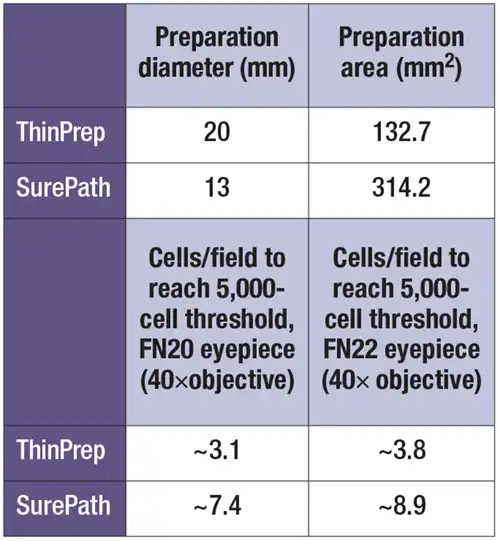
To determine cellularity, one must be careful to take into account the specimen preparation type, preparation diameter/area, and microscope field diameter (which is dependent on the eyepiece and objective used) (Table 2). One common method for manually determining cellularity is to count five fields along both the horizontal diameter and vertical diameter and to calculate the average. While this is a quite reliable methodology, occasionally there will be uneven distribution of cells, with dense clustering in some areas and hypocellular areas in others, which can and should be considered and factored in, especially in borderline cases. Using multiple slide preparations to cumulatively reach a threshold is discouraged, as this is felt to inappropriately correct for the potential preanalytic factors in play (e.g. poor specimen collection).
determining Pap cellularity on
liquid-based preparations
Lastly, presence of an endocervical component should be reported as a quality indicator (in that there is definitive evidence that the endocervical/transformation zone was sampled), rather than used for determining specimen adequacy, and should be reported unless the patient has a history of total (nonsupracervical) hysterectomy or trachelectomy. The threshold for this is 10 well-preserved endocervical or squamous metaplastic cells, present singly or in clusters. This data can be used as feedback for providers who consistently fail to collect samples with an adequate endocervical/transformation zone. In addition, there are certain circumstances in which the presence of an endocervical/transformation zone can impact management recommendations (see “Management guidelines,” next page).
Causes and remedies. Aligning the principles of the quality assurance program to the Pap test provides insights into the causes of unsatisfactory Pap results and guidance to remedy those causes. The commonly encountered causes of an unsatisfactory Pap are a variety of obscuring factors or interfering substances, which include inflammation, blood, lubricants, mucus, and thick smear, compromising the technical interpretability of more than 75 percent of squamous cells. Excessive blood, lubricant, inflammation, and mucus clog the filter by competing with the squamous cells for filter space during the ThinPrep processing technique. Specimens with scant cellularity or excessive cytolysis are additional reasons for an unsatisfactory Pap.

To avoid contamination by excessive blood, Pap specimens should not be collected during menses and ideally should be collected two weeks after the first day of menses. However, advanced scheduling of annual wellness visits to include Pap testing as per the recommended guidelines does not necessarily coincide with this optimal window period in many patients. Remedial reprocessing of visibly bloody specimens with a dilute glacial acetic acid (GAA) wash is effective at clearing blood and improves specimen adequacy. However, caution is urged in evaluating reprocessed slides because GAA may induce cellular alterations of glandular cells, resulting in false-positive interpretations. Additionally, GAA wash has been reported to interfere with the HPV test result. Hence, a homogenized aliquot should be obtained prior to acid treatment in case a reflex HPV test has been ordered.
To avoid discomfort to patients during specimen collection, speculums are often lubricated using a variety of lubricants. Use of improper lubricants is one of the most common causes of unsatisfactory Paps; lubricants containing carbomer or carbopol polymers interfere with the cellularity of ThinPrep Pap test preparation. Alternatively, for patients who physiologically do not need lubricants, the speculum may be lubricated simply by running under warm water. If the use of lubricant is unavoidable during specimen collection, a lubricant that is free of carbomer or carbopol polymer should be recommended, and lubricant should be used sparingly on the outer portion of the posterior blade of the speculum, avoiding the tip. Patients should also be instructed to avoid personal lubricants, vaginal contraceptives, vaginal medications, douches, and vaginal intercourse for 48 hours prior to specimen collection.