
Webinars and Sponsored Roundtables — Register Now

Tuesday, October 20, 2026, 11 AM-12 PM ET
Hear experts review the biological and clinical significance of the HER2 expression continuum in breast tissue, providing a clearer understanding of how these variations might impact diagnosis, and discuss the emerging importance of documenting HER2-low and HER2-ultralow categories using a validated IHC assay.

Webinar presenters Keith Wharton, MD, PhD, Global Medical Affairs Leader–Pathology, Roche Diagnostics Solutions, and Hannah Y. Wen, MD, PhD, Director, Breast Pathology Fellowship, Associate Team Leader, Breast Pathology Team, Attending Pathologist, Memorial Sloan Kettering Cancer Center

CAP TODAY does not endorse any of the products or services named within. The webinar is made possible by a special educational grant from Roche.

Moderated by: Bob McGonnagle, Publisher, CAP TODAY

Thursday, October 29, 2026, 1 PM-2 PM ET
Hear an expert discuss the evolving role of PD-L1 testing in HNSCC and ovarian cancer.

Webinar presenter Georgios Deftereos, MD, Professor of Pathology, Associate Director of the Clinical Cancer Genomics Laboratory, Director of Molecular Cytopathology, University of California, San Francisco

CAP TODAY does not endorse any of the products or services named within. The webinar is made possible by a special educational grant from Agilent.

Moderated by: Bob McGonnagle, Publisher, CAP TODAY

Tuesday, November 3, 2026, 1 PM-2 PM ET
Hear an expert discuss the challenges of detecting NRG1 fusions and how RNA-based testing can support more comprehensive fusion identification in clinical practice.

Webinar presenter Benjamin Weinberg, MD, Associate Professor of Medicine and Attending Physician
specializing in gastrointestinal medical oncology

CAP TODAY does not endorse any of the products or services named within. The webinar is made possible by a special educational grant from Diaceutics.

Moderated by: Bob McGonnagle, Publisher, CAP TODAY

Monday, November 16, 2026, 12:30 PM-2 PM ET
Hear experts discuss a multidisciplinary approach to oncopathology for HER2
assessments for solid tumors in the absence of a companion diagnostic.

Webinar presenters Funda Meric-Bernstam, MD, Chair, Department of Investigational Cancer Therapeutics Medical Director, Institute for Personalized Cancer Therapy, The University of Texas MD Anderson Cancer Center, Houston, Texas, and Emina E. Torlakovic, MD, PhD, College of Medicine, University of Saskatchewan, Canadian Biomarker Quality Assurance, Saskatoon, Saskatchewan, Canada, and Carol Cheung, MD, PhD, JD, FRCPC, Deputy Director, Canadian Biomarker Quality, Assurance—Programme canadien d’assurance de la qualité des biomarqueurs

CAP TODAY does not endorse any of the products or services named within. This program is being sponsored by Daiichi Sankyo, Inc. and AstraZeneca. The speaker is being compensated for the presentation. The program is not CME accredited and may not be used for CME accreditation.

Moderated by: Bob McGonnagle, Publisher, CAP TODAY

Subspecialties

Interactive Product Guides

All Issues

Could CGM dethrone HbA1c for office-based diabetes care?

December 2018—A glucose sensor the size of a quarter placed on the body and a sensor filament inserted under the skin could potentially disrupt traditional diabetes care with its continuous monitoring of glucose almost 300 times a day. Blood glucose can fluctuate widely during the day even in completely healthy people, said David Sacks, MB, ChB, in an interview with CAP TODAY.
Drug overdose deaths and toxicology tests: Let’s talk

December 2018—Drug overdose deaths in the United States continue to rise, and recently many of these deaths have been attributed to opioids, including fentanyl, fentanyl analogs, and other opioid receptor agonists. The rise in drug overdoses and drug-related deaths, and the devastating effects of the opioid crisis, highlight the need for communication and coordination among forensic pathologists, hospital clinicians, and laboratorians.


Higher pay for fibrinolysins interpretation in ’19 fee schedule

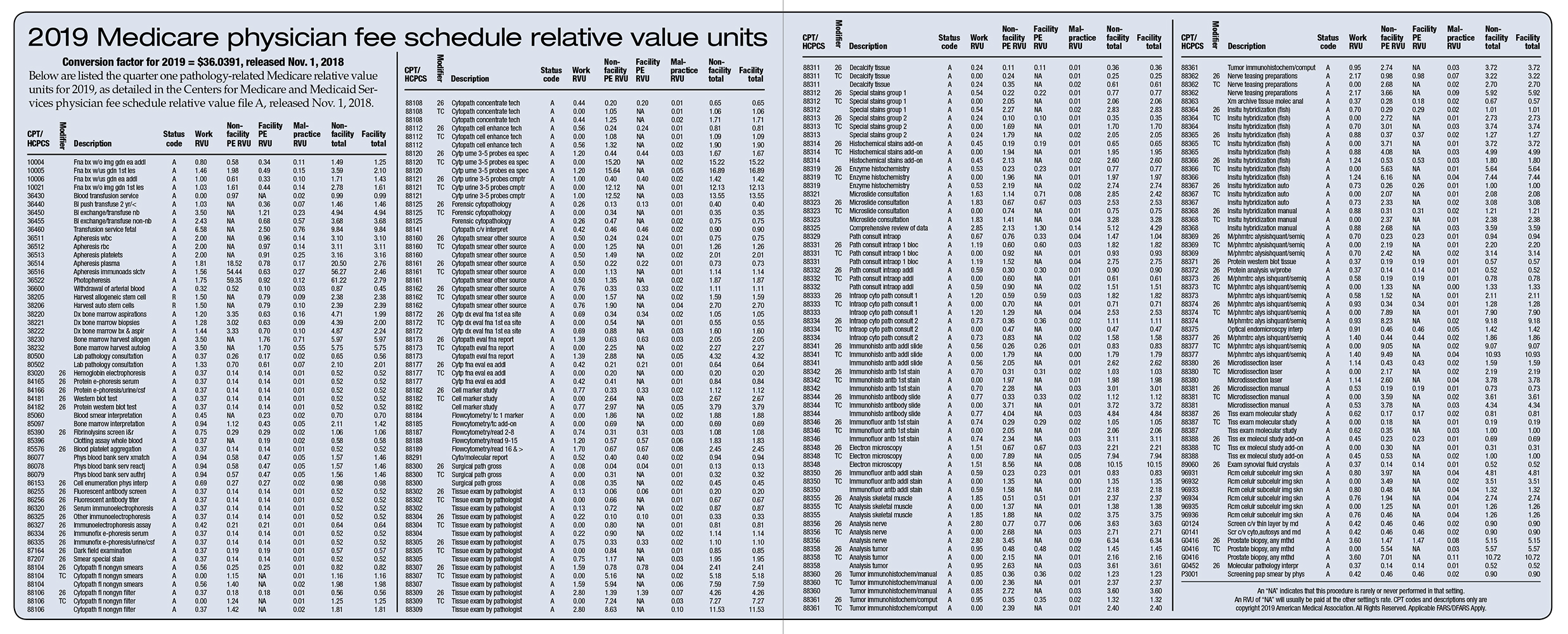
December 2018—The CMS finalized its 2019 Medicare physician fee schedule and its response to the CAP’s recommendations to raise payment for fibrinolysins interpretation and reporting and to forgo a proposed decrease to the physician work value for blood smear interpretation. The Centers for Medicare and Medicaid Services on Nov. 1 published the 2019 physician fee schedule. Services on the physician fee schedule are composed of three relative value units designated by the CMS: physician work, practice expense, and malpractice liability RVUs. Each RVU is separately valued and summed to equal the total RVU for each physician service on the fee schedule. The CAP advocates for the appropriate valuation of pathology services through its representation on the advisory committee of the AMA/Specialty Society Relative Value Scale Update Committee, known as RUC.

AMP case report: Discordant IHC/PCR test results for mismatch repair status in colorectal adenocarcinoma

December 2018—CAP TODAY and the Association for Molecular Pathology have teamed up to bring molecular case reports to CAP TODAY readers. AMP members write the reports using clinical cases from their own practices that show molecular testing’s important role in diagnosis, prognosis, and treatment. The following report comes from Duke University Medical Center. If you would like to submit a case report, please send an email to the AMP at amp@amp.org. For more information about the AMP and all previously published case reports, visit www.amp.org.

Put It on the Board

Pathologists and population health—
first steps

December 2018—Pathologists and population health—first steps: Pathologists who want to become involved in population health initiatives can take five main steps, say pathologists and laboratory leaders interviewed for an article published online last month in Archives of Pathology & Laboratory Medicine. In “The role of the pathologist in population health,” the authors report on the interviews they conducted and their review of the literature to answer several questions, among them whether pathologists in both large settings and smaller community-based settings can engage in population health (yes), and whether pathologists are in a position to analyze data for population health (“The data are there,” they say, “but getting to the data—and providing meaning out of it—is the hard part”). One of the first steps to becoming involved in any type of population health management activities, the authors write, is to understand the philosophy of the institution’s CEO and senior management.

Q&A column

Q. Can you explain further the revised CAP checklist requirement COM.40850 “LDT and Class I ASR Reporting,” which says to describe the method and performance characteristics in test reports unless the information is available to the clinician in an equivalent format? Read answer.
Q. Can we see reactive lymphocytes in the pediatric population (under age two), and can we report them? Read answer.

Newsbytes

In molecular testing labs, gaps between actual and desirable LIS capabilities
December 2018—Flashback to 2013: Alexis B. Carter, MD, then director of pathology informatics at Emory University Hospital, was contemplating whether other pathology labs nationwide were facing the same challenges managing molecular testing data as she and her colleagues. So she decided to find out. Dr. Carter conducted a survey, and the responses confirmed her suspicions: Most laboratory information systems fall short in providing the infrastructure for complex molecular and genomic testing.

From the President’s Desk: Embracing our future at CAP18

December 2018—The CAP Curriculum Committee chaired by Sarah M. Bean, MD, follows a competency-based model to build an annual meeting program that is practical, prescient, and diverse. The committee is balanced demographically, experientially, and scientifically. Whatever the topic, there is someone who can speak to it.